Narrative of UFO Events at Minot AFB
on 24 October 1968
In the early morning hours of 24 October 1968, United States Air Force maintenance and security personnel at the Minuteman ICBM missile complex surrounding Minot Air Force Base, North Dakota, observed one—and at times, two—UFOs. The Base Operations Dispatcher established radio communications with the ground personnel reporting in the field; Minot AFB, Radar Approach Control (RAPCON); and the crew of a returning B-52H Stratofortress aircraft.
RAPCON alerted the B-52 pilots to the location of the UFO high in the northwest, which was observed on the B-52 radarscope maintaining a three-mile distance throughout a standard 180° turnaround. As the B-52 initiated the descent back to Minot AFB, the UFO closed distance to one-mile at a high-rate of speed, while pacing the aircraft for up to 20 miles before disappearing off the radarscope. During the close radar encounter, the B-52 UHF radios would not transmit. Radarscope film was recorded.
Shortly afterward, RAPCON provided vectors for the B-52 to fly over a stationary UFO. During the downwind leg of the traffic pattern, the pilots observed an illuminated, stationary UFO ahead of the aircraft on or near the ground, before turning onto the base leg over the large UFO and observing it at close range. After the B-52 landed, both outer and inner-zone intrusion alarms activated at the missile Launch Facility designated Oscar-7. Altogether, reported observations continued over a period of about three hours.
In the weeks following, staff at USAF Project Blue Book completed a final case report as required by Air Force Regulation 80-17.[1]
Ground-visual UFO Observations (2:15-3:44)[2]
The initial observation of an unidentified flying object was reported by a Camper Team, comprising Airman First Class (A1C) R. McDowell, and A1C W. Johnson. A camper team is a security detachment in a camper truck, which can be posted on site to provide temporary security during equipment failure, or whenever a nuclear warhead is exposed during maintenance procedures. In this instance, McDowell and Johnson were stationed at the missile Launch Facility (LF) designated Oscar-6, providing aboveground security for a Target Alignment Team working on the Minuteman ICBM in the underground silo.[3]
At 2:15 a.m., the team radioed Oscar-Flight Security Controller (FSC), Staff Sergeant (SSgt.) William Smith Jr., at the O-1 Launch Control Facility (LCF), to report the presence of a strange light near their post. In an August 2001 interview, Smith recalled the Camper Team observed “a large glowing object go down by some trees not far away,” and that members of the Target Alignment Team also observed the strange light.[4] At 2:30, Smith also observed the glowing object himself in the vicinity of O-6. In his Air Force Form 117 (AF-117), Sighting of Unidentified Phenomena Questionnaire, he reported:
I was notified it had been seen in an adjacent area. I alerted my [sentries]. The object was first seen in the southern part of my area by a posted sentry. I directed my gaze south of my position and saw the object about fifteen minutes after my sentry sighted it.[5]

Oscar-1 Launch Control Facility located 28 miles north of Minot AFB, looking north; and (inset) the underground Launch Control Center. Two Missile Combat Crew Commanders (capsule crew) are stationed in the LCC, and constantly monitor missile launch status and security for 10 missiles encircling the LCF. Aboveground, the LCF is manned by a minimum of six security personnel responsible for the security requirements of the capsule crew, who remain locked in the underground capsule for 24-hour tours of duty. The security personnel were divided into two teams of three people each, consisting of a Flight Security Controller (FSC) and two Security Alert Team (SAT) members. Each team operated in 12-hour shifts over a three-day period. Bruce Ecker’s spherical panoramic photographs of a decommissioned Minuteman LCF, LCC, and LF at Ellsworth, AFB, SD, are available from: http://nonplused.org/panos/minuteman/index.html.

Locations of the initial observations of “a large glowing object” by the camper team at O-6, and security team at the Oscar-1 Launch Control Facility, 9 miles to the north. Project Blue Book investigators did not interview the camper and targeting team personnel during the subsequent investigation. A satellite view of Oscar-Flight (zoom-in to view Oscar-1) is available from: Wikimapia.
Smith reported his observation to Tech Sergeant Bowles at the 91st Strategic Missile Wing, Security Control, at Minot AFB.[6] Apprehensive about the unknown object so close to the exposed nuclear warhead, the Captain in charge of the targeting team informed the Missile Combat Crew Commander in the underground Oscar-Launch Control Center, to the effect, “we can do this another time, its just not worth us being out here,” and they closed the missile silo, secured the site, and returned to base.[7]

Oscar-6 Launch Facility looking south-southwest. O-6 is located 19 miles north of Minot AFB, to the west of Highway 83. According to Smith, the camper team was providing aboveground security for the targeting team working in the missile silo, when they observed a large glowing object go down behind some trees not far away. Concerned about an unidentified glowing object near the exposed nuclear weapon they secured the site and returned to base.
For weeks prior to these events, SSgt. Smith had been observing inexplicable lights traveling across the sky that would reverse direction.
SMITH: Most of what we saw were just back and forth patterns. They weren't going very high. . . . We were looking south so they were moving east-west, west-east. They would stop, and they might go up a little bit and go slower, and we're saying “a helicopter might do that, but…” We did call and make the reports as we were supposed to of anything that you cannot explain, but nothing was done. So I talked to the capsule crew again, and said “sir, we're just not happy with what we're seeing.” We had reported this before and they said, “Well, just keep them under observation.”
He recalls that a few days before the events of 24 October there was a noticable increase in the activity. Asked to explain what he was observing, he recalled:
SMITH: Seeing a white light, and on clear nights you could see it almost change colors. When I say colors we’re talking a reddish-dark light, almost like a light bulb in the distance that would have a somewhat reddish hue to it. You could even see it change a little bit, almost like an aircraft a long distance away that would have red and green lights, and would revolve—not bright white, dull reddish white. But the lights themselves were doing different things, I mean, we talk about one light but we saw several on occasion, and they were just not doing things we thought aircraft should be doing this time of the morning.[8]
During the same time as the observations near O-6 , A1C Robert O’Connor, and A1C Lloyd Isley of the 91st Minuteman Maintenance Squadron, were driving to the Launch Facility designated November-7 (located 15 miles W-SW of Oscar-6), to perform routine missile maintenance. Five miles north of N-7, their attention was drawn to a luminous object hovering near the horizon in the east. When first observed at 2:30 a.m., O’Connor reported “It appeared to be between two farmer yard lights, which were a little smaller, then the object grew brighter moving S.E.”[9] In a February 2005 interview, he explained that as they continued down the gravel road the object rose up and began to pace their movements:
O’CONNOR: We were going down the dirt road and then I glanced out [turns to his left] the truck window and noticed that some farmer had left his yard light on.
INTERVIEWER: There were farms along there?
O’CONNOR: I don’t know because at nighttime it’s so hard to see. You can’t tell if there is a building. It was dark—it gets dark out there when it is cloudy. We started down that road and I noticed that farmer’s yard light, and then—I don’t know what made me glance over at it again—then I saw it raise up and start paralleling our truck going down the road. . . . It was almost on the ground, probably at normal height, which would have been 30-40 feet something like that. It was illuminating the ground. After it picked up and started following us down the road I noticed that the farmer’s light wasn’t there [any] more. [10]
A1C Lloyd Isley also recalled that the unidentified object appeared to follow them down the road to N-7:
ISLEY: It would’ve been up above the horizon line, now whether we could see—it was hard at all times to determine how far away, for whatever reasons, there wasn’t ever a good fix in my mind as to how far this thing was from us. It just seemed to stay with us, and at times, at that time seemed pretty close to us, close enough that it would have been following us and nothing else, you know.
INTERVIEWER: What gave you the impression it was following you?
ISLEY: Well, it wasn’t really behind, it was off to the side of us and it just seemed to be staying at the same speed we were.[11]

Looking east from the location of O’Connor and Isley’s initial UFO observation at 2:30 a.m. The O-6 Launch Facility is due east about 13 miles distant, and November-7 is 5 miles south (to the right).

At 2:30 a.m., SSgt. Smith observed the object at the same time as the maintenance team’s observation on the road 5 miles north of N-7. It appears they were observing the same object: Isley and O’Connor’s observation was near the horizon to the east, in a direct line with O-6 about 13 miles distant; at which time Smith reported the UFO south of O-1, about 10 miles at 15 degrees elevation, also in the direction of O-6. A simple triangulation illustrates the UFO in the immediate vicinity of O-6, as reported to Smith by the Camper Team.[12]
O’Connor also noted in his AF-117 that the “object seemed to be observing us. When we stopped the object seemed [to] hover or stop when we turned out our headlights.”[13] Growing uneasy with a strange light following them, they radioed the base Transportation Control Center to inquire whether there were any aircraft operating in the area, but were informed there were no helicopters or other aircraft out at this hour of the morning.[14] Since the object did not appear like aircraft routinely observed around the base, they were uneasy regarding it’s intentions, particularly because they were unarmed. “I remember Isley getting in the back of the truck and grabbing an axe, just in case there were some little green men or something,” O’Connor recalled. “I didn’t know what was going on but I was totally concerned.”[15]

Isley's drawing from his Air Force Form 117 (AF-117), page 9.
When Isley and O’Connor arrived at N-7 they parked outside the front gate and continued observing the object from outside the truck. In his AF-117, Isley noted it remained circling about 2 miles south of the Launch Facility, and “came within hearing distance twice.”
We first saw the object to the east of us while we were traveling toward the site. It started moving south. We arrived at the site then started observing the object from outside the truck. It was moving in a large circular area to the south of us. [16]
Isley initially reported the object high above the horizon at 50 degrees: “The object had lights on the front like headlights or landing lights. It had a green flashing light toward the middle or rear.” Unable to determine the precise size or shape, he nevertheless compared its size to a KC-135 Stratotanker “by the lights on the object.” [17]
Likewise, O’Connor reported that:
The object appeared self-luminous like a big ball of white-light that seemed to change to a dim green light then later to a dim amber color. The object seemed to take on the appearance of a stingray fish. . . . I was unable to make out a definite shape because the object put out such a bright light. [18]
Asked to describe the object he recalled:
O’CONNOR: I couldn’t really see a shape other than the light and that it was glowing… You would almost think it was an aircraft but it wasn’t [laughs]. It was hovering above the ground and you could not hear [anything] so I knew it wasn’t a helicopter.
INTERVIEWER: How far away was it?
O’CONNOR: I would say 300-400 yards—it was quite close. I could not compare it to anything other than I knew it was probably as big as a B-52—in that size range.[19]

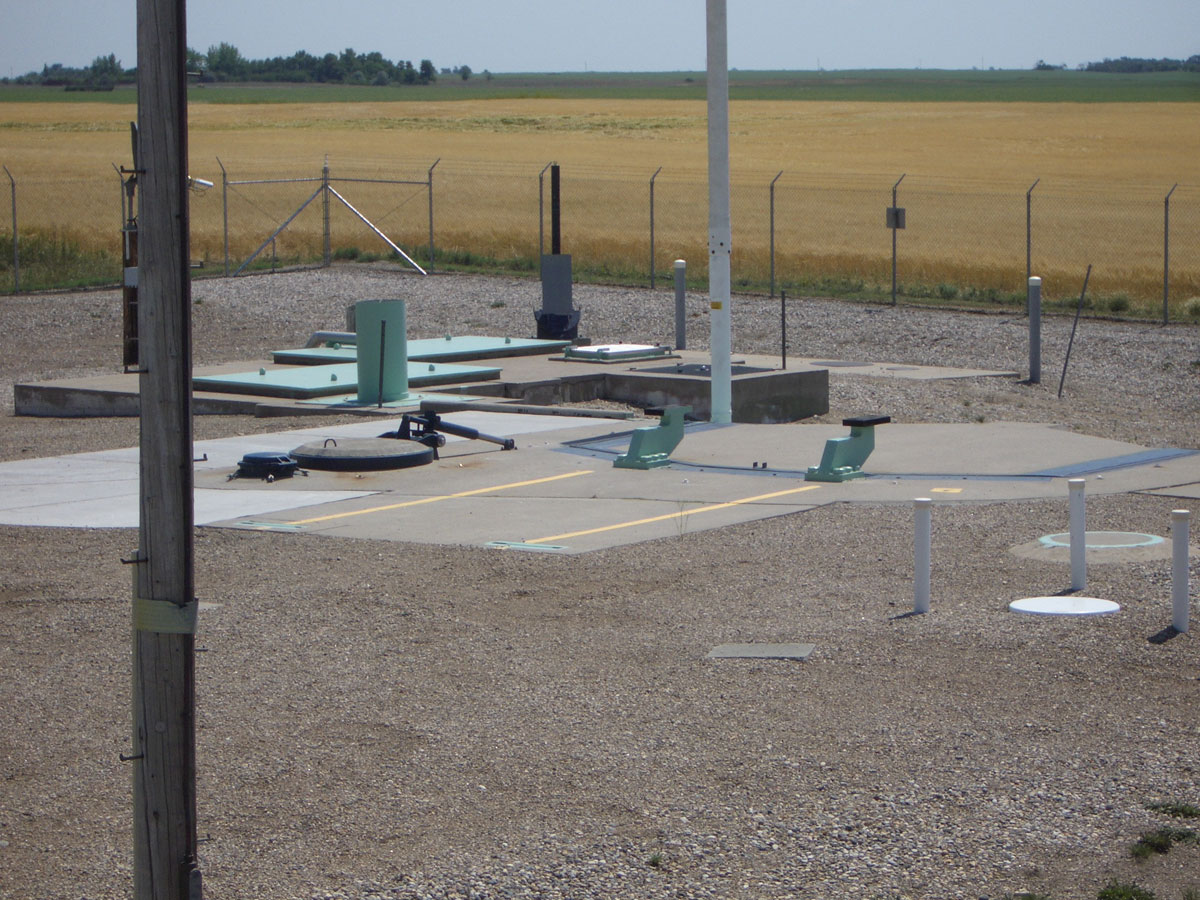
November-7 Launch Facility looking southeast from the front gate, and (left) illustration of the Minuteman missile in the underground silo. O’Connor and Isley parked outside the gate and continued to observe the bright UFO circling to the south. Shortly after 3:00, O’Connor entered the facility and went down into the Launch Support Building to report to Flight Security Controller, SSgt. James Bond, at the November Launch Control Facility, 10 miles to the north. A satellite view of November Flight (zoom-in to view N-7) is available from Wikimapia.
In response, Transportation Control routed the maintenance teams call to the Base Operations Dispatcher, who further verified there were no aircraft in the area. The dispatcher then notified the Minot AFB, Control Tower operator, and controllers at Radar Approach Control (RAPCON) establishing a phone patch, and open-line of communications with the remote observers at N-7. He instructed O’Connor to continue describing what he was observing, and over the next two hours kept a written log noting the time and circumstances.[20] His first entry, at 0800Z (3:00 a.m. CDT), describes the
Object S/E of N-7 moving toward site with brilliant light like the sun. Lights flashing on and off. It’s too brilliant and big for an aircraft now moving south and hovered over N-7, turned green, amber off than on. [21]

At 2:15, the Camper Team reported a glowing object near O-6 to SSgt. Smith at O-1. At 2:30, Smith observed the UFO in the south, at the same time the maintenance team of O‘Connor and Isley reported a UFO in the east. While driving south to N-7, the UFO appeared to pace them while growing brighter. By the time they arrived at N-7, the “big ball of white light” was “moving in a large circular area to the south.” They reported the observation to SSgt. Bond at November-1. It appears the UFO traversed roughly 15 miles from O-6 to a position a few miles southeast of N-7 where it remained for the next hour.
After observing the object for a while, O’Connor unlocked the gate and hurried down into the Launch Support Building adjacent to the silo, to phone in their arrival. According to procedure, he authenticated identification and assigned entry codes with Flight Security Controller, SSgt. James Bond, at the November-Launch Control Facility. Bond, along with his Security Alert Team of A1C Joseph Jablonski, and A1C Gregory Adams, received O’Connor’s report shortly after 3:00 a.m.[22]
In a February 2005 interview, Jablonski recalls O’Connor’s hysteric-sounding voice over the radio and imagined O’Connor was describing the object hovering directly over them at N-7. Going outside for a better view, he and Adams could see the security lights of N-7 to the south, and a bright light above it, about 35 degrees above the horizon “alternating all kinds of pretty colors.”[23]
At 3:08, Bond reported the maintenance team’s observation to SSgts. Underhill and Neal at missile Wing Security Control.[24] The Wing Security controller then alerted adjacent Flight Security Controllers, and the 91st Strategic Missile Wing, Command Post.[25] The controller also summarized events in a document later provided to Blue Book investigators. According to his first entry:
At 3:08 hours the initial report was received from a maintenance team enroute from N-8 to N-7. An A1C O’Connor was the maintenance Team Chief and he stated that all members of the team observed the lighted object. They further stated that it was reddish orange in color, a very large object, with flashing green and white lights. After they entered N-7 the object came directly overhead with the sound of jet engines.[26]
The idea that the object “came directly overhead ” seems to result from O’Connor’s initial excitement, and the original report by Bond that the object appeared to be hovering above N-7. Neither Isley nor O’Connor reported the object overhead, though O’Connor reported, “at one time the object came within about ½ mile of site,” and “the noise I heard was similar to that of a jet engine only more steady and at a lower pitch.”[27] Isley noted that when first seen it appeared about 50 degrees above the horizon, and “came within hearing distance twice. The sound was that of jet engines.”[28] In an August 2001 inteview he recalled,
ISLEY: At least once it seemed like it was passing pretty close overhead, and it was at one of these times that I heard some air noise or something that an aircraft might make. I don’t remember hearing any jet engines… maybe what a plane would make going through the air without its engines on—just the air movement across the wings, or whatever.[29]
After receiving O’Connor’s report, SSgt. Bond dispatched Jablonski and Adams to assist the maintenance team at N-7. Jablonski recalls that after observing the object, he and Adams returned to the LCF to get their weapons, and on their way to the pickup passed by all of the N-1 personnel outside observing the bright light in the distance.
Once on the road, the team observed a second, similar object appear out of the east traveling to the south. Jablonski reported:
When first dispatched to N-7 another object exactly the same appeared out of the East and had picked up speed in a path moving towards the other. Never did see the two join or meet as the second one disappeared and no longer could be seen.[30]
Adams concurred: “When enroute to N-7 another object appeared (same as first one). They seemed to get pretty close at one time and all of a sudden one disappeared.”[31]
In February 2005, Jablonski further elaborated that after leaving N-1 he and Adams observed numerous points of light streaking across the sky, originating from the bright object in the south:
JABLONSKI: I don’t even know if I put this in my report, but I saw lights coming off that, like smaller craft, going like (gestures back and forth path)…. Now these lights that I saw coming off of it while we were going down there were like what you were saying—small, almost like shooting stars but they weren’t because they were actually maneuvering (gestures curving paths), and they were going towards (pointing) that direction of Oscar Flight.
INTERVIEWER: So those objects would have been to the east of you, going up north?
JABLONSKI: Yeah. And he [Adams] saw them too, but he didn’t want to see them (laughs). I said, “Look at what’s going on!”
INTERVIEWER: Did they just disappear?
JABLONSKI: They faded out. But there were so many of them.
INTERVIEWER: How many—more than 10?
JABLONSKI: Oh yeah. This is when we first started out you know, then we focused mainly on that site because we were getting more in a straight line [heading south], and then we weren’t seeing any more of them. [32]
In fact, between 3:20 and 3:25 a.m., at least nine other ground observers at three LCFs observed two objects in strikingly similar terms. During the same time that Jablonski and Adams were driving to N-7, the Wing Security controller noted:
[03:20] SSgt Smith at Oscar-1 saw the object separate in two parts and go in opposite directions and return and pass under each other. At this time [03:24] Juliet Flt and [03:25] Mike Flt Team observed the same things and described it in the same way. [33]
In their AF-117’s, Isley and O’Connor included drawings of a second object southwest of N-7, while the first object remained in the southeast.[34] The time of this observation is not given, although the dispatcher’s log notes at 3:28: “Two are seen now.”[35] In addition, Bond included a drawing of two objects on a course towards each other, in which the second object “was in view for only about three minutes.”[36]

SSgt. Bond’s drawing in his AF-117 (4). If this is his view from N-1 looking south, then the second object was in the southwest traveling to the east before disappearing at the point of contact (Click image for full scan).

A1C O’Connor’s drawing in his AF-117 (4) (Click image for full scan).

Locations of the ground observations at 3:20-3:25 of two objects separating in opposite directions and returning to pass under each other. Additionally, Jablonski and Adams on the road to N-7 observed a second identical object in the east on a path to the first, which got close and disappeared. O’Connor and Isley at N-7 noted, “at one time there were two in the area,” indicating a second object in the southwest. Bond at N-1 noted two objects moving toward each other, and the second object disappearing at the point of contact, which “was in view for only about three minutes” (AF-117s, 4). The possibility of two UFOs was not an issue during the subsequent Blue Book investigation, and the sighting data is meager. In any case, complete data from the three LCFs would have certainly resolved the probability that observers were reporting a celestial object.
Over a distinct period of time, two similar objects were reported moving in relation to each other by 14 ground observers in diverse locations. Unfortunately, no specific observational data was obtained during the subsequent investigation, nor from the security personnel at the Juliet-1 and Mike-1 Launch Control Facilities, which would allow for correlations. Later, Minot AFB investigating officer, Lt. Colonel Arthur Werlich, simply notes in the Basic Reporting Data, “AT ONE POINT DURING THE GROUND SIGHTINGS, THE FIRST OBJECT WAS OBSERVED JOINED FOR A SHORT TIME BY A SECOND LIKE OBJECT.”[37] Other instances in the documentation point to the presence of two UFOs. For example, at 3:30 [3:40], when the Transcription of Recorded Conversation commences between RAPCON and the crew of a returning B-52, the first entry notes, “Controllers received information on UFO 24 miles NW.”[38] This location is in Mike-Flight about 7 miles west-northwest of the observers at N-7, who were reporting a UFO in the southeast.
Jablonski and Adams arrived at the N-7 missile silo around 3:30.[39] Jablonski recalls that when they pulled up the gates were standing wide open, and O’Connor and Isley were in a frantic state:
JABLONSKI: I was too excited to be scared. When we got there, to see a man with that rank running, I mean they were all telling us ‘Shoot it!’ when we pulled up.
INTERVIEWER: It’s that close?
JABLONSKI: Evidently, it was close in the beginning and then it moved off, but it stayed in the vicinity, you know, it gained altitude or whatever, and you could not hear any engines. [40]
In his AF-117, he noted that the phenomenon was not in sight continuously, indicating that this was
Not due to our movement, but the behavior pattern of the phenomenon. Object appeared as orangish-red lighted, seemed to switch to almost completely white and there was some green. This pattern was not always the same, and at certain times a combination of all could be seen at once. Object first appeared to hover, then move slowly, speed up, always alternating in color. Then lights would vanish, but return some 5 minutes later. [41]
He also recalled:
JABLONSKI: Whatever it was, you could not make out the shape. It was long and slender with lots of lights on it. In the debriefing [they said] that it was the size of a B-52 with a tanker—it had come up on base radar as that big. But the thing of it was the lights, which were alternating—they were bright white to like an amber-red and to a green, back—
INTERVIEWER: What would you compare it to—a nut or a basketball?
JABLONSKI: Oh, it was bigger than that, I mean, it was like the size of the B-52. You could not make—as far as shape you know, ‘saucer-like,’ whatever; it was oblong, slender with lots of lights on it.[42]
Jablonski took over responsibility for radio communications, reported back to Bond and the capsule crew at N-1, and continued relaying movements and descriptions of the object to the dispatcher and the RAPCON controller, who, by this time, was in contact with a returning B-52.[43] He explained the difficulty of providing RAPCON with the precise coordinates of the UFO because:
JABLONSKI: The lights were not always on. When it made a move it was without the lights. That’s what was so tough with the B-52, because they wanted coordinates and everything. But when the lights were off you could not see it, as dark as it was.
INTERVIEWER: Then the light would appear in another spot?
JABLONSKI: Right. It was when it was hovering that you could actually see all these pretty lights and everything. That’s when it was staying in one place. But when it actually went to move you might see a little white, and then nothing—blank, you know, and then here it is over here (gestures right), then here it is over here (gestures left). [44]

After Jablonski and Adams arrived at N-7 around 3:30, the personnel continued observing the UFO in the southeast for approximately 30 minutes. During this time, Smith was also observing the UFO from O-1, 19 miles to the northeast of N-7. Based on data in the AF-117s, Smith observed the UFO “off and on” south southwest of his position for a length of time of one hour and fifteen minutes [2:30-3:45]; and also reported the time of his last sighting as 4:15, for a period of one hour and forty-five minutes (1, 3). O’Connor continued to observe the UFO that went “out of sight” a few times southeast of N-7 for one and a half hours [2:30-4:00]; and also reported the time of his last sighting as 3:45, for a period of one hour and fifteen minutes (1, 3). He estimated the distance of the UFO as 1/2-6 miles (7). Jablonski notes they observed the UFO for 35 minutes after 3:08 [until 3:43], estimating the distance of the UFO as 3-5 miles (AF-177, 3, 7). Adams notes they observed the UFO for 45 minutes after 3:08 [until 3:53], estimating the distance of the UFO as 2-5 miles (AF-117, 3, 7). All of the observers at N-7 note the UFO disappeared at the same time the B-52 appeared in the west. Based on information in the Transcription, and our reconstruction of the B-52 flight track, this was until 4:02.[45]
As the observers at N-7 continued reporting the UFO, the base communications networks were buzzing with activity. O’Connor recalls: “We conversed back and forth and then everybody, we started hearing all the chatter on the radio from everybody else that was seeing this thing.”[46] Jablonski recalls that after they arrived at N-7:
JABLONSKI: We took over because we were talking to my boss [Bond] and the capsule crew. I mean, there were so many people on that radio that…
INTERVIEWER: Who else?
JABLONSKI: People from the Squadron, people at the base, then when they diverted the B-52, I was talking to the ‘52 people.[47]
The missile Wing Security Control communication network was also patched in to RAPCON, and the capsule crews were listening in the hope that an incoming B-52 would provide their eyes in the sky. Smith insisted:
SMITH: I’m the Staff Sergeant and I don’t usually call out of my chain of command unless I’m really frightened. So, I used my chain of command, I called back the people that I deal with, so I’ve done what I’m supposed to do and I just keep it under advisement. I talked to my capsule crew. Depending upon the crew they were interested or not interested. But it got frustrating; we got really angry that nobody was listening to us. So, I remember after I got my crew more interested then they [finally] called. Now the plot thickens because they started calling people and said, “My people upstairs are saying here’s what’s happening and we want some more information.” So they did call the Tower, and matter of fact, I remember listening on the phone—they let me stay on and listen. They called their Operations [Wing Security Control], who said, “OK, let’s get somebody else to think about this.” Then the B-52 crew was called in. They said, “we have a B-52 that’s out and we’ll see what they can see.” That is how we got the [B-52] crew involved. [48]
B-52 Air-Radar UFO Observation (3:44-4:02)[49]

B-52 Aircraft Commander and pilot, Captain Don Cagle; Co-pilot, Capt. Bradford Runyon Jr.; Radar Navigator, Major Charles “Chuck” Richey (dec.); Navigator, Capt. Patrick McCaslin; Electronic Warfare Officer, Capt. Thomas Goduto; and Gunner, Technical Sergeant Arlie Judd Jr. All crewmembers were rated as instructors in their respective positions, establishing them as one of the top crews at Minot AFB in 1968. During this particular mission, there was an additional pilot aboard from another B-52 crew, Maj. James Partin, being evaluated by Cagle. When it became apparent that the crew were being asked to look for a UFO, Cagle dismissed himself from the flight deck, leaving Partin and Runyon in charge for the remainder of the flight.
In the midst of the events, a Boeing B-52H Stratofortress long-range bomber of the 23rd Bombardment Squadron, 5th Bombardment Wing (Heavy) at Minot AFB, returned from a 10-hour training mission.[50] The precise time the B-52 returned, and particularly, its whereabouts for the first hour and a half of the UFO observations are not clearly established in the Project Blue Book documentation.[51] Col. Werlich later commented in the Basic Reporting Data:
AT THE TIME OF THESE EVENTS, A B-52 WAS IN THE LOCAL AREA. THE AIRCRAFT INITIALLY ARRIVED IN THE AREA ON A 50 [NAUTICAL] MILE RADIUS CLEARANCE WITH A BLOCK ALTITUDE OF FL210 [Flight Level 21,000 feet] TO FL230 AND BEGAN VARIOUS INSTRUMENT PRACTICE MANEUVERS INCLUDING A VERTICAL “S” PATTERN. THIS TOOK PLACE AT ALMOST THE SAME TIME AS THE FIRST GROUND SIGHTING.[52]
The B-52 Navigator, Captain Patrick McCaslin, recalls that they were returning about 3:00 in the morning, possibly from Grand Forks AFB, east of Minot:
McCASLIN: I want to say we’d been over to Grand Forks and shot some approaches there. I don’t think we had done a lot of navigation-type things like low-level routes, or high-level bombing, or any of that stuff. I think it was mostly a pilot’s-type mission. But at some point around—my memory is about 3:00 in the morning—we showed up at Minot, and the reason I think we were coming from Grand Forks, my memory is that we were coming from the east to the west and flew an approach of some kind into the runway, did a low approach as I remember it.[53]
Upon entering the Minot area, defined by a 50-nautical mile circumference around Minot AFB under the control of Radar Approach Control (RAPCON), the B-52 pilots practiced routine high-altitude instrumented procedures. Because of their altitude, and without landing lights, it is doubtful that anyone on the ground could have possibly seen them, especially with the extended overcast.[54] In a February 2005 interview, the B-52’s co-pilot, Captain Bradford Runyon Jr., recalls:
RUNYON: I think we did some high altitude work, probably some vertical S’s, maybe some steep turns you know, maybe some 60-degree bank turns.
INTERVIEWER: That is at 20,000?
RUNYON: Right, at higher altitude, like for the vertical S’s we might have gotten a block from 20 to 30; or 30 to 40,000 feet for that.
INTERVIEWER: That is what?
RUNYON: Just go up and down, certain air speeds, certain rates of descent and then do 60-degree banking turns—that is high altitude. We are probably at 40,000.
INTERVIEWER: So nobody could see you up there.
RUNYON: No, no way, and we were probably not over our base anyway—were out in the middle of nowhere. [55]
Following this, the B-52 departed FL200 and descended from the southeast for a low approach over the runway at Minot AFB. At 3:34 [3:44], co-pilot Capt. Runyon requested clearance to fly out to the Tactical Air Navigation (TACAN) aid, referred to as the TACAN initial approach fix, or simply “WT fix,” located 35 nautical miles to the northwest near Bowbells, North Dakota.[56] Werlich comments:
AFTER A VOR PENETRATION, LOW APPROACH AND MISSED APPROACH TO RUNWAY 29 AT MINOT AFB THE AIRCRAFT CLIMBED TO FL200 ON A HEADING OF 292 DEGREES[57]
The Transcription of Recorded Conversations between Runyon and the RAPCON ground controller begins at 3:34 [3:44], and establishes a timeline and relative location of the B-52 over the next hour.[58] However, the first statement at 3:30 [3:40] notes RAPCON controllers “received information on UFO 24 miles NW” of the base. The source of the information is unknown. The location is in Mike-Flight about 7 miles west-northwest of the observers at N-7, who were reporting another UFO in the southeast.
Transcript of tape for 24 Oct 68 from 0830 to 0915
[3:30 to 4:15 a.m. CDT][59]ct = [radar approach] controller [MIB]
ac = [B-52] aircraft [JAG 31]
tw = [control] tower
03:30 Controllers received information on UFO 24 miles NW [3:40] 03:34 JAG 31 a B-52 on a TA calibration check to rw [runway] 11 requested clearance to WT at FL200 [3:44] 03:34 ac $MIB approach control does JAG 31 have clearance to WT fix at FL200? [3:44] ct JAG 31 roger climb out on a heading of 290 climb and maintain 5000. Standby for higher altitude. We’re trying to get it from center now. 03:35 ct JAG 31 climb and maintain FL200 [3:45] ac Roger 31 leaving 5000 for 200 ct 31 roger ct And JAG 31 on your way out to the WT fix request you look out toward your one o’clock position for the next 15 or 16 miles and see if you see any orange glows out there. ac Roger roger…glows 31 ct Somebody is seeing flying saucers again. ac Roger I see a …(garbled)[60]
When it became apparent the pilots were being asked to search for a UFO, Aircraft Commander Capt. Don Cagle excused himself from the flight deck, and for the remainder of the flight isolated himself in the bunk area leaving Runyon and Major James Partin—a non-crew pilot being evaluated by Cagle during this mission—in charge.[61] Cagle planned to be on a commercial flight to Atlanta later that morning for a job interview with Delta Airlines. He had missed a similar appointment one month earlier, due to an unannounced Operational Readiness Inspection on base. His concern was that any direct involvement would require him to be present at Minot and miss yet another opportunity for a new career.[62]
After RAPCON’s request at 3:35 [3:45] for the pilots to look out in the direction of N-7 for “any orange glows out there,” and a final “(garbled)” response, there were no further communications with the B-52 for 7 minutes. Ascending to the flight level altitude at 20,000 feet, the pilots would have had limited ability to see anything as a result of the extended overcast and haze reported above 10,000 feet.[63] When communications resumed at 3:52, the B-52 was about 34 nautical miles northwest of the base, and in the beginning stages of executing a standard 180-degree right turnaround back over the WT fix. On completion, the aircraft was aligned on a straight approach to the runway to begin its descent back to Minot AFB. Once again, RAPCON alerted the B-52 crew, “0352 [JAG]31 the UFO is being picked up by the weathers [sic] radar also, should be at your 1:00 [o’clock] position 3 miles now.” Runyon responded, “We have nothing on our airborne radar and I am in some pretty thick haze right now and unable to see out that way.”[64]
McCaslin, downstairs in the belly of the B-52, aroused Radar Navigator Major Charles (Chuck) Richey, requesting that he switch the radar to a 360-degree surveillance mode designated “Station Keep.”[65] In this mode, the coverage is elevated and concentrated close to the aircraft; used primarily for formation flying, and lining up behind the docking boom of a KC-135 air-refueling tanker.[66] Following this, McCaslin noticed a bright echo appear on his radarscope in the same location indicated by the weather radar:
McCASLIN: We’re climbing out to do this approach, and we were asked to keep our eyes open for anything strange. No one had said anything like UFO or anything like that. It was just, “Keep your eyes open for anything.” Since I was flight-following the approach anyway, I asked Chuck to put it in Station Keep mode, because I figured if there is anything in the area my best chance to see it would be in Station Keep—more energy, closer. And he did that for me. As we climbed out, I monitored the direction we were heading, the altitude, and I watched the scope. At some point on the way out to the VOR, or to the Nav-aid, I saw a weak—off to our right, maybe 3 miles out—I saw a weak return, one scan. The next scan, there was a very strong return at that location about 3 miles off our right wing, which meant to me that something had either climbed into the radar energy, which was why it would be weak as it entered it, and then was about co-altitude in the next sweep, or it could’ve descended into it. Don’t know which. But it was clear that something was out there and it was large. It was as big or bigger than a KC-135. My impression was it was a larger return than the KC-135 gave me. So I called the pilots and said, “There’s traffic off our right wing at 3:00. Looks like co-altitude,” and nobody saw anything. So I kept watching this thing. The pilot’s basically said, “Keep us advised,” and I think I may have called them a time or two and said “It’s still out there.”[67]
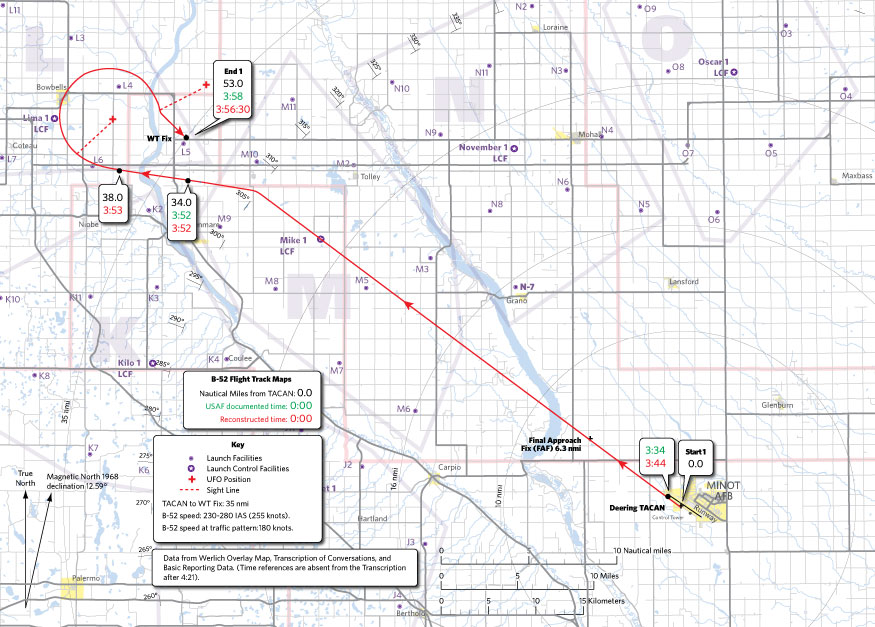
At 3:34 [3:44] the B-52 is over the runway requesting clearance to the WT fix. At 3:35 [3:45] RAPCON requests that they lookout at their right for the next 15-16 miles “for any orange glows out there.” At 3:52, RAPCON informs the pilots that the weather radar located the UFO 3 miles to their right at one o’clock. McCaslin asked Richey to switch the radar mode to Station Keep, and at about 3:53 observed the UFO 3 miles off the right wing of the B-52. As the B-52 continued the turnaround back over the WT fix, the UFO maintained the 3-mile distance, transiting to the northeast outside of the B-52 turn radius.
McCaslin also requested that Richey switch on the 35mm camera mounted over the top of the radarscope. The camera films the 10-inch radarscope, while superimposing the data plates via a separate optical path. It automatically exposes one frame during a three-second time exposure, which is equal to one complete rotation of the radar beam sweep.[68]
Safely turning a B-52 around requires about a three-mile radius, and the presence a large, unknown aircraft at co-altitude inside the turn-radius presented a serious safety concern for the crew. Yet, as the B-52 banked around the wide turn, McCaslin watched the object on the radarscope moving out to the northeast, while maintaining the three-mile separation in relation to the turning aircraft. This allowed the B-52 to safely turn inside, and the object ultimately assumed a position 3 miles to the left of the B-52 at the completion of the turnaround:
McCASLIN: I advised the pilots that it was still out there, and as we approached the VOR [WT fix], my memory is that we were going to make a right turn into the VOR . . . and then start our descent over the VOR headed back toward the base. And that was of some concern to me because we were turning into this thing.
INTERVIEWER: It was off your right side?
McCASLIN: Yeah, and I may have—I can’t believe that I would not have advised the pilots, “we’re going to be making a right turn in the direction of this thing,” and it was, “Keep us advised.” So they started their turn back to the VOR, and my clear memory is that as we turned back, this return moved out at the same rate we were turning in—it moved out to the northeast—and by the time we rolled back out headed southeast to start the approach it was 3 miles off our left wing, and I advised the pilots of that.
INTERVIEWER: So it moved relative to you? How many miles?
McCASLIN: I can’t remember the turn rates of a B-52 anymore—but relative to a track over the ground, it must’ve moved 6, 7, 8 miles to the northeast to accommodate the turn we made.
INTERVIEWER: You’re implying intelligence there, aren’t you?
McCASLIN: Yeah, I guess I am.
INTERVIEWER: What did you think at the time this thing was?
McCASLIN: I really didn’t—I don’t know that I thought it was anything. I mean my first concern was that it was an aircraft of some kind. I was worried about hitting an aircraft.[69]

Partial scan of Col. Werlich’s Overlay Map showing the B-52 flight track and 180-degree turnaround back over the WT fix (black circle). The UFO positions (red X’s) and flight track are in red, while the blue section is Werlich’s estimate of where the radarscope photographs were exposed. Actually, the 14 photos appear to show the UFO spiraling around behind the B-52, from a position front-right of the aircraft to a position 1 nmi off the left wing before disappearing from the radarscope. Werlich also indicated six lat./long. coordinates to accurately align the overlay onto a base map ([Werlich Overlay Map).
At 03:56, the B-52 requested routine approach procedures, acknowledging “wilco” to RAPCON’s request to “report leaving [FL]200 on this approach.”[70] Shortly after, the aircraft would pass over the WT fix and depart FL200 to begin its penetration and descent back to Minot AFB.[71] At this time, the object’s return on the radarscope remained as bright as it had been, indicating to McCaslin that the UFO was following at a distance of 3 miles, while also descending at the same rate as the B-52. It was now clear to the crew that a large unidentified object was keeping pace with them, though there was little they could do except keep a watchful eye on the situation.
McCASLIN: We’re now in the descent and this thing’s apparently descending with us. I advised the pilots of that. It seemed to me that the pilots were getting a lot more interested in it. There seemed to be a lot of talk on the intercom, ‘Do you see it? I still don’t see it,’ that kind of thing. It’s clear now that whatever this is [was] staying with us, and that’s cause for concern, since—I think there were calls to the tower, although I may not have heard those, I think there were calls about, “Do you have traffic?”—and no one was owning up to any traffic in the area. . . . As we descended on the approach, it stayed as bright as it had been, which for a navigator means, or a radar navigator, it is remaining co-altitude. In other words, it is descending at the same rate we are.[72]
At 3:58, the B-52 abruptly lost two-way communications with RAPCON, at the same time that the UFO suddenly reduced its distance from three miles to one. The seemingly instantaneous change of position occurred in less than a three-second sweep of the radar antenna. Runyon recalls that the object’s movement occurred so unexpectedly that it startled Radar Navigator Ritchey, and by the shrill tone of his voice over the interphone, for a second, Runyon imagined that a collision was imminent.[73] McCaslin recalls:
McCASLIN: So at some point in the descent, with this thing still shining out there, I saw it at 3 miles on the left, and then the next scan it was at one mile. I mean it was just—there was no sense of it closing. There was no time for that. It was at 3 miles at one point, and the next scan it was one mile off our left wing. I was on the intercom immediately and called the pilots and said, “Hey, this thing’s one mile off our left wing now,” and, well I knew whatever it was, in my own mind, at that point I knew there was something there that I’d never seen on radar. The ability to close 2 miles and stop instantaneously was—although I wasn’t a pilot yet, I went to pilot training 2 months after that and I did a lot of flying, and I don’t know of anything—been a lot of R&D since I got out—but certainly at that time, and during [my] career when I was flying as a pilot I didn’t know of anything that could go laterally in 3 seconds, 2 miles, and just stop.
INTERVIEWER: And maintain your airspeed.
McCASLIN: Right. It was maintaining our descent rate, and then just laterally into one mile—perfect formation. So the pilot’s were telling me they were looking. They still didn’t see anything. No one claimed to see anything at that point. And it was about that time that the tower, and I don’t remember exactly how the loss happened, but the tower either lost our transmission to them, or we lost contact with the tower, but we did not have two-way communications with the tower anymore.
INTERVIEWER: And at what point did you realize that was the case?
McCASLIN: That happened as soon as I called up—right about the time I called up and said, “This thing’s a mile off our left wing.”
INTERVIEWER: When you start to do your descent for approach, that’s when your radios go down?
McCASLIN: No. We started the descent; it stayed 3 miles off our left wing. At some point during the descent it moved in to a mile. And just from one scan to the next—at that point, we lost two-way communications with the tower.[74]
Capt. Runyon, from his position on the flight-deck, recalls the abrupt change of position of the UFO and loss of radio transmission occurring at the WT fix, prior to the start of descent. Due to the sudden loss of radio transmission he was concerned about his inability to report leaving FL200.
RUNYON: The Navigator told me that we had something off our right wing at 3 o’clock and of course I am looking there too, and I really can’t see it.
INTERVIEWER: At that point you are in what direction in relation to the base?
RUNYON: We’re still flying away from the base and we still haven’t reached our TACAN penetration point. So we’re flying out through there with the object showing on radar, and I don’t know whether it blended in with the night and the clouds, haze, or whatever we had. I don’t know why I couldn’t see it…. And so we reached our penetration point and our radios had quit working when the object got in close to us. I’m not sure just at what point I realized that we couldn’t talk to the ground, but we made our turn and penetration back towards the base and departed our altitude without receiving permission, which bothered me at the time because it was basically illegal to change your altitude without approval beforehand. [75]
Runyon’s recall is consistent with his later communications in the transcription at 4:04, when the controller asked, “I was wondering how far out did you see that UFO?” “At 35 miles when we started in,” Runyon replied.“I wonder if that could have been your radio troubles,” queried the controller. “I don’t know,” Runyon said, “but that’s exactly when they started.”[76]
After the B-52’s radio transmission abruptly broke off in mid-sentence, the B-52 could still hear the controller, but RAPCON could not hear the B-52, and were apparently unaware of the UFO pacing the aircraft. The controller requested them to “squawk ident,” which meant to use the aircraft’s SIF/IFF transponder to paint a bright blip on RAPCON’s radarscope, signaling that the pilots could hear the controller’s transmission.[77] Satisfied that the B-52 could hear them, the controller then contacted the Minot AFB Control Tower to clear the runway for the approaching B-52:
03:58 ac Approach control 31 ct 31 go ahead… 31 go… JAG 31 Minot go ahead… 03:59 ct JAG 31 Minot approach go ahead… JAG 31 if you hear me squawk ident… 31 Minot 04:00 ct JAG 31 if you hear me squawk indent…. JAG 31 ident observed cleared for the approach attempt contact on frequency 271.3 and you’re cleared for the low approach ct to tw Tower this is on JAG 31, disregard, he’s about 24 miles out but can I have clearance on him now for a low approach, he might be having radio problems tw Cleared for low approach wind 15002 ct JAG 31 you’re cleared for low approach wind 15002, if you hear me squawk ident ct JAG 31 if you’re having any other difficulties besides radio transmitter squawk mayday…. (no mayday squawk was received)[78]
The B-52 attempted to communicate with RAPCON on two different UHF radios but neither would transmit during this time.[79] However, they were able to signal RAPCON they were in no immediate danger, which was a grave concern, since three weeks earlier a B-52 experiencing technical problems on approach had crashed, killing four crewmembers.[80]
The B-52 continued its descent, still unable to visually observe the pacing UFO through the haze. According to Werlich, the “RADAR ECHO ACCOMPANIED AIRCRAFT TO APPROXIMATELY 14 NAUTICAL MILES, 296 RADIAL, APPROXIMATELY 9,000 FEET MSL,” at which point it departed.[81] As the object left his radarscope, McCaslin’s impression was it descended, dropping out of the radar energy, so he noted the precise ground coordinates in the bomb navigation system.[82] At the same time, the B-52’s radio transmission with RAPCON was suddenly restored.
04:02 ac Minot approach control JAG 31 how do you hear ct You’re loud and clear how me ac Roger you’re loud and clear ct Remain this frequency ac Our UFO was off to our left there when we started penetration ct Roger understand you did see something on your left side ac We had a radar return at about a mile and a quarter nine o’clock position for about the time we left 200 to about 14 04:03 ct JAG 31 how do you hear this transmitter? ac You’re loud and clear how me ct You’re loud and clear also ac OK. I’ll stay on this frequency? ct Affirmative I was wondering how far out did you see that UFO? ac He was about 1½ miles off our left wing at 35 miles when we started in and he stayed with us ‘til about 10 ct I wonder if that could have been your radio troubles ac I don’t know.… but that’s exactly when they started.[83]

Clearing the WT fix, the UFO rapidly closed distance to one mile, and the B-52 radio transmission failed. Werlich notes in the Basic Reporting Data that the “RADAR ECHO ACCOMPANIED THE AIRCRAFT TO APPROXIMATELY 14 NAUTICAL MILES, 296 RADIAL, APPROXIMATELY 9,000 FEET MSL” before disappearing from the scope (3). Based on an analysis of radarscope photo #783, Dr. Claude Poher locates the B-52 at 18.8 nmi at an altitude of 8865 feet. It is notable that the UFO disappeared from the radarscope shortly before emerging in to view below the overcast at 9,000 feet. Note: Our reconstructed time during this segment is 1 minute and 28 seconds behind the documented time, perhaps because the B-52 speed during the turnaround back over the WT fix was less than the average of 255 knots. The radarscope photo time (4:06:14-4:06:51), which is also the B-52 onboard time, is ahead by more or less than 6 minutes.

Lt. Col. Arthur Werlich transferred to Minot AFB in July 1968 as chief of Base Operations, and director of the T-29 aircraft ground school and flight training program. In addition, he was appointed Blue Book project officer responsible for investigating UFO reports at Minot AFB. This case was his first official UFO investigation. Col. Werlich retired from the USAF in 1970, and passed away in March 1992.
Col. Werlich provides two separate accounts of the B-52 radar encounter in the documentation. The first is a 24 October, Memo for the Record of his telephone conversation reporting the incident at 4:30 p.m. (CDT) to Project Blue Book chief Lt. Colonel Hector Quintanilla, Jr., and his assistant 2nd Lieutenant Carmon Marano, in the Aerial Phenomenon Branch at the Foreign Technology Division (FTD), Wright-Patterson AFB, Ohio.[84] Evidently, Werlich had spent most of the day trying to reconstruct the events.[85] This Memo for the Record provides a calculated speed of the UFO and its initial position to the right of the B-52, though the right-to-left (of the B-52) movement appears out of sequence. He initially informed Blue Book duty officer Sgt. Harold Jones “that the crew of a B-52 had sighted and photographed an [sic] UFO and that the Base Commander and Major General Nichols of the 15th Air Force were both interested.”[86] Jones contacted Marano, who returned to the office and informed Quintanilla, before phoning Werlich back. Marano asked whether he required an immediate reaction, to which Werlich responded “No,” however, “since it was such an unusual sighting he [Werlich] wanted to know if we could help him in any way.” Marano asked for the details:
At about 0300 hours local, a B-52 that was about 39 miles northwest of Minot AFB and was making practice penetrations sighted an unidentified blip on their radar. Initially the target traveled approximately 2½ mile in 3 sec or at about 3,000 mi/hr. After passing from the right to the left of the plane it assumed a position off the left wing of the B-52. The blip stayed off the left wing for approximately 20 miles at which point it broke off. Scope photos were taken. When the target was close to the B-52 neither of the two transmitters in the B-52 would operate properly and when it broke off both returned to normal function.[87]
Col. Werlich’s second account, written four days later in his comment section of the Basic Reporting Data, provided some corrections to the original report, and more details, while omitting the weather radar detection; initial B-52 radar detection to the right-side of the aircraft; the right-to-left (of the B-52) movement of the UFO; and the speed calculation.
AFTER ROLLING OUT OF A RIGHT TURNAROUND TO THE TACAN INITIAL APPROACH FIX, A BRIGHT ECHO SUDDENLY APPEARED 3 MILES ABEAM AND TO THE LEFT OF THE AIRCRAFT. THE ECHO RAPIDLY CLOSED ON THE AIRCRAFT AND REMAINED AT ABOUT 1 MILE. AT THIS MOMENT THE UHF TRANSMISSION FROM THE B-52 TO RAPCON WAS INTERRUPTED IN MID-SENTENCE. THE RADAR ECHO CONTINUED WITH THE AIRCRAFT DURING ITS TACAN PENETRATION FOR ABOUT 20 MILES. RAPCON HAD REQUESTED THE AIRCRAFT TO CHANGE UFH FREQUENCIES TWICE BUT THE AIRCRAFT WAS UNABLE TO TRANSMIT ON EITHER FREQUENCY. THE B-52 UHF RECEIVER WAS NOT AFFECTED NOR WAS THE IFF/SIF IDENTIFICATION FEATURE AFFECTED. DURING THIS TIME, RADAR SCOPE PHOTOS WERE OBTAINED AND CLEARLY SHOW THE RADAR ECHO. AS SOON AS THE ECHO DISAPPEARED THE B-52 UHF TRANSMITTER BECAME OPERATIONAL. WHATEVER CAUSED THE ECHO WAS NOT VISUALLY SIGHTED BY THE AIRCRAFT CREW MEMBERS NOR WAS IT SEEN BY THE TOWER OPERATOR WHO WAS FOLLOWING THE AIRCRAFT PROGRESS THROUGH BINOCULARS. DUE TO HEAVY HAZE AND SEVERAL CLOUD LAYERS, THE AIRCRAFT WAS NOT VISIBLE THROUGHOUT THE APPROACH. [88]
During the B-52 radar encounter, the missile Wing Security Control communication network was patched-in to RAPCON, and the underground capsule crews were closely following the progress of the B-52. The Oscar-capsule crew allowed Flight Security Controller SSgt. Smith to listen-in to the comunications between the B-52 and RAPCON, though the radio transmission was patchy and difficult to hear:
SMITH: Matter of fact, we had an officer I think on the phone with the capsule crew, and of course I was patched in, they were asking me questions, and they said, “Well OK, we’ll have a diversion of this B-52 crew coming in,” and they gave a time when it would be coming. . . . They described it, said, “We’re breaking off” and then it followed them back for a certain time, and my understanding was that they lost them on radar, and we were able to hear that, they said, “We don’t have them on radar right now.” And so the conversation was, “My gosh what may have happened?” Then when it got within so many miles of the base they were able to pick them up on radar again, and the traffic came. Matter of fact, I remember they kept calling them trying to get them on radio and there was no radio transmission either and everybody was concerned at that time because they hoped they didn’t crash.[89]
FSC SSgt. Bond recalls the November-capsule crew informing him of the B-52 encounter:
BOND: The combat crew did tell me that there was a B-52 being rerouted to the area and they were going to check on it. They also told me that they had been talking to the B-52 crew by radio from the capsule and about seeing the thing, it following them, also about losing all communications in their airplane when it got close to them, and for how many minutes they had no contact with the support base or anything else. Yeah, that was real strange. . . . Not much more than that they were pretty tight lipped about it. They wanted to know what I was seeing.[90]
B-52 and the Ground Observers at N-7
As the B-52 continued its descent to Minot AFB, the remote observers at N-7 were unaware a UFO was closely pacing the B-52, and that the pilots had lost two-way communications with RAPCON. At some point, the Base Operations Dispatcher informed them that a B-52 was diverted to area, and they were directed to the precise time and location of the incoming aircraft. O’Connor noted that, “a B-52 was sent to the area to check out the sighting and was seen west of the object at first.”[91] Jablonski compared the bright illumination of the UFO to the landing lights of the approaching B-52:
As to the alternating illumination, particularly the white, it appeared as two or three automobile headlights. When the B-52 had flown in its search it had been using its landing lights which were quite similar in nature. As to avoid confusion between the plane and the object Base Ops had pointed out where and when we saw the B-52. Must add that the B-52’s engines could be easily heard while the UFO made no sounds to be heard at about the same distance. [92]
The N-7 personnel had been observing the UFO in the southeast, but when the B-52 appeared high in the west-southwest, the UFO descended to the horizon and was no longer observed in the area. According to Jablonski:
Just prior to our sighting the diverted B-52 in the WSW the object had descended gradually and for 1 minute or 2 had appeared to be obstructed by trees. . . . When the B-52 flew in the vicinity (SSE) it was no longer seen in that location.[93]

November-7 Launch Facility looking southeast.
It is intriguing to note, about the same time the UFO disappeared from view southeast of N-7, another UFO, which had been pacing the B-52 high in the northwest, also disappeared from the B-52 radarscope, just prior to emerging into view below the overcast and haze above 9,000 feet. The visibility at lower altitudes was 25 miles and clear.[94] Dr. Claude Poher’s recent photogrammetric analysis of the B-52 radarscope photographs proposes that the aircraft was at an altitude of 8865 feet, while 18.8 nautical miles from the runway at the time of the last radarscope photo. This position is west-southwest of N-7, and suggests that the UFO broke off just before the observers at N-7 first observed the B-52. In fact, the ground observers could clearly see and hear the incoming B-52 but did not observe the UFO pacing the aircraft.

N-7 looking south from the front gate.

N-7 looking southwest from the front gate, with Lake Darling, the Upper Souris National Wildlife Refuge, and Grano Crossing in the distance. A satellite view of November-Flight (zoom-in to view N-7 and surrounding area) is available from Wikimapia.
B-52 Air-visual UFO Observations (4:24-4:28)[95]
As the B-52 passed by on its way to the base, the personnel at N-7 were no longer observing the UFO and returned to their assigned duties.[96] RAPCON cleared the incoming B-52 for low approach to the runway. By 4:06 they had completed a missed approach, and were given a vector to turn left onto the crosswind leg of the traffic pattern bearing 335 degrees, at a standard altitude of 3200 feet MSL (roughly 1500 feet above the local terrain). The controller then provided clearance for the B-52 to visually land if communications were interrupted.
04:06 ac 31 going around ct 31 roger ac Steady 335 3200 04:09 ct JAG 31 roger, radar contact this will be a vector to the precision final approach course rw [runway] 11 ac JAG 31 roger ct Jag 31 if no transmissions received for one minute in the pattern take over visually if unable cleared for approach ac Roger 31 understand ct Jag 31 turn left heading 290 maintain 3200 downwind leg[97]
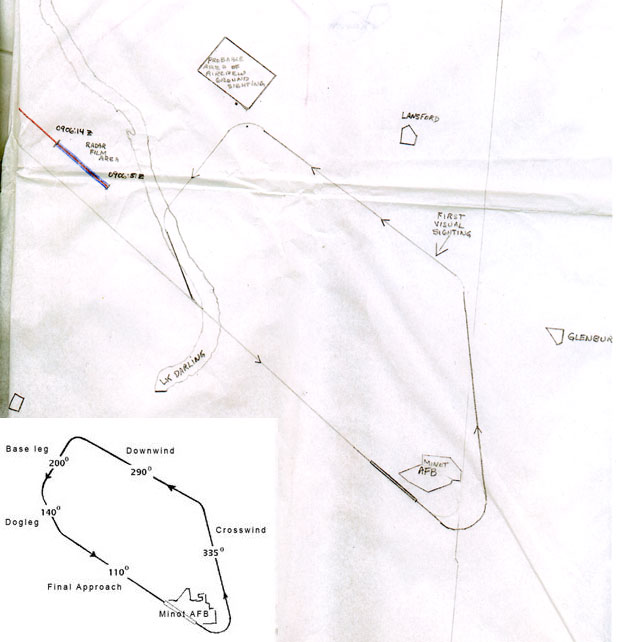
Partial scan of Werlich’s Overlay Map showing the first circuit around the traffic pattern. Werlich did not plot the second circuit of the traffic pattern, when the pilots observed and over flew the UFO on or near the ground. Our reconstruction of the B-52 flight track suggests that the B-52 flew further out during the second go-around (Werlich Overlay Map).
RAPCON vectored the B-52 to turn left bearing 290 degrees onto the downwind leg, which would ultimately take them out in the vicinity of N-7. After further instructions from RAPCON, and the completion of the landing and altimeter checks in preparation for landing, the B-52 was approaching the turn to the base leg when the controller queried:
04:13 ct JAG 31 are you observing any more UFOs? ac Negative on radar, we can’t see anything visually. ct JAG 31 roger the personnel from the missile sites advise that they don’t see anything anymore either. ac Roger ct JAG 31 turn left heading 200 maintain 3200 base leg[98]
RAPCON continued to provide vectors, and at 4:17 the B-52 was back in line with the runway on final approach.[99]

First circuit around the traffic pattern. At 4:13, at the beginning of the turn onto the base leg, RAPCON queried the pilots whether they were observing any more UFOs. Total flight time of the first go-around is 13:51 minutes. Detailed information regarding Minot AFB (KMIB), including an airport diagram is available from: http://www.airnav.com/airport/KMIB.
Although preparing to land the B-52, the pilots received an order from a General officer not to land, but rather, to fly back around the traffic pattern in order to overfly and photograph the UFO.[100] The specific request by the General, or the request relayed by RAPCON and Runyon’s response, are clearly absent in the communications transcript. Although the crewmembers were fatigued and anxious to land the aircraft, Runyon reluctantly conceded:
RUNYON: The request was made after our radios came back in and before we made our low approach, which, like I said, I thought we wanted to land—but maybe even before we could tell the ground people we wanted to land someone came over the radios. He didn’t say “This is General such-and-such,” he just said, they said, “General such-and-such wants you to go back around and overfly the object.”
INTERVIEWER: But, did he come over the radio?
RUNYON: It’s possible I don’t know, he could have—they could have patched him in—he could have been at SAC Headquarters, or it could have been Tom Goduto on the HF radio, because he would have been in contact with higher headquarters through that radio. But basically someone told us to go back around and the ground controllers knew that—well, I don’t know they could hear—but they knew we were supposed to go back and overfly the thing. [101]
McCaslin also recalls the conversation over the intercom:
McCASLIN: There was a request for us to go around one more time visually, and see if we could see something. I do not remember the exact words but the pilots were not keen to do that, but agreed to do it on the condition that they were going to come around one time visually and then were putting it on the ground and full stop.[102]
Frankly, McCaslin was hoping that the pilots would decline the request:
McCASLIN: I can remember that conversation. They wanted us to go around and do a visual and our pilot was reluctant to do that, but he agreed to go around and take a look. That to me was the tensest part of it, going over this thing at low altitude, basically on a search mission at a low altitude, and I remember that being a pretty tense time. I even remember him saying “We’ll go around one time and then we’re putting this thing on the ground,” because everybody had had about enough of it.[103]
Thus it appears a General was in contact with somebody at Minot AFB, and concurrently monitoring the events. Further, it is clear the General and RAPCON knew the precise location of the UFO at rest, on or near the ground. None of the ground observers reported the UFO in this general location, and the source of this information is not evident in the documentation, except for a notation by the Wing Security controller stating, “the approximate grid coordinate of the apparent landing was at AA-43.”[104] This location is just over 2 miles north-northeast of N-7; adjacent to the “probable area of aircrew ground sighting” indicated on Werlich’s overlay map.[105]
At 4:21, Runyon requested vectors back around the traffic pattern for an Instrument Flight Rules (IFR) surveillance approach, which would take them once again around the traffic pattern to a terminal landing (full stop) at 4:40.
04:21 ac Approach control this is 31 ct JAG 31 this is Minot approach control go ahead ac I’d like to get a vector around for an IFR, surveillance approach. Like to touch down at 40 past. ct Roger you want full stop at 40 ac Affirm be termination[106]
After executing another missed approach to the runway, the B-52 pilots were provided the first vector for the crosswind leg of the traffic pattern.
04:21[+] ct Jag 31 roger turn left heading 335 maintain 3200 this will be a vector to the surveillance final approach course rw11 usable length 13,200, descent to minimum descent altitude will be authorized 5 miles from rw ac 31 roger ct Lost communications remain the same do you wish any portion repeated ac Negative 31 ct 31 roger ct (garbled) ac 31 roger ct JAG 31 (garbled) requests that somebody from your aircraft stop in at basops after you land ac Roger 31 we’ll give them a call[107]
After 4:21, the time-code references for the remaining entries are absent from the commmunications transcript. In addition, the next vector for the 290-degree downwind leg of the traffic pattern, and apparently, any communications during the downwind leg are also absent. RAPCON should have provided the 290-degree vector just prior to the pilots initial air-visual observation of the UFO on the ground ahead of the aircraft. Runyon recalls:
RUNYON: [The RAPCON controllers] gave us a heading to fly back over the object, and when we made our go-around over the runway, made our turn and headed back, just as soon as we rolled out at wings level there was an orange glow sitting out there, almost off our nose about 11:30 position, just a little bit to the left side of the airplane, so we were heading towards it, straight to it.
INTERVIEWER: Do you remember talking about it with Partin?
RUNYON: No, I just don’t remember. I got busy with checklists and fuels and things like that. And you know, just as soon as I got everything caught up, I looked up and we were on top of it.[108]
During the official investigation, none of the regular B-52 crewmembers were interviewed, including Runyon or Aircraft Commander Cagle. The only air-visual description of the object is provided by the non-crew pilot Major Partin in his AF-117, from the initial position of observation (first visual sighting) “northeast of Minot AFB, N.D., 10 miles at an altitude of 3200 feet MSL.” He noted the time and duration from 4:30 to 4:35 as determined by the pilot chronometer.[109] As seen through the windshield, he described an “unusually bright light I had never seen at night in this area,” which was below the horizon in the west-northwest (292 degrees), and looked like “a miniature sun placed on the ground below the aircraft.”[110]
As I turned on to [the] downwind leg in the traffic pattern, I saw a bright orange ball of light at my one o’clock position. It appeared to be about 15 miles away and either on the ground or slightly above the ground. The light remained stationary as we flew toward it. I turned onto the base leg about one mile to the south of the light and was above it. The light did not move during this time.[111]
In his AF-117, Partin neglects to recount the earlier air-radar encounter, and the descriptions of the air-visual observation seem rather perfunctory. In a January 2001 interview he recalled some additional details:
PARTIN: We were on a crew mission and back in the local area at Minot. We were about ready to make our penetration and low approach, and I guess we were in the neighborhood of 20,000 feet probably [when] the radar called and said he had a return off the left wing and did I see anything? I looked up there and didn’t see anything. . . . All of a sudden, he said “God Almighty!” and I said “What’s wrong?” He was alarmed, you know, and he said that whatever that was took off to our left at a tremendous rate of speed, he couldn’t even measure it.
INTERVIEWER: Is he seeing this on the radarscope?
PARTIN: Yeah, he watched it go. So we forgot it and went on down and were shooting low approaches in the traffic pattern. Somewhere in the process, I changed seats got into the co-pilot’s seat. I don’t remember doing that but I remember looking off to my right probably about the 2 o’clock position as they used to say, and low, and I saw a—it was sort of oblong, there were, looked like windows around it that were lit and it was just hovering there. . . .
INTERVIEWER: This was a visual pass, the last one?
PARTIN: Yeah, I don’t know if it was—you could see houses on the ground from that altitude, and they looked like, you know, about the size of dice—a die.
INTERVIEWER: Maybe like a Monopoly house?
PARTIN: Yeah, right and this was much larger than that. [112]
During the final go-around of the traffic pattern, the conversations in the communications transcript lack any reference whatsoever to the pilots air-visual observations and overflight of the UFO, suggesting that the completion of the flight was routine and uneventful. This was certainly not the case according to Runyon and his fellow crewmembers. Nonetheless, Werlich furnished the following remarks in the comment section of the Basic Reporting Data.
REMAINING AT RADAR TRAFFIC PATTERN (3200 FEET MSL) THE AIRCRAFT COMPLETED ONE GCA [Ground Controlled Approach] AND MISSED APPROACH AND WAS ON A HEADING OF 335 DEGREES FOR A RADAR VECTOR TO THE GCA DOWNWIN[D] LEG WHEN THE INSTRUCTOR PILOT, SITTING IN THE RIGHT SEAT, VISUALLY SIGHTED AN OBJECT AHEAD AND BELOW. AS THE AIRCRAFT APPROACHED TO WITHIN APPROXIMATELY 2 MILES, THE OBJECT SEEMED TO REMAIN STATIONARY AND CLOSE TO THE GROUND. VISIBILITY WAS REPORTED AS 25 MILES AT THAT ALTITUDE. THE AIRCRAFT TURNED ONTO THE BASE LEG, LOST SIGHT OF THE OBJECT AND CONTINUED WITH A GCA AND TERMINAL LANDING.[113]
In fact, immediately after the B-52 turned onto the 290-degree downwind leg, both pilots observed the large, bright orange ball of light ahead in the distance. Over the next few minutes, Runyon had his head down in the cockpit occupied with routine tasks, running the numerous checklists, and checking fuel settings in preparation for landing.[114] Eventually, out of the corner of his eye, his attention was drawn to something on the left side of the aircraft.
RUNYON: When I first looked up we were already beside it, and so I didn’t look straight ahead out my window, but I looked out the pilot’s window, and there was something that to me—. Well, the first thing I saw was a dark square, a rectangle and then this red, a dull red around it. I mean, it wasn’t well lit, it would blend in with the ground pretty well, or the night sky, but this one part—one shadow was completely black and my eyes were drawn to it.
I was thinking “Well that’s a barn loft and the door’s open where they put hay in the thing,” but I wasn’t thinking that a barn was not going to be that high, because I’m really not looking down, I’m looking out, maybe down some to the side. My concentration was on that dark spot at first. So we’re flying beside the object and I take my eye away from that—there was really nothing to see just this dull-reddish and I didn’t see the bottom, and I didn’t see the top. I’m just looking along the side and it might be my field of view was limited looking across the airplane.
So then, we come to a metallic cylinder, sort of like stainless steel or shiny aluminum protruding from the end of this thing, and it’s on the ground and the ground is just well lighted here. I could see maybe trees, bushes, or breaks in the ground; I could see different things on the ground. And as we are going past this, I looked back and I thought that this thing might be pretty close to the first big part of the object, but it appeared to be attached, and it was coming out of the end of it, and that end was well-lit, and well, it was sort of barn red but it was lighter—a whole lot brighter than it was down the sides from the glow of the next section, which was like a crescent moon—a crescent-shaped object attached to the other end of the cylinder.
The light illuminating from it had the cylinder completely illuminated just about as if it was daylight, really. The crescent-shaped part appeared to be solid but [also] appeared to be translucent, like you could almost see through it, it was solid, the lines were distinct on it, and it was higher than the tube section was—not a whole lot higher, but it wasn’t nearly as high as the main body of the thing was.
As we banked over it to make our crosswind, I guess we were told to turn about that time, and our radios went out again because I did transmit something and they did not receive. And as we went by, it was pretty good size because that is all that really showed up—or maybe I was just concentrating on it and didn’t see anything else—but at one point I could see it and the tubular section and the front part of the main body together.[115]

Capt. Bradford Runyon’s drawing of the UFO following our initial interview. He cautiously estimated the size as 200 feet in length; 100 feet in width; and 50 feet in height. At 3200 MSL, their altitude would have been around 1500 feet above the local terrain.
Runyon estimates that he viewed the object for approximately 10 seconds, as they flew alongside and banked over the end of the object.
RUNYON: We are level and we don’t bank until we get right to the end of it. Major Partin started his turn just as we got abreast of the end of it, and turned almost over the top of the thing. I’m sure we were told to turn by the ground controllers, so they knew exactly where we were in relation to it.[116]
His attention was ultimately drawn to the source of the bright lights emanating from the backside of the crescent-shaped section, attached to the end of the main body by a shiny cylinder.[117]
RUNYON: And the object we saw on the ground, it wasn’t—well, it was different types of material. It wasn’t just a big ball of glowing anything; it had different features to it.
INTERVIEWER: Any other colors?
RUNYON: The part I thought was the cabin, the control center, so forth—now it had colors inside it. I mean the colors I saw really weren’t on the outside; they were back inside. . . . I tried looking in there, but I could not—I could see some lights, and it seems to me like I can remember green and yellow, but I just don’t know. I thought I should be able to see objects in there, [but] we went over real fast and I really could not distinguish anything inside.
INTERVIEWER: You assumed there was something inside?
RUNYON: Well, I just assumed there was something in there because I could see lights, and it looked like I could see back inside for part of the front view of it.[118]
Once again, when the B-52 was in close proximity to the UFO the radios lost the ability to transmit to the ground controllers.
RUNYON: Well, anyway our radios went out again and I was talking to the ground controllers, and they said—of course every time the radios went out they thought we had a problem, or something—they mentioned that our radios went dead in mid-word, not mid-sentence, just the word broke off. . . . The controllers were asking me if we had it and so forth. I'm talking to them. After we went back and turned towards the runway again the radios came back in. Of course they had me change and try different frequencies, but there wasn't anything wrong with the radios. So we were instructed to send one of the crewmembers to tell someone about what we had observed. Since Major Partin [was] a little bit more senior than I was, he went in to tell what he had seen and I have no idea what he said. We never discussed it afterwards.[119]
Though navigator McCaslin was down in the belly of the aircraft during this time, he recalls the pilot’s amazement on viewing the object close up.
McCASLIN: The first time I was aware that the pilots saw anything was after that low approach, when we came back and were basically bombing the position, and when they—there was an expletive from the top, they started describing this thing and asking if I wanted to come up and see it. After the fact, when we were talking in the debriefing, and as we were taxiing in and all that, everybody agreed it was pretty spectacular.
INTERVIEWER: Did he describe it to you?
McCASLIN: I don't remember if it was Brad or one of the other pilots. The description to me was this: that it was an elliptical shape, kind of a cough drop-shaped thing, glowing orange with a boomerang exhaust, or boomerang-shaped exhaust, or whatever—a fluorescence off one end the same color, and that’s all I remember of the description.[120]
Apprehensive, McCaslin declined an invitation to come upstairs to view the object.
McCASLIN: I tried to put myself in the position of whatever this thing was; and now you’re going to have an eight-engine bomber fly over you at a very low altitude. I mean these guys that were asking me to come up and take a look were in ejection seats.
INTERVIEWER: You were scared?
McCASLIN: Let’s say prudent. Now, I’ve been very afraid in airplanes, and I don’t remember being afraid. I knew there was something going on that wasn’t normal, and I knew that in situations like that you want to give yourself every chance to survive in it. You know, in retrospect I wish I’d seen the thing visually.
INTERVIEWER: Anything stopping you?
McCASLIN: No, I was being invited up to take a look, which I would have had to unstrap, climb up the stairs, go up front, stand there between the pilots to look—completely unstrapped to anything, no parachute, nothing. To quote our former 41st President, “Didn’t seem prudent.” So I stayed where I was.[121]

Second circuit of the traffic pattern. Since time references are missing in the communications transcript following 4:21, we have plotted several possible patterns that would bring the B-52 to a full stop (parked with engines off) at 4:40. Total flight time is between 15:02 and 17:05 minutes, which is an additional 1-3 minutes compared to the first go-around, indicating that the B-52 flew further out to the north and/or west during the second go-around. At 4:26, at the same time the B-52 pilots were observing a stationary UFO ahead of the aircraft, the Base Operations Dispatcher noted an object ostensibly reported by Bond “direct S/W of N-1 moving north then lights went out” (0828).
According to Runyon, controllers provided the vector for the B-52 to turn around and over the top of the UFO onto the base leg. Following this, the pilots were no longer observing the UFO, eventually arriving at final approach to the runway on an extended final of 115 degrees.[122] The B-52 terminally landed and came to a full stop at 4:40. RAPCON had earlier requested that “somebody stop in at baseops,” and since Partin was senior officer he attended the debriefing at Base Operations, while the crew proceeded to the routine post-flight mechanical debriefing.[123] Along the way, someone was sent over to meet McCaslin and appropriate the radarscope film packets.[124]
At some point, the crewmembers were instructed to return to base later that morning for a debriefing in the office of Brig. General Ralph Holland, commander of the 810th Strategic Aerospace Division. But in the meantime, while Cagle hurried off to Atlanta, the rest of the crewmembers headed home to bed. McCaslin reminisced:
McCASLIN: All of us were tired. We were beat. We’d been at it all day and we were ready to go home, and I remember going home and telling my wife—Sammy, she still tells me this—I woke her up and said, “You’re never going to believe what I saw tonight,” and I told her all about it, what I remembered of it, and then I went to sleep. I was bushed, and she was up the rest of the night looking out, wondering what’s out there and everything.[125]
Oscar-7 Launch Facility Break-in (4:49)
After the B-52 passed by N-7 on its way to the base, Jablonski and Adams went on patrol, while Isley and O’Connor completed their maintenance tasks in the Launch Support Building, secured the site, and headed back to base.[126] At around 5:00 a.m., as they were driving east past the Oscar-7 Launch Facility, O’Connor noticed the overhead security lights were turned on with nobody present on the site.

Oscar-7 Launch Facility located 24 miles north of Minot AFB, to the south of ND Highway 5W; and (inset) the personnel access hatch’s weather cover open, with the vault door removed, providing access to the controls to open the primary door. In this instance, somebody had entered the facility triggering the outer-zone alarm, opened the weather cover, and turned the combination dial off its setting triggering the inner-zone alarm.
As they approached, he also noticed that the navy-style hatch (weather cover) protecting the controls for the personnel access to the missile silo was standing open.[127] O’Connor recalls,
O’CONNOR: They all left and then I remember getting in the truck and we were going out the gate, the site was all secured again, we were going back and we came up the road by Oscar-7. I saw the light on the missile site, which they can turn on from the capsule, they’ll do that for you. . . . But anyway, then the support building cover was open, the hatch that opened over the top of the combinations for the access—
INTERVIEWER: Silo access?
O’CONNOR: Yeah, for the B-Plug that was open and I thought it very strange and—
INTERVIEWER: The big one?
O’CONNOR: No, the small one, that was open and the SAT team was just arriving at the site, coming up the road as we were going by, so that looked very out of place to me, and I didn’t stop or anything because we had already been through a lot of stuff. But I don’t know why that had happened. I kind of assumed that somebody went in there that wasn’t authorized and that’s why they were coming to check it.[128]
At 4:49, shortly after the B-52 had landed, both Outer-zone (OZ) and Inner-zone (IZ) security alarms at O-7 sounded in the Oscar-Launch Control Center. It was common for the sensitive OZ perimeter alarm system to be activated by animal activity, and even snow accumulations altering the topography. However, the triggering mechanisms for the IZ alarms were protected from the local environment, and both alarm zones activating at the same time was an exceptional situation. Oscar-Flight Security Controller, SSgt. Smith, immediately dispatched his Security Alert Team of A1C Donald Bajgiar and A1C Vennedall to secure the site. By coincidence, the team arrived at O-7 just as O’Connor and Isley were driving past on their way back to the base.
Smith recalls,
SMITH: The key thing if I remember correctly was that the lock was undone on the gate… . And, from what I understand they could see that it was open, and so we went to heightened alert at that point, now we know somebody was on the site. We assume that somebody is there, and we get our weapons charged and ready to go, now our level of security goes up… . But I remember the standard procedures: you just go through the checklist, and try to find if there are people there, and we searched that thing for a long time because we knew that this was out of the ordinary… . So we reported, they do their whole process and of course don’t find anything… . We were pretty sure Stanboard wasn’t out. With all the things going on we doubted [they] would try to pull something like that. So we were pretty sure that if in fact somebody was on that site, they were dangerous and we had to be very careful, or it was something happening related to what we saw that was going on.[129]
Col. Werlich reported in the comment section of the Basic Reporting Data:
AT 0949 ZULU (0449CDT) OSCAR 7 SITE’S INNER AND OUTER ALARMS SOUNDED AT WING SECURITY CONTROL. OSCAR 7 IS 10 MILES NORTH AND ELEVEN AND ONE HALF MILES EAST OF NOVEMBER 7. A SECURITY ALERT TEAM WAS DISPATCHED AND FOUND THE PADLOCK TO THE CHAINLINK FENCE OPEN AND THE FENCE GATE STANDING OPEN. THIS SET OFF THE OUTER ALARM. INSIDE THE COMPLEX, A HORIZONTAL DOOR HAD BEEN UNSECURED AND LEFT OPEN AND THE COMBINATION LOCK DIAL HAD BEEN TURNED OFF ITS SETTING THUS TRIGGERING THE INNER ALARM. NO TRACKS, PRINTS OR IMPRESSIONS WERE FOUND.[130]
While Bajgiar and Vennedall found no additional evidence of intruders, later that day Smith met another team sent out by the missile Wing Security Control to conduct a further investigation of the O-7 break-in.
SMITH: [I] went out and met an officer on one of the sites. I remember he was a Lieutenant and he was investigating the incident and wanted to find out what happened and how—of course I was aware of what had gone down as far as the site being open and that kind of thing.
INTERVIEWER: The same site that had the alarms?
SMITH: Yes, the team had gone to check it out. And he indicated that he had found a low-level type of radiation on the site, and so I was concerned about that because it was not where the missile was, but was off to the support part of the site—it’s a graveled area.
INTERVIEWER: Within the perimeter fence?
SMITH: Yes. It was inside the perimeter fence and was somewhat elevated on the actual sites for drainage, a huge area for parking. And that’s where he said he found the radiation. He said it was a large circular pattern of radiation. He did indicate that.[131]
In a Memo of a 31 October conversation with Blue Book staff, Werlich seems to be suggesting that the break-in was the result of a disgruntled missile security policeman.
This is a sensitive subject. Anybody that could unlock the padlock wouldn’t be a prankster from the farm areas. There are keys for these padlocks and it’s hard to judge how many keys have been made. It looks like a Navy hatch and underneath is the combination lock. Pranksters just couldn’t go and open it. The person, if it was a person, would have to know how to open it. We have had about three occurrences of this in the last two or three years doing this. All three of these cases were traced back to AP’s [Air Police]. Guys who had been in the service on these areas. It is not a serious offence. 99 chances out of 100, that if a person, a human being, accomplished this thing then it had to be somebody who had a key to the padlock. Lt Marano told Col Werlich that we have no evidence though that the UFO events did this. Col Werlich agreed but said that a Lieutenant examined the area the next day and could find no evidence of cars, tire tracks, footprints, etc. Col. Werlich said he didn’t know if an examination investigation was going on or not but felt they probably were looking into it. Lt. Marano asked him to get the results of their investigation.[132]
In recent interviews, a couple of the witnesses seem to recall being informed that as many as three different Launch Facilities experienced intrusion alarms, yet no evidence of a physical entry was found. 5th Bomb Wing intelligence officer Richard Clark recalls:
CLARK: I don’t know how accurate it is, and I can’t remember who I heard it from, but it had to be somebody in the wing. I heard that they sent a crew out to one of the missile silos after the alarms went off and something happened to the crew, the motor stopped, the lights went off—I cannot remember. I don’t even remember which three silos went off.
INTERVIEWER: Three silos?
CLARK: Three separate silos went off and they ended up, what I did hear was that they could not find anything.
INTERVIEWER: Exterior, interior alarms?
CLARK: Yes, interior alarms. But they didn’t find anything. Nobody could have been in there.[133]
B-52 Electronic Warfare Officer (EWO) Lt. Thomas Goduto also recalled talk of several alarms:
GODUTO: It could have been a discussion later where they said that there were possibly three intrusion alarms that had gone off on the missile sites, the unmanned sites where the silos are. But this would have been right at this time when things were occurring. And of course my thinking is they’re after nuclear material. What I understood was that the intrusion alarms went off and security reaction teams responded but they found no locks, or no entries there.[134]
Another curious event that is unsupported by other documentation or testimony was noted by the missile Wing Security Controller in his summary of events:
SSgt Bond the FSC at Nov Flt stated that the object which looked to him as the sun, came near the handred [hardened] antenna at N-1. It then moved to the right and he sent the SAT out to check and see what it was. The object then moved about one mile away with the SAT following. They came within ½ mile from where it appeared to be landing. When it reached surface the lights became dimmer and finally went out. After this they could see nothing.[135]
There is no express time for this occurrence, and neither Bond or his Security Alert Team reported anything at all comparable to this, nor have any memory of this particular event. In reference to the quote, Bond recently asserted:
BOND: It was not anywhere near November-1. I was at November-1. It might have been at another site that they were talking about. In fact, if it had been that close to my LCF my combat crew would have been going bananas! It wasn’t anywhere near the antenna, didn’t come near my site, my LCF. Just didn’t happen.”[136]
Final Ground-visual UFO Observations (4:26-5:34)
At the time when the B-52 was still flying around the second traffic pattern and observing the stationary UFO on or near the ground ahead of the aircraft (a location to the south southeast of N-1), the Base Operations Dispatcher noted an object ostensibly reported by Bond southwest of N-1, moving north:
4:26. Object direct S/W of N 1 moving north then lights went out. A B-52 went out to location of sighting and saw object and had on radar 20,000 feet. Object followed B-52 to fifteen miles from base. During this time B-52 lost radio contact on all frequencies. At this time N-7 lost sight of object. B-52 went around again and negative contact.
4:40. B-52 landed.[137]
The dispatcher was apparently not privy to the pilot-RAPCON communications during the second go-around, and unaware of the B-52 pilot’s air-visual observation and overflight of the UFO on or near the ground. However, he did continue to monitor the November Security Alert Team of Jablonski and Adams, and Flight Security Controller Bond.
After the B-52 passed by on the way to the base, O’Connor and Isley returned to their maintenance tasks at N-7, and eventually headed back to base. Jablonski and Adams also started back to N-1 on patrol, periodically observing the UFO in the west. Jablonski recalls that by this time Adams was feeling unnerved by the events, so he attempted to make light of the situation by jokingly referring to the then-popular TV show The Invaders.[138]
At the time the B-52 completed it’s terminal landing, the dispatcher noted:
4:40. N-7 picked up object again 3 miles west of site. Stationary — seems to be on the ground — lights bright orange then illuminated to white then white disappeared and green came on.
4:44. Disappeared
4:45. In sight — stationary position.
5:04. Object has moved — still west of N-7, now stationary once more.
5:10. 2 miles east of N-7 — object still 5 miles west of him approximately 50 feet off the ground stationary green lights.[139]
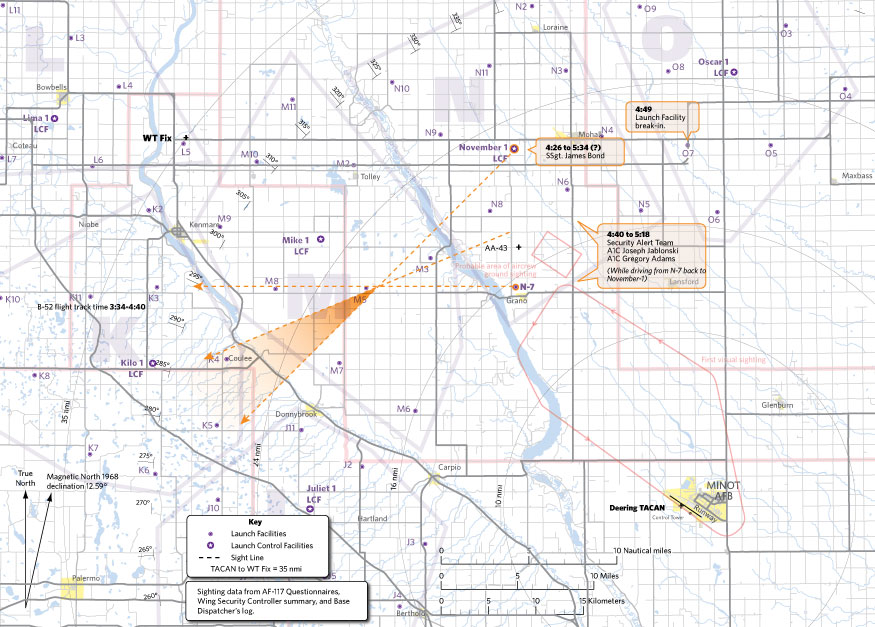
While driving back to N-1 on patrol, Jablonski and Adams continued observing a UFO in the west until their final observation in the west-southwest at 5:18. From N-1, Bond was also reporting a UFO that appeared to land and gradually disappear. In his AF-117, he noted that he observed the UFO for a period of 2 hours and 26 minutes (3:08-5:34).
In his AF-117 report, Jablonski noted:
Our attention was again caught when it appeared approx. 5 miles due west where it remained until it finally disappeared about 15 minutes afterwards.”[140]
And:
Prior to our return to N-1 it caught our attention again, this time WSW in location. It had appeared as before starting bright orange-red, to white and finally green. The object was stationary at the time and appeared approx. 1,000 FT above ground. The green light started to diminish slowly till no longer seen.[141]
Bond appears to confirm this last observation in the southwest, from his position at N-1: “Appeared to land and slowly changed to a dim green, after about 15 minutes it disappeared (gradually).”[142] He also recalled:
When they [Jablonski and Adams] got back to the LCF, we didn’t talk about it that much because everybody had already been talked out. In fact, I think when they came back in, they got out of the vehicle and secured it, came in, I don’t even think they got anything to eat. I think they sat and read, watched the tube, or whatever. They were awful quiet. [143]
Endnotes
[1] Project Blue Book was the official USAF project to investigate UFOs. The USAF UFO program was active from January 1948 until December 1969, and investigated approximately 13,000 UFO reports. Following the closure, the project files were transferred to the Air Force Archives at Maxwell AFB, Montgomery, AL, and later, to the National Archives for redaction and public release in 1976. The files currently reside at the National Archives in College Park, Maryland. See: http://www.archives.gov/research/guide-fed-records/groups/341.html#341.15. The index for the 94 rolls of 35mm microfilm (T1206) of the Project Blue Book files is available from: http://www.minotb52ufo.com/pdf/T1206-PBB-Microfilm-index.pdf.
[2] The UFO observations occurred during the early morning hours from 2:15 until 5:34 a.m. (CDT), for a total period of 3 hours and 19 minutes. Daylight Saving Time ended on Sunday, 27 October . Documentation originating at Wright-Patterson AFB, Dayton, Ohio, is Eastern Daylight Saving Time (EDT, and later EST). For documentation originating at Minot AFB, both CDT (later CST) and Greenwich Mean Time (GMT), or the equivalent letter designator Z (Zulu Time) are used. For Minot, ND, CDT offset from GMT is -5 hours. CST offset is -6 hours. “[3:44]” is a corrected time (for 3:34) based on our reconstruction of the B-52 flight track. See: “Discrepancies and Omissions in the Transcription of Recorded Conversations, 24 October 1968.”
[3] Information and procedures regarding the targeting and alignment of Minuteman ICBMs available from the Association of Air Force Missileers: Part 1; Part 2; and Part 3.
[4] Smith, William, Jr., 2001b. Transcript of interview by Thomas Tulien and Jim Klotz, 25 August (Sign Oral History Project), 14-16. Regarding the Camper Teams, see: 2001b, 8.
[5] Smith, William, Jr., Air Force Form 117 (AF-117), Sighting of Unidentified Phenomena Questionnaire, 26 October 1968, 1, 5. Smith estimated the distance to the object at 10 miles, which suggests the object was 1-2 miles southeast of O-6 (7).
[6] Smith, AF-117, 8.The 91st Strategic Missile Wing, Command Post (later, Missile Support Base), provides logistics support and control communications for the 740th, 741st and 742nd Strategic Missile Squadrons, comprising the 15 Launch Control Centers (each responsible for 10 missiles) at Minot AFB.
[7] Smith, William, Jr., 2001b, 14-16. In addition, November-FSC SSgt. Bond was also informed of the UFO incident at O-6 by his MCCC. “They told me, ‘well, believe it or not, there’s a maintenance crew over there that’s really scared out of their gourds because this thing is right in the area where they are, and they’re trying to do a reprogram on one of the birds that’s in one of the holes over there’—and I thought that a little strange” (2005, 15). Unfortunately, the Camper Team and the Target and Alignment Team did not complete AF-117’s and were not interviewed during the subsequent investigation. Consequently, there is scant mention in the documents. The Camper Team are listed as personnel who sighted the UFO in a document ostensibly created by the 91st Strategic Missile Wing, Security Control controller, however, no time is noted for the observation. During our research, we were unable to properly identify and interview the Camper Team.
[8] Smith 2001b, 10-12. Smith had also been receiving reports of strange lights at O-2, near the Canadian border: “Some of our Camper Crews, and some officers had told us that they had seen lights up at Oscar-2. A lot” (2001b, 22).
[9] O’Connor, Robert M., Air Force Form 117 (AF-117), Sighting of Unidentified Phenomena Questionnaire, 28 October 1968, 1, 7. In this instance, “S.E.” refers to the ordinal direction in relation to their position, and not the direction the object was traveling. O’Connor was an electrician and Field Maintenance Team chief, while Isley was a heating and air conditioning technician responsible for the environmental control systems.
[10] O’Connor, Robert M., 2005. Transcript of interview by Thomas Tulien, 23 February (Sign Oral History Project), 6-7.
[11] Isley, Lloyd M., 2001. Transcript of interview by Thomas Tulien and Jim Klotz, 23 August (Sign Oral History Project), 7-8.
[12] Smith, AF-117, 1, 7; Isley, AF-117, 1; and O’Connor, AF-117, 1.
[13] O’Connor, AF-117, 3; and O’Connor 2005, 6-7. This is also suggestive of a parallax effect: the apparent shift of an object against a background due to a change in observer position.
[14] Isley 2001, 6-8.; and O’Connor 2005, 7.
[15] O’Connor 2005, 11. In addition, ISLEY: “We were both pretty much wide-eyed and a little bit, you know, a little bit frightened by being out in the middle of nowhere like that” (2001, 6).
[16] Isley, Lloyd M., Air Force Form 117 (AF-117), Sighting of Unidentified Phenomena Questionnaire, 28 October 1968, 7, 9. Also: Isley 2001, 8-9. In his AF-117, Isley notes the sighting time as 12:30 until 4:30 a.m., and the length of time the phenomenon was in sight as “3 ½ to 4 hours” based on “the length of time we were on N-7” (1, 3). Isley’s sighting time is inaccurate by 2 hours. In addition, the observation time at N-7 is too long and would be about one hour (3:00-4:02). The total length of time the phenomenon was in sight would be 2:30-4:02. For a discussion of this with Isley, see: Isley 2001, 10-11.
[17] Isley, AF-117, 1, 4, 6. Also: Isley 2001, 9, 13, 17-18. The KC-135 Stratotanker is an air-to-air refueling tanker aircraft similar in appearance to a Boeing 707: Length: 136’ 3” (41.53 m); Height: 38’ 4” (12.70 m); Wingspan: 130’ 10” (39.88 m).
[18] O’Connor, AF-117, 4, 6. Also: O’Connor 2005, 8-9. Note: Both O’Connor and Isley recall completing the AF-117 later that same morning in Base Operations, although the AF-117’s state 28 Oct. 68 as the date when the form was completed (AF-117, 8). For a discussion of this with O’Connor, see: O’Connor 2005, 15-16; and Isley 2001, 15, 17.
[19] O’Connor 2005, 7-8. 400 yards is about a quarter mile. In his AF-117, he estimated the distance to the phenomenon as “½ to 6 miles,” and noted: “The noise I heard was similar to that of a jet engine only more steady and at a lower pitch” (7).
[20] Note: Minot AFB investigating officer, Col. Werlich, has misconstrued the initial reporting sequence in the Basic Reporting Data and Format [TWX], 290428Z OCT 68, 5. (The equivalent date of the Teletype is 28 October, 10:28 p.m. CST). Werlich states that O’Connor reported to the “WING SECURITY CONTROLLER OVER THE VEHICLE RADIO,” however, O'Connor reported to Base Operations and later to November-FSC SSgt. Bond, who subsequently reported to Wing Security Control at 3:08. The general provisions of Department of the Air Force. Research and Development. Air Force Regulation No. 80-17, Unidentified Flying Objects (UFO), 19 September 1966. Washington, D.C., required each Air Force base commander to provide an investigative capability (#3). In this regard, Minot AFB commander Col. Ralph E. Kirchoff designated Base Operations chief Lt. Col. Arthur Werlich as investigating officer to the UFO program. Werlich’s primary responsibility was to collect and collate a list of Basic Reporting Data and Format (#11), and to provide his “initial analysis and comment on the possible cause or identity of the stimulus in a supporting statement” (#10). The analysis section comprises the last four pages of the 8-page report. This was Werlich’s first official UFO investigation: “Col Werlich said this was his first report and didn’t know how to ask questions or anything” (Memo, 1 Nov. 68a, 7). AFR 80-17 with changes and attachment is also available from: http://files.ncas.org/condon/text/appndx-b.htm.
[21] Base Operations Dispatcher’s log, 24 October 1968, 0800. Object S/E of N-7, 0800.
[22] O’Connor 2005, 7, 10-11; and O’Connor, AF-117, 8. In addition: Isley 2001, 8-9; and Isley, AF-117, 8. For a brief description of SSgt. Bond’s workstation in the LCF, authorization procedures, and the use of code packs, see: Bond 2005, 9-10. Also, SSgt. Smith explains the routine of a Flight Security Controller, see: Smith 2001, 4-9. Regarding the “two-man rule,” Bond recalls: “What you have to remember about nuclear weapons, there always [has to] be two of everything. SAC two-man policy is what they called it; and believe it or not, I can still recite this: ‘Any time a completed nuclear weapon, a disassembled nuclear weapon, or a nuclear component is not in complete secure storage, not less than two authorized persons each capable of detecting incorrect procedures with respect to the task being performed, will be allowed physical presence of the weapon.’ You had better know that policy. It was to keep one person from doing something the other didn’t know anything about” (2005, 12). The Launch (Soft) Support Building housed electrical distribution equipment, a back-up generator, and brine chiller to maintain temperature and humidity-controlled air for the launch equipment in the silo. Bruce Ecker’s spherical panoramic image of a 1963 Launch Support Building at Ellsworth, AFB is available from: http://nonplused.org/panos/minuteman/html/delta09_support.html.
[23] Jablonski, Joseph, 2005. Transcript of interview by Thomas Tulien, 22 February (Sign Oral History Project), 9-10. And: Jablonski, Joseph P., Air Force Form 117 (AF-117), Sighting of Unidentified Phenomena Questionnaire, 25 October 1968, 1, 5. See also: Adams, Gregory, Air Force Form 117 (AF-117), Sighting of Unidentified Phenomena Questionnaire, 25 October 1968, 1, 5; and Bond, James F., Air Force Form 117 (AF-117), Sighting of Unidentified Phenomena Questionnaire, 26 October 1968, 1, 5.
[24] Bond, AF-117, 8.
[25] Basic Reporting Data, 5. The 91st Strategic Missile Wing, Command Post (later, Missile Support Base), provides logistics support and control communications for the 740th, 741st and 742nd Strategic Missile Squadrons, comprising the 15 Launch Control Centers at Minot AFB. Three Squadron Command Post (SCP) LCCs, serve as command units for their respective squadrons, and report directly to the Wing Command Post. One SCP is also designated as the Alternate Command Post (ACP), and serves as backup for the Wing Command Post. The other 12 LCCs are classified as primary LCCs. The four primary LCCs within each squadron report to their respective command post (SCP).
[26] Wing Security Controller’s summary, n.d., On 24 Oct 68 the following personnel. Note: The 3:08 time of the “initial report from a maintenance team” is actually when Bond and his SAT first observed the UFO.
[27] O’Connor, AF-117, 3, 7; and O’Connor, 2005, 8, 19.
[28] Isley, AF-117, 1, 9.
[29] Isley 2001, 9, 13. The Dispatchers log notes at 3:28: “Jet engines heard now very clearly,” and at 3:30,“could hear engines” (0828, 0830). Werlich states: “WHEN ALMOST OVERHEAD, A LOW MUFFLED JET ENGINE SOUND WAS HEARD. THIS OCCURRED TWICE DURING THE SIGHTINGS” ( Basic Reporting Data, 2). Later, as a B-52 passed by the observers at N-7, Jablonski noted, “As to avoid confusion between the plane and the object Base Op’s had pointed out where and when we saw the B-52. Must add that the B-52 engines could be easily heard while the UFO made no sounds to be heard at about the same distance” (AF-117, 7).
[31] Adams, AF-117, 4.
[32] Jablonski 2005, 11-13. Bond’s recall of radio conversations with the SAT while on the road, at: Bond 2005, 16-17. Jablonski recalls that Adams was extremely anxious about the situation, and in an attempt to put him at ease, he teasingly alluded to the then-popular TV show The Invaders (2005, 16-18).
[33] Wing Security Controller summary, 1. See also: Smith 2005, 17.
[34] O’Connor, AF-117, 4; and Isley, AF-117, 4.
[35] Base Operations Dispatcher’s log, 0828.
[36] Bond, AF-117, 4.
[37] Basic Reporting Data, 8. Security personnel at Mike-1, Juliet-1, and the Oscar-Security Alert Team of A1C Bajgiar and A1C Vennedall, did not complete AF-117s.
[38] Transcription of Recorded Conversations, Transcript of tape for 24 Oct 68, 0830. The source and actual time of this UFO report received by RAPCON is unknown. See also: Discrepancies and Omissions in the Transcription (3:30-3:35 (0830-0835Z)).
[39] Jablonski recalls that shortly after observing the object at 3:08 they were dispatched to N-7, estimating a drive time of “maybe 15-20 minutes” (2005, 10).
[40] Jablonski 2005, 9-11, 17. Also, Bond: “I remember the combat crew said something about the maintenance team getting a little flaky out there and they might need some help from security, because they were getting a little scared” (2005, 21).
[41] Jablonski, AF-117, 3, 4; and Adams, AF-117, 3, 4.
[42] Jablonski 2005, 10. In his AF-117, Jablonski noted that a match held at arm’s length would cover about one half of the object (6). At estimates of 3-5 miles (7) the object size would be 197-330 feet. Adams noted that one third of the object would be covered (6). At estimates of 2-5 miles (7) the object size would be 212-530 feet. Bond noted that a match head would be covered (6). At estimates of 10-12 miles (7) the object size would be 350-420 feet. Isley compared its size to a KC-135 Stratotanker aircraft.
[43] Jablonski 2005, 11-12. Unfortunately, the Transcription of Recorded Conversations begins at 3:34 [3:44], when the B-52 is over the runway. However, the first entry at 3:30 notes, “Controllers received information on UFO 24 miles NW.” This location is in Mike-Flight about 7 miles west-northwest of the observers at N-7, who were reporting a UFO in the southeast.
[45] In his AF-117, Isley notes the length of time of the observations as 00:30-4:30 (“by the length of time we were on N-7”), which is clearly inaccurate; and estimates the distance to the UFO as 2 miles (1, 3, 7). There is no data in Bond’s AF-117 to indicate when the N-7 personnel last observed the UFO in the SE. He estimated the distance to N-7 as approximately 10 miles and the distance to the UFO as 10-12 miles (1, 7).
[46] O’Connor 2005, 7, 10, 23. Also: Smith 2001, 12-13; Bond 2005, 15; and Isley 2001, 6, 8.
[48] Smith 2001, 11-13. See also: Bond 2005, 17-18. Smith recalls that his capsule crew contacted Air Defense Command (redesignated Aerospace Defense Command on 15 Jan. 1968) at Minot Air Force Station, located about 15 miles south of Minot, ND: “And so when the [B-52] crew did that my Capsule [Crew] also were excited, really excited, so one of them I think had an idea that they might call Air Defense Command, I think he had some connections or knew some people there or something. And from what he was saying to us they were able to use some radar manipulations, and they were able to see something operating they said 50 miles above where we were in the general vicinity—they couldn’t pinpoint it but they said—50 miles above” (2001, 13). Regarding Minot AFS, see: http://www.radomes.org/museum/showsite.php?site=Minot+AFS,+ND.
[49] 3:34 [3:44] is the beginning of the communications between Minot, Radar Approach Control (RAPCON) and the B-52 pilots, when the B-52 is on low-approach over the runway (Transcription, 0834). 4:02 is when the UFO disappeared from the B-52 radarscope and the B-52 radio transmission resumed (Transcription, 0902). 4:06:51 (9:06:51Z) is the B-52 radarscope chronometer time of the last radarscope photograph (when the UFO disappeared). Regarding discrepancies in the transcription, and the B-52 onboard time, see: “Discrepancies and Omissions in the Transcription of Recorded Conversations, 24 October 1968.”
[50] Regarding the SAC B-52 mission, see; Runyon, Bradford, Jr., 2005. Transcript of interview by Thomas Tulien, 25 February (Sign Oral History Project), 4-8. When not on alert status, the B-52 crews routinely flew ten-hour Combat Crew training missions over the continental U.S., involving: airborne refueling, navigational legs, simulated bombing runs, low-level flying, and overall crew proficiency exercises to maintain ratings. Regarding this particular mission, there was an additional pilot onboard from another B-52 crew, Major James Partin, being evaluated by the Aircraft Commander and Instructor Pilot (IP) Captain Don Cagle. This B-52 crew was certified an S-crew (Standards and Evaluation Board, or STANEVAL, and Stanboard), and all crewmembers were rated instructors in their respective positions. As one of the top crews, they were also responsible for instructing and evaluating other crews. See also: Goduto, Thomas, 2001. Transcript of interview by Thomas Tulien, 20 February (Sign Oral History Project), 4-7; and Judd, Arlie, 2001. Transcript of interview by Thomas Tulien, 27 February (Sign Oral History Project), 7-8.
[51] Project Blue Book was the official USAF project to investigate UFOs. The USAF UFO program was active from January 1948 until December 1969, and investigated approximately 13,000 UFO reports. Following the closure, the project files were transferred to the Air Force Archives at Maxwell AFB, Montgomery, AL, and later, to the National Archives for redaction and public release in 1976. The files currently reside at the National Archives in College Park, Maryland. See: Records of Headquarters United States Air Force (Air Staff); Records of Project Blue Book 1947-69, Record Group 341.15 (NARA Microfilm Publication T1206); National Archives at College Park, College Park, MD. The records are available on line from: BlueBookArchive.org; and Footnote.com.
[52] Basic Reporting Data, 5. Werlich notes the time of the ground sightings as beginning at “0800Z (0300 CDT) UNTIL APPROXIMATELY 1015Z (CDT 0515)” (2). The Air Route Traffic Control Center would have handed off the B-52 to Minot AFB RAPCON when it arrived at the 50 nmi clearance, which, according to Werlich, was at 3:00: “THE AIRCRAFT INITIALLY ARRIVED . . . AT ALMOST THE SAME TIME AS THE FIRST GROUND SIGHTING.” In fact, the “FIRST GROUND SIGHTING” preceded the arrival of the B-52 by 45 minutes. The Transcription of Recorded Conversations begins when the B-52 is on low-approach over the runway heading northwest at 3:34 [3:44], and affords no clue to the location of the B-52 for the first 34 [44] minutes. It seems most likely the B-52 remained east of the base practicing high-altitude maneuvers, and would be located high in the southeast before its descent (penetration) from FL200 to a low-approach over the runway at 3:34 [3:44]. Regarding “VARIOUS INSTRUMENT PRACTICE MANEUVERS,” Runyon recalls: “At higher altitude, like for the vertical S’s we might have gotten a block from 20 to 30; or 30 to 40,000 feet for that. . . . [So nobody could even see you up there.] No. [You don’t have your landing lights on?] No, no way, and we were probably not over our base anyway—were out in the middle of nowhere” (2005, 8).
[53] McCaslin, Patrick D., 2001. Transcript of interview by Thomas Tulien, 25 February (Sign Oral History Project), 11. See also: Runyon 2005, 8-9; and McCaslin, Patrick D., 2000. Transcript of interview with Jim Klotz, 11 November (Sign Oral History Project), 5.
[54] (A) 0255 CDT - RADAR 11,000 FEET BROKEN, 2100 FEET OVERCAST, VISIBILITY 25 STATUTE MILES, TEMPERATURE 32, DEW POINT 28, WIND 160 DEGREES. 3 KNOTS, ALTIMETER SETTING 30.14 INCHES, RADAR CLOUD TOPS, BROKEN 19,200 FEET AND OVERCAST 27,700 FEET (Basic Reporting Data, 3-4).
[56] Transcription, 0834. The transcription is time-coded to GMT (-5 hours CDT). In aviation, distances are expressed in nautical miles (1 nmi, US = 1.151 statute mile, or 1852 meters exactly. Conversely, 1 statute mile equals .8689 nmi. The derived unit of speed is the knot, defined as one nautical mile per hour). Tactical Air Navigation (TACAN) system is an ultra-high frequency electronic navigational aid that provides military aircraft with a continuous indication of bearing (azimuth angle) and distance (range) to a TACAN station. At Minot AFB, distances are relative to/from the Deering TACAN transmitter station (ground-to-aircraft beacon), located adjacent to the runway at 37% of the length from the northwest end. The “WT fix” is a virtual point 35 nmi from the TACAN transmitter in line (approach) with the runway, from which the B-52 begins its descent from FL200 and “penetration” of the Minot airspace. Additional technical information on TACAN systems from: http://www.globalsecurity.org/military/library/policy/navy/nrtc/14090_ch2.pdf.
[57] Basic Reporting Data, 5. The runway at Minot AFB is designated runway “11/29” depending on the magnetic heading to the runway of azimuth 110/290 degrees (southeast/northwest). Flight Level (FL) is the nominal altitude of an aircraft referenced to a standard pressure datum, as opposed to the real altitude above mean sea level. Above 18,000 feet, FL is expressed in rounds of hundreds; for example, FL200 is a flight level altitude of 20,000 feet. “VOR,” short for: VHF Omni-directional Radio Range, became the primary navigational system in the 1960s. In this instance and elsewhere, VOR is used generically in reference to the more sophisticated TACAN system used by military aircraft. Aircraft altitudes are Mean Sea Level (MSL), whereby an aircraft’s altitude is measured relative to an average (mean) sea level, rather than the local terrain it is flying over.
[58] Regarding initial time discrepancies from 0830-0845 (3:30-3:35), see: “Discrepancies and Omissions in the Transcription of Recorded Conversations, 24 October 1968.”
[59] The Transcription actually continues past 0915 (4:15), although following 0921 (4:21) the remaining time-code references are omitted. Regarding the initial time references, see: “Discrepancies and Omissions in the Transcription of Recorded Conversations, 24 October 1968.”
[60] Transcription, 0830-0835. The second statement in the transcription at 3:34 [3:44] appears erroneous: “A B-52 on a TA calibration check to rw [runway] 11 [110-degrees heading southeast] requested clearance to WT at FL200.” Conversely, also at 3:34 [3:44], the first communication between Runyon and controller indicates the B-52 is actually on low approach over runway 29 [290-degrees heading northwest]. The acronym “TA” is unknown. It may refer to transition altitude, or Terrain Avoidance System, which provides an aircraft with a situation display of the ground and obstacles so that the pilot can maneuver the aircraft to avoid the obstruction.
[61] See: Runyon 2005, 7.
[62] Don Cagle arrived at the appointment, was hired by Delta, and after thirteen years of military service resigned his commission in January 1969. Cagle was an instructor and evaluation pilot at Delta, before moving to management as Chief Pilot of the International Base after they took over the assets of Pan-Am. He retired from Delta in 1997. During several recent interviews he claims to have no recollection whatsoever of the UFO events. See also: Runyon 2000, 8-9; Runyon 2005, 18; and McCaslin 2001, 27-28.
[63] Werlich notes in the Basic Reporting Data: “THE B-52 AIRCRAFT, OPERATING IN THE LOCAL AREA, REPORTED A HEAVY HAZE CONDITION AT FL200 DOWN TO 10,000 FEET” (4). Also: “(A) 0255 CDT - RADAR 11,000 FEET BROKEN, 2100 FEET OVERCAST, VISIBILITY 25 STATUTE MILES… RADAR CLOUD TOPS, BROKEN 19,200 FEET AND OVERCAST 27,700 FEET. (B) 0355 CDT- RADAR 9,000 FEET OVERCAST, VISIBILITY 25 STATUE MILES, TEMPERATURE 32, DEW POINT 29, WIND 160 DEGREES 4 KNOTS ALTIMETER SETTING 20.12 INCHES, RADAR CLOUD TOPS, OVERCAST 24,700 FEET (C) 0455 CDT–RADAR 10,000 FEET OVERCAST” (3-4).
[64] Transcription, 0852. See also: Runyon 2005, 10; and Runyon 2000, 7.
[65] McCaslin 2000, 6; and McCaslin 2001, 12-13. The Radar Navigator was also responsible for the B-52H’s AN/ASQ-38 Bomb Navigation System. For a description of the B-52 navigation station, see: McCaslin 2001, 8-9. Also: Goduto 2001, 8.
[66] McCaslin 2001, 14; and Goduto 2001, 7.
[67] McCaslin 2001, 15. McCaslin 2000, 6-7. “POSITION OF AIRCRAFT DURING AIR-ELECTRONIC OBSERVATION: INITIAL SIGHTING POSITION WAS 38 NAUTICAL MILES NW OF THE DEERING TACAN, 300 DEGREES RADIAL, FL200” (Basic Reporting Data, 3). At this time, Electronic Warfare Officer (EWO) Captain Thomas Goduto powered his receiver equipment back up, but he “could not substantiate anything on my equipment that was unusual”(Goduto 2001, 12-14). Also, Gunner Tech Sergeant Arlie Judd recalls at some point during the radar encounter he observed a large return on his rear-facing ASG-21 “fire control radar” for a 5 or 10 second duration, first at 1,000 yards, and then at 12,000 yards before it disappeared (Judd 2001, 11-14). Later, at a debriefing in the Division Commanders office, Judd brought up the returns: “I mentioned my radar returns. That was my confirmation of what somebody else had seen. I said, ‘Well it was also on my radar.’ But there wasn’t any follow through” (2001, 21-22).
[68] McCaslin 2001, 44. McCaslin recalls, “At that point where I saw something out there, I asked him to turn on the cameras” (2000, 9); and the duration of filming was “10-15 minutes worth of stuff” (2001, 36). The radarscope is a 10-inch circular tube face with illuminated bearing ring, technically referred to as the Plan Position Indicator (PPI). The data plate is superimposed as a snapshot via a separate optical path. Note: The 14-8X10 first-generation photographic prints of the B-52 radarscope are the original versions of the 13 low-quality (microfilmed) radarscope photographs included in the NARA Blue Book documentation. The photos ostensibly show the movements of the UFO in relation to the aircraft near the end of the air-radar encounter, as it spiraled around the B-52 from the front right to a position about 1 nmi off the left wing.
[69] McCaslin 2001, 16-17; and McCaslin 2000, 7.
[70] Transcription, 0856. “Wilco” is the established standard for—will comply (after receiving new directions); “Roger”—information received; “Copy”—I understand what you just said (after receiving information).
[71] Approach procedures, see: Goduto 2001, 17. For a detailed explanation of Instrument Approach Procedure (IAP), see: http://www.flightsimaviation.com/aviation_theory_15_Instrument_Approach_Procedures_part_1.html. The current Minot AFB airport diagram, and IAPs, or “approach plates,” are accessible online (near the bottom of the page) at: http://www.airnav.com/airport/KMIB. Based on Werlich’s overlay map, the diameter of the 30/180-degree turn is 5.5 nmi, and the circumference equals 17.25 nmi. Including the short final leg before passing over the WT, the distance is 19 nmi. At a speed of 280-230 knots, the flight time would be 4:00-5:00 minutes. Therefore, if the position of the B-52 at 3:52 was 19 nmi before the WT, it would have passed over the WT at 3:56-3:57. Also, in the Transcription, Runyon indicates (at 0904) that they were 35 nmi out, and passing over the WT at the time of the loss of radio transmission at 0858 (3:58 CDT).
[73] Runyon 2005, 10-11; and Runyon 2000, 6-8. Also: Partin, James 2001. Transcript of interview by Jim Klotz, 20 January (Sign Oral History Project), 2-3.
[74] McCaslin 2001, 19-20; and McCaslin 2000, 7. See also: Memo for the Record, 24 October 1968, Subject: UFO Observation, 1; and Basic Reporting Data, 6.
[75] Runyon 2005, 10; and Runyon 2000, 6-8. For a discussion of the B-52’s radios, see: Goduto 2001, 11-12.
[76] Transcription, 0903-0904.
[77] SIF/IFF is an acronym for Selective Identification Feature/Identification-Friend-or-Foe, which refers to onboard radio equipment with electronic coders, and decoders, which in conjunction with similar ground-based equipment, can be interrogated and respond automatically to identify themselves.
[78] Transcription, 0858-0900.
[79] Runyon 2005, 11; and Runyon 2000, 11. Also: “When target was close to the B-52 neither of the two transmitters in the B-52 would operate properly but when it broke off both returned to normal” (Memo, 24 Oct. 68, 1). Also: Goduto 2001, 11-12, 15.
[80] Runyon 2005, 12. Also, researcher Jim Klotz obtained the releasable portions of the B-52H Aircraft Mishap Report, 4 Oct 68 (HQ AFSC/JAR). Included are a Transcription of Recorded Conversations with Minneapolis and Great Falls Air Route Traffic Control Centers (ARTCC), covering a period of time from 0256-0852Z; and Aircraft Accident Transcription-Minot Approach Control, covering a period from 0842-0907Z.
[81] Basic Reporting Data, 3. Note: Dr. Claude Poher’s analysis of the radarscope photos resolves the location of the last radarscope photo (when the UFO departed the B-52) at 18.8 nmi from the Deering TACAN, 8865 feet MSL. See: Claude Poher, “3.4. Refining the B-52 Position With Terrain Features,” in Analysis of Radar and Air-Visual UFO Observations on 24 October 1968 at Minot Air Force Base, ND (2005). Resolving the B-52 altitude in photo #783, see: Poher, “4.7. Discussion 1: The B-52 Altitude and the Tilt-up Angle of the Radar Antenna.”
[82] McCaslin 2001, 21-24; and McCaslin 2000, 7-8. Also: Goduto 2001, 16.
[83] Transcription, 0902-0904.
[84] At the time, the Blue Book staff consisted of Quintanilla, assistant Lt. Marano, secretary Marilyn Stancombe, and duty officer, SSgt. Harold Jones. Quintanilla had been project officer since July/Aug. 1963, and Marano since Sept. 1968. See: Quintanilla’s quixotic unpublished manuscript, UFO’s: An Air Force Dilemma, esp. chapter, “The Making of a UFO Investigating Officer” (34). Referring to Werlich’s initial report, on 29 Oct. Quintanilla informed Col. Pullen, HQ SAC that due to limitations in staffing, “we did not send anyone up [to Minot]. I talked to Col Werlich for over thirty minutes and since this didn’t appear to [sic] unusual I didn’t send anyone up.” Memo for the Record, 30 October 1968a, Subj: Telephone conversation with Col Pullen, 1.
[85] Apparently, it was a long day since the time of the call was 1730 (5:30 p.m. EDT), and both of Werlich’s surviving daughters recall being awoken very early in the morning (“in the middle of the night”) by a telephone call reporting the UFO incident to their father. See: Werlich, Kim 2001, 3, 6; and Werlich, Melody 2001, 9. That afternoon, Werlich had phoned SAC Headquarters requesting technical assistance with his investigation, but was denied: “Thursday afternoon I (Col Werlich) called, with the personal opinion that we needed technical assistance at that time and that is what we requested and we didn’t get it and we have tried to do what we could. Gen Hollingsworth is interested” (Memo, 1 Nov. 68a, 4). Also: “Col Werlich said we were hoping for technical assistance and we didn’t get it” (Memo, 1 Nov. 68a, 6-7).
[86] Major General Edward M. Nichols, Jr. was vice commander of the Fifteenth Air Force, March AFB, CA, one of the Strategic Air Command’s three numbered Air Force command units, with jurisdiction over SAC bases in the Midwest region. See Air Force Link biographies at: http://www.af.mil/information/bios/bio.asp?bioID=6604. The Numbered Air Force (NAF) is a tactical echelon directly under an operational Major Command (MAJCOM; in this case, Strategic Air Command) that provide operational leadership and supervision.
[87] Memo for the Record, 24 October 1968, Subject: UFO Observation, 1.
[89] Smith 2001, 17-20, 12-13.
[91] O’Connor, AF-117, 3. Isley: “A B-52 was in the same area as the object, just before the object left our view” (AF-117, 3). Adams: “B-52 bomber heard approximately 45 minutes after seeing UFO [at 3:08]. B-52 west and much higher than UFO” (AF-117, 3). Also: O’Connor 2005, 11-13; Isley 2001, 12-13; and Jablonski 2005, 13.
[92] Jablonski, AF-117, 7. In addition: “B-52 diverted to general area. First seen and heard approx 35 min. after first sighting of object [at 3:08]. Object basically stayed in the southeast, while the B-52 was in the southwesterly position” (Jablonski, AF-117, 3). At N-7, Jablonski’s impression of the distance to the UFO was estimated at 3-5 miles in the south-southeast (AF-117, 2, 7), while the shortest distance to the B-52 flight track was about 5 miles to the southwest. At the time of the last radarscope photo (783), Poher’s analysis locates the B-52 about 6.5 miles west-southwest of N-7 at 8865 feet altitude. See: “3.4. Refining the B-52 Position With Terrain Features.”
[93] Jablonski, AF-117, 5, 9. Also, Adams: “Right before the B-52 was seen. The UFO descended gradually behind what could have been trees. Hard to say about trees it was so dark” (AF-117, 5). Also, Isley: “It [UFO] went low and out of sight in the southeast” (AF-117, 5).
[94] “(B) 0355 CDT—RADAR 9,000 FEET OVERCAST, VISIBILITY 25 STATUTE MILES” (Basic Reporting Data, 4).
[95] “[4:24-4:28]” is based on our reconstruction of the B-52 flight track. In his AF-117, Partin noted the period of the air-visual observation as “4:30-4:35” based on the pilot’s chronometer (B-52 onboard time).
[96] Jablonski 2005, 15; O’Connor 2005, 13-14; and Isley 2001, 12.
[97] Transcription, 0904-0909. A “precision approach” is an approach in which the controllers monitor dedicated radar displays to determine the precise heading and altitude of the aircraft. The controllers then provide corrections right and left, and/or above and below a predetermined glide path to the runway. During a “surveillance approach” the controller only provides heading corrections, and it's up to the pilots to determine their own rate of descent.
[98] Transcription, 0913.
[99] Transcription, 0917. The final approach fix (FAF) is the point in space where the “final approach” to landing begins, and is indicated when the aircraft crosses the outer marker. At Minot AFB, FAF is 6.3 nmi from the Deering TACAN.
[100] Runyon does not recall the name of the General. The only exterior photographic capability was the Bombay camera. However, the camera would only be loaded with film during combat missions. Runyon: “He told us to go back and fly over the object and I really don’t remember whether we had film in our Bombay cameras, but we were supposed to over fly the thing and observe it and take pictures if we could. So I never discussed with the nav team whether they were able to take Bombay pictures or not” (2000, 11, 24-25). Regarding the Bombay camera, see: Judd 2001, 18-19.
[101] Runyon 2005, 14-15. Also: Runyon 2000, 11, 23. At the time, the only General stationed at Minot AFB was the commander of the 810th Strategic Aerospace Division (SAD), Brig. General Ralph Holland(though to be precise, he was officially promoted on 1 November 1968). In recent interviews with Holland, it was determined that he was not the General that ordered the B-52 to over fly the UFO. See: Holland, Ralph T., 2005. Transcript of interview by Thomas Tulien and Jim Klotz, 20 February (Sign Oral History Project). A reasonable guess would be Holland’s superior, Maj. General Edward M. Nichols, Jr. Vice Commander of the Fifteenth Air Force. Runyon recalls the request came from a two-star general, and Werlich states in his initial 24 October report to Blue Book staff “the Base Commander and Major General Nichols of the 15th Air Force were both interested” (Memo, 24 Oct. 68, 1). The Fifteenth Air Force, based at March AFB, California, was a level of command under Strategic Air Command, responsible for operations in the western United States and Alaska. Under the command of the Fifteenth at Minot AFB were the 810th SAD, the 91st SMW, and 5th BW. In addition, the B-52 EWO, Capt. Goduto was responsible for the HF radio used to communicate with SAC headquarters over extreme distances, especially when over the Polar Regions. Goduto did not receive the call since his equipment was powered down in preparation for landing (2001, 14, 19).
[102] McCaslin 2000, 22-23. Also: McCaslin 2000, 7-8. See also: Goduto 2001, 19; and Judd 2001, 17.
[103] McCaslin 2000, 22; and McCaslin 2001, 22-24.
[104] Wing Security Controller summary, 1. 862nd CES, Minot AFB. Off-Base Disaster Control Grid Map [map]. 1:250,000. Minot AFB, North Dakota: 9 Nov. 1965. (Courtesy of Jim Klotz). This notation by the Wing Security controller appears to indicate that they also knew the location of the UFO on the ground, or were privy to communications with RAPCON at the time.
[105] Later, in the Basic Reporting Data, Werlich notes: “Visual sighting data: 3200 feet MSL, 335 degrees MH [magnetic heading], approximately 180 IAS.” In addition: “Position of aircraft during visual sighting: 14 nautical miles 320 radial of the Deering TACAN at 3200 feet MSL” (2, 3). For Minot AFB, 24 Oct. 68: Declination = 12° 59' E changing by 0° 2' W/year. Calculated at: http://www.ngdc.noaa.gov/geomagmodels/struts/calcDeclination.
[106] Transcription, 0913-0921. IFR (Instrument Flight Rules) is a set of regulations and procedures whereby navigation is maintained with reference to aircraft instruments. A “surveillance approach” is a “non-precision approach” in which only azimuth is provided to keep the aircraft on the runway centerline as viewed on radar.
[107] Transcription, 0921[+]. The runway length is 13,200 feet, or 2.5 miles long.
[108] Runyon 2005, 14-15. Also: Runyon 2000, 12.
[109] Partin, James, Air Force Form 117 (AF-117), Sighting of Unidentified Phenomena Questionnaire, 30 October 1968, 1, 3. Regarding discrepancies in the B-52 onboard time, see: Discrepancies and Omissions in the Transcription of Recorded Conversations, 24 October 1968. Note: the ‘first visual sighting” location is actually north of Minot AFB.
[110] Partin, AF-117, 1, 2, 5, 7.
[111] Partin, AF-117, 4.
[112] Partin 2001, 2-3. Partin’s recall that he changed seats with the co-pilot is incongruous. It is improbable that he would unstrap and change positions with the co-pilot, particularly while piloting the B-52 at low altitude. Runyon also rejects the possibility insisting that he remained in the right seat during the entire flight.
[113] Basic Reporting Data, 7. Partin was also an instructor pilot, but during this flight was being evaluated to maintain pilot ratings by Capt. Cagle. When he first observed the object he was turning onto a heading of 290 degrees [not 335], and piloting the B-52 from the left seat [not the right seat]. Also, he reported, “I turned onto the base leg about one mile [not within approximately two miles] to the south of the light and was above it” (AF-117, 4). It is not clear how Werlich obtained his information, since Partin did not complete the AF-117 questionnaire until 30 October, nearly two days after Werlich had transmitted the Basic Reporting Data (AF-117, 8). RAPCON stated, “JAG 31 (garbled) requests that somebody from your aircraft stop in at basops after you land.” [Perhaps “(garbled)” identified the requestor?]. Partin was the senior officer and attended the debriefing, which may have been the source, or second-hand source of Werlich’s information.
[115] Runyon 2005, 15-16. Also: Runyon 2000, 12-14.
[117] The body of the object is described as: egg-shaped (Runyon), football-shaped (Goduto), cough drop-shaped, and elliptically-shaped (McCaslin), and oblong (Partin), possibly watermelon-shaped, which could be defined as a prolate ellipsoid, generated by revolving an ellipse about its major axis with the polar diameter greater than the equatorial diameter.
[119] Runyon 2000, 12, 14; and Runyon 2005, 18.
[120] McCaslin 2000, 12-13. Also: “At that briefing it was described as an orangish, elliptically-shaped object—not perfectly circular, but elliptically-shaped, with kind of a halo—a boomerang-shaped exhaust, if you will, of the same color, slightly separated from the elliptical shape. I didn’t see it, so I just go with what the pilot said, but that’s what I was told. And that’s my memory of what General Holland was told” (McCaslin 2001, 30). Goduto recalls, “Brad’s description that came over intercom was it was kind of a reddish, orangish football shape” (2001, 19-22).
[121] McCaslin 2001, 23-24. Partin recalls: “When I described to the crew over the interphone what I was seeing, the Navigator, the Radar-Navigator, and everybody tried to get up in our lap in the cockpit and—(laughs)” (2001, 4).
[122] Transcription, 0921[+]-0928. In his AF-117, Partin notes: “I turned onto the base leg about one mile South of the light and was above it” (4). After 0921, the time-code is absent and the final 0928 is erroneous. It appears as though the communications transcript was cut-and-pasted, or edited to include only procedural instructions, in which case the associated time references were problematic and simply excluded. It is unknown who actually transcribed the RAPCON tapes. Werlich informed the Blue Book staff: “Anyway, I’m sending the RAPCON TAPES” (Memo, 1 Nov. 68, 4). The reader may want to compare this transcription with the Transcriptions included in the B-52H Aircraft Mishap Report, 4 Oct 68, HQ AFSC/JAR. Claude Poher also reconstructed the timing and pattern of the final circuit. See: Poher, Appendix 1, Timing of the B-52 Approach Trajectory and Setting of the Radarscope Clock. Note: Poher based his reconstruction on the B-52 clearing the WT fix and departing FL200 at 3:54, whereas our reconstruction is based on 3:58.
[123] B-52 EWO Capt. Thomas Goduto: “Events that happened from landing to getting home we did again and again, and they’re always the same. You’d taxi in, park the airplane, unload the airplane, get on the bus, you’d go through the 781 and write up discrepancies, finish off paperwork—flight paperwork. [By discrepancies you mean equipment malfunctions?] Malfunctions. We had to go to maintenance debriefing. It was a formal debriefing. Each aircraft specialty—engines, radar, electronic countermeasures, gunnery, hydraulics, electrical—those maintenance people would all be there and then we as a crew would go in and we’d sit pilot, co-pilot, radar nav, nav, EW, gunner, and they would read our write-ups, and then if there was a question understanding what the write-up meant, we would verbally communicate. Once it was all understood, they’d go work on the airplane, or make work orders to work on the airplane, and we would pack up our stuff and go back out on the bus. As electronic warfare officer, one of my crew responsibilities was taking care of all the classified material that we had. I had to go into the wing headquarters—not necessarily the command post, but another area so that I could deposit the classified communications information and crew materials that we would normally carry. Normally the pilots would go to the command post and drop off the mission paperwork, and I would go and take care of the classified material. I don’t know how quick you think this all happens, but from landing time; taxi time; bus time; prepare to go into debriefing; have a beer; get into maintenance debriefing; get back on the bus; get back to the wing headquarters; and be done so you can walk out to your cars—probably beyond an hour, maybe an hour and a half” (2001, 22-23).
[124] McCaslin: “Ordinarily they’d just wait for us to hand them in. We were met when we walked into the building by people wanting the film… they were not waiting for us to come to them, in this case” (2001, 43).
[126] O’Connor 2005, 13-14; Isley 2001, 12; and Jablonski 2005, 15.
[127] “In order to access the missile silo, maintenance crews had to pass through "formidable mechanical barriers" in a process that often took up to an hour. First, a weather cover was opened, a combination entered, and the vault door removed. This allowed for retraction of the locking shaft, and operation of the hydraulic controls used to slowly raise the steel and concrete primary door. The crew could then descend a few feet down the cylindrical shaft and enter another combination into the secondary door (B-plug), and retract the locking bolts. Following a preset, timed interval, the large steel B-plug would slowly lower to the level of the upper equipment room. The crews could then climb down into the equipment room surrounding the missile silo, lower their equipment, and begin maintenance tasks. See, “Chapter 5, Maintenance Crew” available from: http://www.nps.gov/mimi/historyculture/upload/The Missile Plains Section II Chapter 5.pdf. In addition: Bruce Ecker’s spherical panoramic image of the Delta-9 LF at Ellsworth AFB shows the personnel access doors open. (In 1991, Ellsworth AFB, SD, was deactivated and Delta-1 LCF, and Delta-9 LF incorporated into the National Park System. At Delta-9, a glass enclosure has been placed over the top of the Minuteman missile in its silo for public viewing). Available from: http://nonplused.org/panos/minuteman/html/delta09.html. Also, an image in the lower equipment room and the retracted B-plug is available from: http://nonplused.org/panos/minuteman/html/delta09_silo4.html.
[128] O’Connor 2005, 14. In addition: “[There was no reason for you to stop.] No, no reason to stop. The SAT team was there, they were unlocking the gate getting ready to go in. [The gate was locked but all that stuff was open inside?] Yeah, that’s what caught my eye, and if I hadn’t seen the SAT team rolling up the road I would have stopped and checked it out” (O’Connor 2005, 15).
[129] Smith 2001, 14. Regarding LF access, alarm systems, and Standardization (Stanboard) teams, see: Smith 2001 6-10, 21. Smith does not appear to recall the weather cover being open.
[130] Basic Reporting Data, 7-8.
[132] Memo, 1 Nov. 1968, 2-3. Werlich also informs Marano: “This weekend I would like to go down with a geiger counter and go down to the OSCAR-7 break-in” (1). Regarding LF intrusion alarms see: Bond 2005, 11-14; and Smith 2005, 9-10.
[133] Clark, Richard, 2003. Transcript of interview by Thomas Tulien, 11 July (Sign Oral History Project), 14. Also, during the B-52 crew debriefing, McCaslin and Runyon recall that General Holland discussed an incident at one of the missile sites, in which a UFO was hovering over a security alert team in a vehicle. McCaslin: I don’t think he gave us a great bunch of detail. I mean he talked in terms of, “Well, a couple of security policemen were—had this thing hovering right over them.” Scared ‘em to death. A couple of young guys. [Hovering over their vehicle?] Over their vehicle, and that—my memory is it’s at that briefing where I learned that when they saw that thing leave them, they—my memory is that he said that it went dark—it was hovering over them—that it went dark and lifted up” (2001, 29). And: Runyon 2005, 20-21.
[134] Goduto, Thomas, 2000. Transcript of interview by Jim Klotz. 22 November (Sign Oral History Project), 5.
[135] Wing Security Controller summary, 1.
[137] Base Operations dispatcher, 0926-0940.
[138] Jablonski, 2005, 16-17, 18.
[139] Base Operations dispatcher, 0940-1010.
[141] Jablonski, AF-117, 5. Also: “The object appeared to move more westerly each time but never could be seen in the westerly direction until the last and final illuminations at 05:10 lasting until approx. 05:18 when it no longer could be seen” (6).
[142] Bond, AF-117, 5. The time of Bond’s last observation (5:34) is determined by the length of time stated in his AF-117 of 2 hours 26 minutes (3), given the time of his initial observation as 3:08 (1). Jablonski and Adams both noted the time of their last observation as 5:18 for a length of time of 2 hours 10 minutes (AF-117s, 1, 3). The camper team reported the initial observation to Oscar-FSC Smith at 2:15, for a total reporting time of 3 hours and 19 minutes.