Investigation of UFO Events at Minot AFB
on 24 October 1968
Following the UFO events, Strategic Air Command, Offutt AFB, NE, initiated investigations. After the B-52 landed, the pilot Maj. James Partin reported to Base Operations for a debriefing. Minot AFB investigating officer, Lt. Col. Arthur Werlich, was awakened and informed of the situation. Later, the 5th Bombardment Wing commander requested an analysis of the B-52 radarscope film by targeting studies officer SSgt. Richard Clark. The 810th Strategic Aerospace Division commander, Brig. Gen. Ralph Holland, debriefed the B-52 crewmembers. The 91st Strategic Missile Wing commander sent a team to investigate the break-in at Oscar-7. Werlich phoned SAC headquarters requesting technical assistance for his investigation. Denied assistance, he was instructed to comply with Air Force Regulation 80-17.
Later in the day, Werlich phoned Project Blue Book at Wright-Patterson AFB, Ohio, reporting the UFO events, and began the process of collating the case data per AFR 80-17. Several days later, he submitted the Basic Reporting Data, and following, Blue Book staff requested supplemental information. Werlich also forwarded all information to Gen. Hollingsworth at SAC headquarters for briefing Commanders and staff.
In the week following, Air Force officers arrived from off base to review the radarscope film and invited B-52 Navigator Capt. Patrick McCaslin to join the meeting. Oscar-Flight Security Controller SSgt. William Smith informed Werlich of numerous reports of unusual lights near the Canadian border, and recalls an officer spent a few days around Oscar-2 camped in a vehicle. Blue Book chief Lt. Col. Hector Quintanilla evaluated the case data received from Minot AFB, and submitted a final case report on 13 November 1968.[1]
1. Background
The modern UFO era was ushered in on the afternoon of 24 June 1947, when private pilot Kenneth Arnold reported nine, silvery crescent-shaped discs traveling at high-speed near Mt. Rainier, Washington. Based on Arnold’s description, headline writers coined the phrase “flying saucers” for the new phenomenon, heralding the story in newspapers across the country. The repercussions encouraged other citizens to come forward with their own reports of puzzling things seen in the sky — many before Arnold’s account.
The considerable increase in sightings over the first week of July 1947 brought the first official statements in the press. On 4 July, the New York Times quoted a spokesman as stating the Air Force is “inclined to believe either that the observers just imagined they saw something, or that there is some meteorological explanation for the phenomenon.” Evidently, officials assumed that flying saucers were merely some sort of transitory phenomenon and would soon go away.
The situation took an alarming turn on 8 July, when Air Force pilots, other officers, and a crew of technicians at a high-security research and development facility in the Mojave desert, observed reflecting, silver-colored “flying discs” traveling at high-speed against prevailing winds. All attested that they could not have been airplanes. Pentagon officials suddenly wanted answers, issuing orders for Air Force Intelligence to investigate all reports.
By August, analysts had concluded that the phenomenon was real, and of a disk-like aerial technology with very high-performance characteristics. For purposes of analysis and evaluation, it was assumed that the flying saucers were manned aircraft of Russian origin.[2] In January 1948, USAF headquarters established Project Sign with the directive, “to collect, collate, evaluate, and distribute to interested government agencies all information concerning sightings and phenomena in the atmosphere which can be construed to be of concern to the national security.”
Project Sign investigated several dozen sighting reports from credible observers that they could not explain, and considering the performance characteristics and inconceivable power plant requirements; possibly nuclear — or even more exotic — it was impossible they could be ours, or even the Soviets. In September 1948, they drafted a formal intelligence summary, or “estimate of the situation,” concluding that the flying objects were interplanetary spacecraft. The estimate made its way up into the higher echelons of the Air Force, but when it reached all the way to Chief of Staff General Hoyt S. Vandenberg, it was “batted back down” without his approval. The conclusion lacked proof.
In February 1949, Sign issued its report qualifying the project as “still largely characterized by the collection of data.” On the other hand, “proof of non-existence is equally impossible to obtain unless a reasonable and convincing explanation is determined for each incident,” acknowledging that the lack of data in reports by qualified and reliable witnesses “prevents definite conclusions being drawn.”
Unable to easily resolve the issue, and disengage itself from the public side of the controversy, Air Force policy shifted to downplay the significance and effectively put an end to UFO reports. Project Sign staff, and top people in the intelligence division, were transferred or reassigned. The project was even given a new name — Project Grudge. New staff operated on the premise that all reports could be conventionally explained, however, throughout 1950 attempts to terminate the project proved ineffective.

Senior air traffic controller for the Civil Aeronautics Administration, Harry G. Barnes, tracked some of the UFOs that were reported over Washington, D.C. in July 1952. In a widely distributed newspaper account, he wrote: “There is no other conclusion I can reach but that for six hours on the morning of the 20th of July there were at least 10 unidentifiable objects moving above Washington. They were not ordinary aircraft. Nor in my opinion could any natural phenomena account for these spots on our radar. Exactly what they are, I don’t know.” The Air Force explained the cause of the reports as anomalous radar propagation due to temperature inversions. (Photo: Time-Life Books Inc.) The full text of the article is available here.
The one uncontrollable variable — UFO sightings — refused to go away. As Cold War tensions escalated with the Soviet Union, Air Force commands responsible for the air defense of the North American continent were continuing to experience unexplained UFO incidents, and justifiably concerned, if not perturbed, about the way the Pentagon was handling intelligence on these matters. USAF, Director of Intelligence General Charles Cabell agreed, ordering an immediate reorganization of the project.
Under the leadership of Captain Edward J. Ruppelt, new staff designed and instituted plans for a systematic study of the UFO phenomenon. In March 1952, the project received a new name, Project Blue Book, and formal authority promulgated by Air Force Letter 200-5. Reports were on a dramatic increase nationwide, culminating over two consecutive weekends in late July, when radar systems tracked UFOs cavorting in high-security areas above Washington, D.C.
On Saturday 19 July, at 11:40 p.m., a group of unidentified flying objects appeared on the long-range radarscopes in the Air Route Traffic Control (ARTC) center, and the control tower radarscopes at Washington National Airport. The objects moved slowly at first, and then shot away at fantastic speeds. Several times targets passed close to commercial airliners, and on two occasions, pilots reported lights they could not identify that corresponded to radar returns at ARTC. Captain S.C. "Casey" Pierman, a pilot with 17 years of experience, was flying between Herndon and Martinsburg, W.Va., when he observed six bright lights that streaked across the sky at tremendous speed. "They were," he said, "like falling stars without tails.”
The following weekend, Washington National Airport and nearby Andrews AFB, Maryland, radar picked up as many as a dozen unidentified targets. This time, Air Defense Command scrambled F-94 jet fighter-interceptors from New Castle AFB, Delaware, resulting in what one pilot described as an “aerial cat and mouse game.” When the F-94s arrived in the area the UFOs would disappear, and when they left the UFOs reappeared.[3]
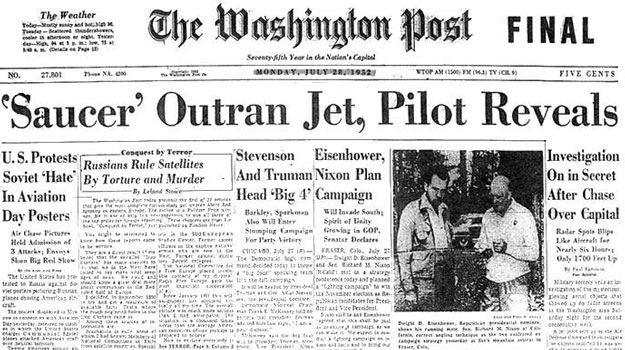
The front page of the Washington Post on July 28, 1952. The full text of the article is available here.
On Monday morning, the front pages across America heralded the story of UFOs outrunning fighter planes. In Iowa, the headline in the Cedar Rapids Gazette read like something out of a sci-fi flick: “SAUCERS SWARM OVER CAPITAL.” An unidentified Air Force source told reporters “We have no evidence they are flying saucers; conversely we have no evidence they are not flying saucers. We don't know what they are.” Responding to banner headlines and public alarm, President Truman ordered the Director of Central Intelligence, General Walter Bedell Smith, to look into the matter.
General Smith assigned a special study group in the Office of Scientific Intelligence (OSI), anchored by Assistant Director of Scientific Intelligence, Dr. H. Marshall Chadwell. The group was to focus on the national security implications of UFOs, and the CIA’s statutory responsibility to coordinate the intelligence effort required to solve the problem.
In August and September, OSI consulted with some of the country’s most prominent scientists. Chadwell’s tentative conclusions addressed national security issues, recommending psychological-warfare studies and a national policy on how to present the issue to the public. He also acknowledged the air vulnerability issue, and the need for improved procedures for rapid identification of unknown air traffic — a vital concern of many at the time, since the U.S. had no early warning system against a surprise attack.
Furthermore, Chadwell briefed Gen. Smith on 2 December, convinced “something was going on that must have immediate attention.”
Sightings of unexplained objects at great altitudes and traveling at high speeds in the vicinity of major U.S. defense installations are of such nature that they are not attributable to natural phenomena or known types of aerial vehicles.
He recommended an ad hoc committee be formed to “convince the responsible authorities in the community that immediate research and development on this subject must be undertaken,” with an expectation that this would lead to a National Security Council, Intelligence Directive for a prioritized project to study UFOs. What he got was something quite different.
In January 1953, the CIA convened a panel of prominent scientists, chaired by Caltech physicist and defense consultant Dr. Howard P. Robertson, in order “to evaluate any possible threat to national security posed by Unidentified Flying Objects and to make recommendations thereon.” After four days, the panel concluded that the evidence presented shows no indication that UFOs constitute a direct threat to national security, however, continued emphasis on UFO reporting does “in these parlous times,” threaten the orderly functioning of the government, while cultivating a “morbid national psychology in which propaganda could induce hysterical behavior and distrust of duly constituted authority.” A clearly defined approach to the problem was established. The Robertson panel recommended that the national security agencies debunk UFO reports and institute policies of public education designed to reassure the public of the lack of evidence (and “inimical forces”) behind the UFO phenomenon.[4]
Air Force Regulation 200-2
In response to the Robertson panel recommendations, USAF headquarters promulgated Air Force Regulation 200-2 on 26 August 1953, codifying the official UFO policy chiefly as a public relations issue.[5] Indeed, a 1959 revision was unequivocal in declaring that, “Air Force activities must reduce the percentage of unidentifieds to the minimum” (AFR 200-2, par. 2c).
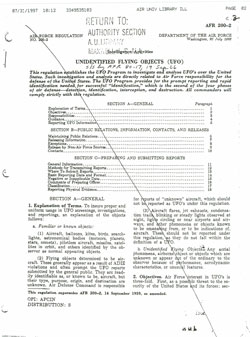
To achieve this, air base Commanders were responsible for “all investigative action necessary to submit a complete initial report of a UFO sighting,” and instructed to make every effort “to resolve the sighting in the initial investigation” (par. 3b). Further, “all Air Force activities will conduct investigations to the extent necessary for their required reporting action (see paragraphs 14, 15 and 16).” This amounted to collating a formatted list of Basic Reporting Data and transmitting it to Blue Book; with the caveat, “no activity should carry an investigation beyond this point” without first obtaining verbal authority from Blue Book at Wright-Patterson AFB, Ohio (par. 5).
Thus, Air Force investigators were explicitly limited to compiling responses to a formatted list of questions prescribed by AFR 200-2 (par. 14), and restricted from conducting any full-scale investigations and gathering all the available data. Blue Book was relieved of any investigative burden. If the UFO report remained unidentified at the base level, it was their responsibility to simply evaluate the data it received and submit a final case report.
In order to “reduce the percentage of unidentifieds to the minimum,” Blue Book adopted the premise that all UFO reports result from either hoaxes, or the misidentification of a natural object or phenomenon. They broadened the identified category to include possible and probable explanations, allowing investigators to identify a report based on the probability that a sighting was of a known phenomenon. In press releases, and year-end Blue Book evaluation statistics, the possible and probable subcategories simply disappeared and the sightings were listed as identified.[6]
To control the flow of information to the public and media, Blue Book forwarded a copy of the final case report to the Secretary of the Air Force, Office of Information, which was solely responsible for “release to the public or unofficial persons or organizations all information or releases concerning UFO’s, regardless of origin and nature” (par. 7). The only exception being “in response to local inquiries regarding any UFO reported in the vicinity of an Air Force base, when “the commander of the base concerned may release information to the press or general public only after positive identification of the sighting as a familiar or known object” (par. 8).
The policy effectively institutionalized secrecy. To further ward off publicity leaks, in December 1953, the Joint Chiefs of Staff issued Joint-Army-Navy-Air Force-Publication-146 (JANAP-146), which made releasing any information about a UFO report to the public, a crime under the Espionage Act. Only if Blue Book could positively identify the sighting as a hoax or misidentification would the Air Force release the information to the public. These policies remained in effect through 17 December 1969, when the Air Force announced the termination of Project Blue Book.[7]
2. Strategic Air Command Investigations
Certainly, Strategic Air Command Commanders and staff understood the objectives of the Air Force UFO policy. Moreover, strict compliance with the regulation was mandatory, even to the extent of managing information that would not facilitate the policy and support a conventional explanation.
On 24 October, following the landing of the B-52, Commanders at Minot AFB ordered immediate debriefings and investigations. These inquiries occurred before notifying Project Blue Book of the UFO events late in the afternoon, while the results were not available to Blue Book investigators. Over the next two weeks, officials at SAC headquarters monitored the progress of the Blue Book investigation, and Minot AFB investigating officer, Lt. Colonel Arthur Werlich, forwarded all the information he collated to General Hollingsworth for briefing SAC’s Vice Commander in Chief, Lt. Gen. Keith Compton.[8]
B-52 Pilot Debriefing
Following 4:21 a.m. (CDT), at the time of the B-52 pilots observation and overflight of the UFO on or near the ground, controllers at Radar Approach Control (RAPCON) relayed the following request to the pilots: “JAG 31 (garbled) requests that somebody from your aircraft stop in at baseops after you land.”[9]
Apparently, somebody in command wanted to know what the B-52 pilots had experienced, though the purpose of the debriefing and the officials in attendance are unknown. Most likely, the request came from Minot AFB Commander Col. Ralph Kirchoff, who was responsible under AFR 80-17 for providing the investigative capability necessary to submit a complete initial report of a UFO sighting.[10] The senior officer who reported to Base Operations was the non-crew pilot Major James Partin. Meanwhile, the B-52 crewmembers proceeded to the routine post-flight mechanical debriefing before eventually heading home to bed.[11] At some point, they received an order to return later in the morning for a debriefing in the office of the commander of the 810th Strategic Aerospace Division, Brig. General Ralph T. Holland.[12]
B-52 Radarscope Film Analysis
At 7:30 a.m., 5th Bombardment Wing intelligence officer Staff Sergeant Richard Clark arrived for work at the headquarters building, and was directed to set aside routine duties in order to analyze the B-52 radarscope film. In a 2003 interview he recalls:
CLARK: Our major priority was keeping up with the intelligence of the day — we were virtually always updating the bombing information for what we were going to do if we came to war over Russia…. But this turned into a priority so we informed the photo lab that we wanted it now. [13]
The primary concern was to determine whether the film confirmed the account of the B-52 crewmembers, though, Clark recalls “the big question was how fast it was going and what we felt it was.” He retrieved the processed film from the photo lab, and based on the sequence illustrated by the 14-radarscope photographs, recalls estimating a minimal average speed of the UFO at 3900 mph.[14]
By early afternoon, he had completed his report confirming the account of the B-52 crewmembers, while concluding that the speed and maneuverability of the UFO were phenomenal. He requested two sets of 8 X 10 positive prints of the significant 14 radarscope film frames, one to include in his report sent up his chain of command, while retaining the other as a personal desk-copy.[15]
Like B-52 Navigator Capt. Patrick McCaslin, what impressed Clark were the speed and performance characteristics of the UFO:
CLARK: Well, it had to have been a UFO. We had nothing that could do the kind of speed it had back then and be able to change directions. I mean, flying with the plane and changing directions while still maintaining — you’re going like this [indicating straight line motion with hand] and then all of a sudden it’s over here, and it’s still going this way. Even if we had something that could go that fast it’s going to go that fast this way — but it can’t go that way too. That’s why it was phenomenal. It had to be something other than what we were aware of, you know, I did not think our technology had anything like that as far as capability — so it’s got to be a UFO.[16]
Furthermore, someone informed SSgt. Clark
That they were sending somebody out from Washington to talk to the crew. I do not remember who asked me, but they wanted to know if I was sure about this [pointing to the radarscope photos], and I told them, ‘it’s there in black and white, there’s nothing else that it can be.’[17]
B-52 Crew Debriefing

Gen. Ralph Holland.
Later that morning, the B-52 crewmembers returned to base for a debriefing in the office of the commander of the 810th Strategic Aerospace Division. At the time, Brig. General Ralph Holland was the highest-ranking officer stationed at Minot.[18] In attendance were Co-pilot, Captain Bradford Runyon; Radar Navigator, Major Charles Richey; Navigator, Capt. Patrick McCaslin; Electronic Warfare Officer (EWO), Capt. Thomas Goduto; and Gunner, Technical Sergeant Arlie Judd. Not present at the debriefing were Maj. Partin, the B-52 instructor pilot from another crew who was onboard this mission being evaluated to maintain ratings by Aircraft Commander, Capt. Don Cagle; nor Cagle, who had intentionally avoided any direct involvement in the UFO events.[19]
For the first time the crewmembers learned of the extent of the ground observations and missile site intrusions. Unfortunately, it is doubtful that just a few hours after the events, Gen. Holland — or even Colonel B.H. Davidson, the 91st Strategic Missile Wing commander who briefed Holland on the situation — would have had a complete grasp of the situation. As a result, information provided to the crew by Holland may have been inaccurate or misconstrued. In particular, the recollections are not supported by the existing documentation.
For example, following are pertinent recollections of Capt. Runyon regarding the debriefing.
RUNYON: Well instead of asking us any questions, he just informed us as to what had gone on during the previous night, about outer and inner alarms going off at one of the missile sites. He did mention that there had been two different instances having to do with missiles within a week, one at another base — and I couldn’t differentiate the things that were going on from one opposed to the other. There had been outer and inner alarms activated and Air Police [Security Alert Team] had been sent to investigate. The first Air Police had not reported in. Other Air Police were sent to check and found the first Air Police either unconscious or regaining consciousness, and the paint was burned off the top of the vehicle. The last they remembered is that something was starting to sit down on them — and they started running. The Air Police did go onto the missile site and the 20-ton concrete blast door — he might have called it blast door — anyway, the 20-ton concrete lid had been moved from the top of one of our Minuteman missiles, and the inner alarm had been activated. He also mentioned that Air Police had seen us fly over, and had seen the object take off and join up with us. Basically that was it. I think that he asked us for any additional input. I don’t remember whether I mentioned anything or not.
INTERVIEWER: You never described the object you overflew?
RUNYON: I don’t think I ever did. Maybe to some of my friends in Stanboard, or to my crew when they asked about it. Maybe they thought I never looked outside the airplane; I have no idea why I was ignored.[20]
Capt. McCaslin recalled less detail, however the essential experience of the Security Alert Team (Air Policemen) is similar.
INTERVIEWER: Do you recall other topics of discussion?

MCCASLIN: No, not really. I remember he volunteered the information about the Air Policemen. He volunteered the information about the missile alarms going off. I’m sure he talked about other things, I just don’t remember — those are the things that stick in my mind …. My memory is that General Holland said that there were two — and he was saying it like he was very sympathetic toward these two Air Policemen. You know, like, imagine being in this position — that at the time our aircraft did the low approach there were two poor Air Policemen out there with this thing hovering, or something hovering directly over their pickup truck. I think he said they were responding to one of the missile alerts that had gone on in the missile —
INTERVIEWER: Alarms?
MCCASLIN: Yeah. And there may have been more that responded, but they were either the team — the Air Policemen responding, or one of the crews of Air Policemen responding, and that this thing was directly over their vehicle.
INTERVIEWER: Did it damage the vehicle in any way?
MCCASLIN: Don’t know if he told us that. The only memory I have is that it was lit in some fashion when it was over the top of them, and my impression is that it was very close to their vehicle, and that they were scared to death. And at the point these Air Policemen saw our aircraft taking off or doing a low approach — they didn’t know which — at the base, my impression is it was off to their left, that this thing went dark and began to climb in the direction of our aircraft.[21]
The impression is that the crewmembers were struggling to incorporate the information related by Holland with their own experience, in order to create a coherent picture of the events. It is unclear, however, whether Holland’s information describes additional undocumented events at other missile Launch Facilities, or was misconstrued from the facts.
For example, when the missile maintenance team of Airman (A1C) Robert O’Connor and A1C Lloyd Isley arrived at the N-7 Launch Facility around 3:00 a.m., they reported the UFO circling to the south to SSgt. James Bond at the November-Launch Control Facility. November-Security Alert Team member A1C Joseph Jablonski recalls O’Connor’s hysteric-sounding voice over the radio as he was apparently describing the bright object hovering directly over them at the N-7.[22] Later, when the personnel at N-7 (by this time including Jablonski and Adams) observed the incoming B-52 in the west, the UFO they had been observing for over an hour in the southeast disappeared, which could be construed as, the UFO “went dark … at the same time they saw our airplane.” For example:
McCASLIN: My memory is that it was at that briefing where I learned that they saw that thing leave them … my memory is that he said that it went dark — it was hovering over them — went dark and lifted up. And, at the same time they saw our airplane making that initial approach it took off in the same direction our airplane was going.[23]
McCaslin assumes this occurred during their initial approach to the runway before flying out to the WT fix, which is also when RAPCON requested they look out for “any orange glows out there.” In other words, the UFO described by Holland as brightly lit while hovering over the top of a security vehicle, suddenly “went dark,” and followed the B-52 up to altitude in the northwest where it first appeared on radar. According to the existing documentation, this could not have been the UFO observed by personnel at N-7, or have occurred at the Oscar-7, since the break-in was after the terminal landing of the B-52.
This suggests that there were additional undocumented UFO events at other missile Launch Facilities. For example, Runyon recalls that Gen. Holland “did mention there had been two different instances having to do with missiles within a week — one at another base.” This confused Runyon, since he could not “differentiate the things that were going on from one [event as] opposed to the other.” In addition, Richard Clark recalls hearing about alarms at three missile sites, and alludes to the experience of the missile security personnel as recalled by the crewmembers:
CLARK: I don’t know how accurate it is, and I can’t remember whom I heard it from but it had to be somebody in the wing. I heard they sent a crew out to one of the missile silos after the alarms went off and that something similar to that happened to the crew, you know, the motor stopped, the lights went off — but I cannot remember. I don’t even remember which three silos went off.
INTERVIEWER: Three silos?
CLARK: Three separate silos went off, and they ended up — what I did hear was that they could not find anything. Nobody could have been in there.[24]
Capt. Goduto also recalled a discussion about security intrusions at three missile sites:
GODUTO: I can’t remember, it could have been a discussion at a later time when they said there were possibly three intrusion alarms that had gone off at the missile silo sites. This would have been the same evening, right at the time when things were occurring …. Security [Alert] Teams responded but they found no locks, or no entries there.[25]
In any event, the consensus of the B-52 crewmembers was that the debriefing seemed perfunctory, and not concerned with effectively interrogating them to obtain useful information regarding the events or their particular experiences. Goduto felt “the right questions weren’t asked by the interviewers,” while Arlie Judd assumed the debriefing was merely pro forma “in case somebody happened to ask them.”[26] Moreover, during the Blue Book investigation, none of the B-52 crewmembers were interviewed, nor completed an AF-117 Sighting of Unidentified Phenomena Questionnaire regarding their experience.
Oscar-7 Launch Facility Break-In
At 4:49 a.m., nine minutes after the B-52 landed, Oscar-7 Outer-zone (OZ) and Inner-zone (IZ) security alarms sounded underground in the Oscar-Launch Control Center. It was not unusual for the sensitive perimeter alarm system to activate because of animal activity, equipment malfunctions, and even drifting snow; however, the triggering mechanisms for the inner-zone alarms were isolated from the local environment, and both alarm zones activating at the same time was an exceedingly unusual situation. Oscar-Flight Security Controller, Staff Sergeant William Smith Jr., immediately dispatched his Security Alert Team of A1 Donald Bajgiar and A1C Vennedall to O-7.
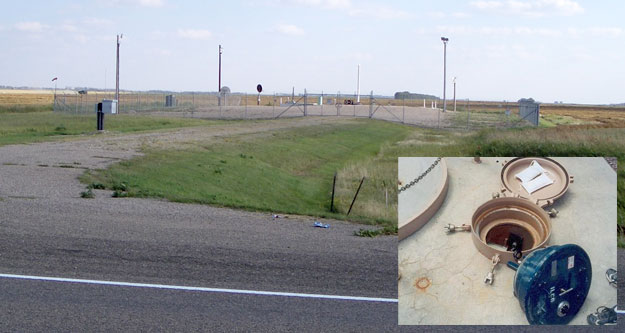
Oscar-7 Launch Facility located 24 miles north of Minot AFB, looking south-southeast; and (inset) the personnel access hatch’s weather cover open, with the vault door removed, providing access to the controls for opening the large primary door (A-plug).
When the team arrived, they found the front gate unlocked and open, while a weather cover protecting the controls for access to the missile silo was left standing open. Inside, somebody had turned the combination lock dial on the vault door off its setting, thus triggering the inner-zone alarm. The security team conducted a procedural investigation of the site but found no additional evidence of intruders.[27] Later the same day, SSgt. Smith met another team sent out by the 91st Strategic Missile Wing headquarters to conduct a further investigation at O-7.
SMITH: I was still on duty the next day. I think it was a maintenance Lieutenant that came and was doing the investigation, so I went out as well to let them know that this is strange because we had never in my experience found a gate wide open with those locks that we had — unless you had a key. The lock was not broken. We just knew we had somebody on that site with all the weird things going on. So we did go through the process of investigating the site, but that gate being open, we were not happy with that. In fact, I think that's why they sent somebody out, and they did find radiation on part of the site that was away from the missile — on the parking area. You had the missile and you had a service area right next to it. We had keys to get down inside and check it out.
INTERVIEWER: Right, the support equipment.
SMITH: Yes, when I was working as an inspector I used to hide down there from the guys and scare the doo-doo out of them under the sub floor and things like that. Well, we went through that whole process, and I was with my crew when they did that — as supervisor I decided that I needed to go out there and find out what's going on. I stayed with the crew, which I did not have to being in charge of security. Anyway, that is how I knew what went on. When the Lieutenant was out there, they did find a circular ring of low-grade radiation, and he called it low grade such that it would not be enough to contaminate people, but it was nonetheless a circular pattern of radiation. That freaked us out. I am telling you, right then I said, ‘Oh, shucks.’ He was serious about that, and I was there and saw where he had seen this pattern, and I [wondered] ‘Now, what could that be?’”[28]
3. Information Unavailable to Project Blue Book
The results of the SAC investigations were not available to Blue Book investigators, including the pilot and B-52 crewmember debriefings, radarscope film analysis, and the O-7 break-in investigation. Little if any information was available regarding the Radar Approach Control (RAPCON) systems, and Aerospace Defense Command’s (ADC) long-range radar systems at Minot Air Force Station, located 16 miles south of Minot, ND.[29]
Furthermore, the communications transcript notes the weather radar detection and location of the UFO in relation to the B-52, though Col. Werlich seems to remain ignorant of this fact.[30] During a conversation with Blue Book staff on 31 October, Werlich insists that the only radar detection of the UFO was by the B-52, stating that ADC “do not remember having any unidentified paints. The only one I have is the one on the plane.”[31] Later, after receiving supplemental information, which included the transcription, Blue Book staff attempted to contact Werlich twice to request information on the weather radar detection of the UFO, but ultimately received no response.[32] The paucity of information in this respect seems intentional, especially since a target tracked by multiple radar systems would lend considerable weight to the argument for an airborne, radar-reflective object.[33]

Minot Air Force Station, ND, looking north. The radar systems consisted of a Westinghouse AN/FPS-26A Frequency Diverse height-finder and AN/FPS-27 FD search radar, designed to have a maximum range of 220 nautical miles and search to an altitude of 150,000 feet. Regarding the AN/FPS 27 FD system, and Minot AFS, see: http://www.radomes.org/museum/showsite.php?site=Minot+AFS,+ND.
To a certain extent, these omissions can be understood to be a result of exceedingly restrictive security regulations in effect at a strategic nuclear airbase such as Minot; particularly since classification levels for defense radar systems, and all activities pertaining to the operational delivery of nuclear weapons, were beyond that which Blue Book was authorized to receive.[34]
For instance, in the early 1960s, as Cold War tensions reached a climax during the Cuban Missile Crisis, the United States was completing its “strategic nuclear triad” with the implementation of the Minuteman, Intercontinental Ballistic Missiles (ICBM), and the Navy’s Polaris, Submarine-Launched Ballistic Missiles (SLBM), complementing the B-52 bomber force.[35] Each force provided the United States with different strategic options to independently impose unacceptable damages on the Soviet Union. In response, war planners formed the Joint Strategic Target Planning Staff, in order to coordinate a National Strategic Target List, and prepare a Single Integrated Operational Plan (SIOP) for the execution of a nuclear war. The essence of the first SIOP was the targeting for a massive nuclear strike on military and urban-industrial targets in the Soviet Union, China, and their allies. To ensure strict secrecy, an exclusive marker classification — Extremely Sensitive Information (SIOP-ESI) — was established so that only those with a “need-to-know” would have access to the documents and targeting plans. Not until the mid-seventies did the existence of the SIOP become public record, while much of the information is still highly secret and may never be declassified.[36]

The Strategic Air Command’s Command Post and global communications center located several stories below the headquarters building at Offutt AFB, Nebraska. From the command balcony, the Commander in Chief and his battle staff could execute the Single Integrated Operational Plan (SIOP) and deploy U.S. strategic forces in the event of a nuclear war. In August 1960, SAC reached the pinnacle of power and prestige when Secretary of Defense Thomas Gates instituted the Joint Strategic Target Planning Staff at SAC headquarters. For a time, there were more than forty Generals stationed at the base.

All Minot AFB personnel involved in the operational delivery of nuclear weapons to predetermined targets held SIOP-ESI clearances, including the B-52 crewmembers, all personnel whose work required access to weapons and targeting plans, and the capsule crews in the underground missile Launch Control Centers. This would restrict the information and witness testimony available to Blue Book investigators, and explain SAC headquarters’ periodic inquiries to Blue Book staff over the course of the investigation. Initially, from Colonel J. A. Weyant in the office of the Deputy Chief of Staff for Operations regarding Blue Book investigative procedures and strict compliance to AFR 80-17. Moreover, by Col. H. V. Pullen, assistant to the Deputy Chief of Staff for Intelligence, Brig. General Richard Stewart, responsible for managing the dissemination of Sensitive Classified Information, in which unauthorized disclosure could be expected to cause exceptionally grave damage to national security.[37] This concern, particularly regarding Blue Book chief Lt. Col. Hector Quintanilla’s conclusions, is evident in a telephone conversation with Pullen on Tuesday, 29 October, when
Col Pullen requested that Col Quintanilla send a preliminary report so that he could give it to General Stewart to get this thing simmered down. Send it SSO [Special Security Office] SAC, attention Col Pullen. He requested that Col Quintanilla hit a little heavy on what happened to other aircraft on occasions like this, this would help to play the issue down.[38]
Col. Werlich was also in contact with SAC headquarters. During a conversation with Blue Book on Thursday, 31 October, Lt. Marano complained to Werlich “that SAC was giving us trouble because they wanted to know what we are doing.” Werlich then informs Marano that before notifying Blue Book on 24 October, he had phoned SAC requesting technical assistance for the investigation but “we didn’t get it and we have tried to do what we could.”[39] Apparently, when he phoned SAC he spoke with Col Weyant, who had directed him to comply with AFR 80-17.[40] He then mentions, “Gen Hollingsworth is interested.” Later in the conversation, he informs Marano that he has forwarded all of the information he obtained in his investigation to General Hollingsworth for briefing the second in command, Vice Commander in Chief, Lt. Gen. Keith Compton, and the briefing was probably taking place as they were speaking (3:00 p.m. CST, 31 October).[41]
The next day, Friday, 1 November, Quintanilla finally responded to Pullen’s earlier request to “play the issue down,” suggesting that the radar and air-visual observation by the instructor pilot, Maj. James Partin
AND PERSONNEL ON THE GROUND IS MOST PROBABLY A PLASMA OF THE BALL-LIGHTNING CLASS …. I CONSIDER THE UFO REPORTS AS FAIRLY ROUTINE, EXCEPT FOR THE PLASMA OBSERVATION WHICH IS INTERESTING FROM A SCIENTIFIC POINT OF VIEW. WE WILL STUDY THIS REPORT IN MORE DETAIL WHEN WE RECIEVE THE RAW DATA FROM MINOT.[42]
Nearly a week later, on 7 November, Col. Pullen demanded that Quintanilla complete his report:
SAC COMMANDER AND STAFF ARE EXTREMELY INTERESTED IN THIS ITEM. REQUEST A COPY OF YOUR REPORT OF THIS INCIDENT BE FORWARDED THIS HEADQUARTERS AS SOON AS POSSIBLE. IF ANY DIFFICULTY IS ENCOUNTERED SECURING RAW DATA OR ASSISTANCE FROM MINOT PLEASE ADVISE. YOUR EXPEDITIOUS HANDLING OF THIS INCIDENT IS APPRECIATED.[43]
Clearly, SAC is closely monitoring the progress and conclusions of the Blue Book investigation. Moreover, it seems evident they are purposefully managing the information and data available to the Blue Book investigation, and thereby facilitating its function to normalize all UFO reports.
For example, following the B-52 air-radar UFO encounter, the pilots were preparing to land when they received an order from a General officer to continue back around the traffic pattern in order to overfly a stationary UFO and photograph it.[44] The specific request by the General, or the request relayed by RAPCON and co-pilot Runyon’s response, should appear in the communications transcript — but are clearly absent.[45] McCaslin recalls Runyon’s response to the request:
McCASLIN: My memory is that the tower asked us to go take a visual look at what was out there. I heard the pilot saying things to the tower that made it clear to me that is what they wanted, and he was not too keen to do it. He said something like, ‘Okay, look, I’ll go, I’ll do one visual pattern, and then I’m putting this thing on the ground.’[46]
Furthermore, following 4:21 CDT (0921Z) the time-code references have been omitted for the entire final circuit of the traffic pattern. Additional omissions include the RAPCON vector directing the B-52 to turn left onto the 290-degree downwind leg, which is when the B-52 pilots observed the UFO ahead of the aircraft for several minutes before turning over it onto the base leg, and apparently any pilot-RAPCON conversations during the air-visual encounter.[47] Capt. Runyon recalled conversations with RAPCON and the second loss of radio transmission during the close approach:
RUNYON: Okay, well [the radio] went off again, because the controllers were asking me, you know, if we had it and so forth. I’m talking to them. Then after we went by it and turned towards the runway the radios came back in. Of course, they had me change and trying different frequencies and everything, but there was [nothing] wrong with the radios.[48]
In 2001, Maj. Partin recalled the excitement upon viewing the object:
PARTIN: When I described to the crew over the interphone what I was seeing, the navigator, the radar navigator and everybody tried to get up in our lap in the cockpit and — [laughs].[49]
Capt. McCaslin, down in the belly of the B-52, recalls his apprehension at being invited up to have a look:
McCASLIN: I heard the pilot say something like ‘[expletive], look at this,’ and they were talking back and forth about it, apparently we flew right over the thing. At one point, I think the Aircraft Commander said, ‘Come on up here and take a look at this thing,’ and I indicated that I was not about to get out of a perfectly good ejection seat and climb upstairs with no parachute to look at whatever this was. Because it occurred to me that if I were someone in a strange place investigating things and this huge aircraft flew over me at a very low altitude — I am not sure what I would have done. I wanted to make sure that I had something that would get me out of the airplane if they took umbrage at that.[50]
Regardless, the communications transcript reads as if the final go-around of the traffic pattern was merely routine and uneventful.[51] At the very least, whoever transcribed the RAPCON communication tapes lacked experience and proper equipment for accurately displaying the encoded time references.[52] On the other hand, the omissions correlate specifically to the air-visual observation of a huge, luminous UFO at very close range by highly qualified military observers.
4. Project Blue Book Investigation

In its later years, USAF Project Blue Book staff was headed by Lt. Col. Hector Quintanilla, Jr. (seated); with the assistance of 2nd Lt. Carmon Marano (center standing), duty officer SSgt. Harold T. Jones, and secretary Marilyn Stanscomb. Major Quintanilla (promoted during his tenure) took over as head of the project in August 1963 until its doors finally closed on 30 January 1970.
Background
Throughout the 1950s, the Air Force was successful in its ongoing public relations campaign. The turning point came in 1965, with a prolonged wave of sightings that continued through 1967. A surprisingly large number of cases were reported by scientists and technically trained observers, and prompted widespread press coverage and some of the first questioning — if not criticism of the Air Force UFO program. Public interest grew enormously, and for the first time the scientific community entered into the debate.
In March 1966, one of the most widely publicized events in the history of the phenomenon occurred over several nights in Michigan. Sightings by over 140 witnesses, including sheriff’s deputies and police officers across several counties caused a nationwide furor.

Hillsdale, Michigan Daily News, Wednesday 23 March 1966. Witnesses got together after the sightings at the Washtenaw County sheriff’s headquarters and composed this drawing of the UFO. Sheriff Douglas J. Harvey gasped: “If there is such a thing as a flying saucer, this must be it.” Additional information at http://www.cohenufo.org/SwampGasCase_cpy.htm.
During the evening of 21 March at Hillsdale College, southwest of Ann Arbor, seventeen female students and the college dean watched a glowing football-shaped object hover in a swampy area. At one point the object darted toward the women’s dormitory before stopping suddenly and retreating back to the swamp. The women called Hillsdale County civil defense director, William Van Horn, who arrived with police to search the area. From the second floor of the dormitory, they observed the object at a distance of about 1500 to 1700 feet. After about 10 minutes two dim lights began to grow in brilliance to red and the white. As the lights became more brilliant the object would rise to a height of approximately 100 to 150 feet, stop momentarily, and descend. The object stayed in the area for four hours before vanishing.
The next day, Michigan Congressman Weston Vivian requested an official investigation, prompting Quintanilla to send Blue Book scientific consultant J. Allen Hynek to the scene. Three days later, at the “largest press conference in the Detroit Press Club’s history,” Hynek suggested that what people had seen “could have been due to the release of variable quantities of marsh gas,” whereby methane gas released by rotting vegetation is spontaneously ignited.
The press pounced on the solution, and “swamp gas” became an object of wide-ranging ridicule and humor across the nation. The New Yorker was openly derisive:
We read the official explanations with sheer delight, marveling at their stupendous inadequacy. Marsh gas indeed! Marsh gas is more appropriate an image of that special tediousness one glimpses in even the best scientific minds.
The uproar was so adverse, that then Michigan Congressman and House Republican minority leader Gerald R. Ford formally called for Congressional hearings.
In April 1966, the House Armed Services Committee acted on Ford’s suggestion and held the first open Congressional hearing on the subject. Facing mounting discontent with the Air Force’s UFO policy, Secretary of the Air Force Harold D. Brown directed the Air Force Office of Scientific Research to locate a university to conduct an independent investigation of the UFO phenomenon. On 7 October 1966, the Air Force publicly announced that the University of Colorado had accepted the UFO study contract, under the direction of the eminent physicist, and former head of the National Bureau of Standards, Dr. Edward U. Condon.
While the conclusions of the two-year study would eventually lead to the long-anticipated closing of Project Blue Book, for the time being, the Air Force was relieved of its public relations pressures as the focus shifted to the University of Colorado UFO study, and for the most part, the press and public adopted a wait-and-see attitude.[53]
Air Force Regulation 80-17
In September 1966, responsibility for the UFO program transferred out of the intelligence community to the Deputy Chief of Staff, Research and Development. This move put Blue Book within the Air Force scientific community, supported by the Foreign Technology Division (FTD) in the Air Force Systems Command at Wright-Patterson AFB, Ohio. A revised UFO regulation, issued on 19 September as AFR 80-17, reflected the official change in attitude concerning the importance of UFOs, while allowing Blue Book to submit UFO reports directly to the University of Colorado UFO study.
This regulation establishes the Air Force program for investigating and analyzing UFOs over the United States. It provides for uniform investigative procedures and release of information. The investigations and analyses prescribed are related directly to the Air Force's responsibility for the air defense of the United States. The UFO Program requires prompt reporting and rapid evaluation of data for successful identification. Strict compliance with this regulation is mandatory.[54]
The program objectives were two-fold, omitting the third objective in previous regulations concerning the mandate to reduce the percentage of unidentifieds to the minimum:
To determine if the UFO is a possible threat to the United States and to use the scientific and technical data gained from study of UFO reports. To attain these objectives, it is necessary to explain or identify the stimulus which caused the observer to report his observation as an unidentified flying object (AFR 80-17, Sec. A, par. 2).

Col. Arthur Werlich.
To implement the program, UFO reports were referred to the nearest Air Force base and each base commander was required to provide an investigative capability. In this case, Minot AFB Commander Col. Ralph Kirchoff designated Lt. Col. Arthur Werlich, head of the 862nd Combat Support Group, Operations Division, as liaison to the UFO program. Werlich’s primary responsibility was to collect data, collate a formatted list of Basic Reporting Data, and provide his
initial analysis and comment on the possible cause or identity of the stimulus in a supporting statement. He will make every effort to obtain pertinent items of information and to test all possible leads, clues, and hypotheses. The investigating officer who receives the initial report is in a better position to conduct an on-the-spot survey and follow-up than subsequent investigative personnel and analysts who may be far removed from the area and who may arrive too late to obtain vital data or information necessary for firm conclusions. The investigating officer's comments and conclusions will be in the last paragraph of the report submitted through channels (Sec. C, par. 10).[55]
This was Col. Werlich’s first official UFO investigation.
Notifying Blue Book

Following the UFO events on Thursday, 24 October, in the afternoon Col. Werlich contacted SAC headquarters requesting technical assistance for his investigation. Denied assistance, Col. J. A. Weyant in Operations directed him to act in accordance with AFR 80-17. At 4:30 p.m. (CDT), he telephoned Project Blue Book duty officer SSgt. Harold Jones at Wright-Patterson AFB, Ohio, reporting that:
The crew of a B-52 had sighted and photographed an UFO and that the Base Commander and Major General Nichols of the 15th Air Force were both interested.[56]
Jones called assistant Lt. Carmon Marano, who returned to the office to inform Blue Book chief Lt. Col. Hector Quintanilla before phoning Werlich back at Minot AFB. Since it was such an unusual sighting, Werlich wanted to know if Blue Book could help in any way. Marano then asked him for the details of the sighting.
At about 0300 hours local, a B-52 that was about 39 miles northwest of Minot AFB and was making practice penetrations sighted an unidentified blip on their radar. Initially the target traveled approximately 2-1/2 miles in 3 sec — or about 3,000 mph. After passing from the right to the left of the plane it assumed a position off the left wing of the 52. The blip stayed off the left wing for approximately 20 miles at which point it broke off. Scope photographs were taken. When the target was close to the B-52 neither of the two transmitters in the B-52 would operate properly but when it broke off both returned to normal function.
At about this time a missile maintenance man called in and reported sighting a bright orangish-red object. The object was hovering at about 1000 ft or so, and had a sound similar to a jet engine. The observer had stopped his car, but he started it up again. As he started to move the object followed him then accelerated and appeared to stop at about 6-8 miles away. The observer shortly afterward lost sight of it.
In response to the maintenance man’s call the B-52, which had continued its penetration run, was vectored toward the visual which was about 10 mile northwest of the base. The B-52 confirmed having sighted a bright light of some type that appeared to be hovering just over or on the ground.
Fourteen other people in separate locations also reported sighting a similar object. Also, at this approximate time, security alarm for one of the sites was activated. This was an alarm for both the outer and inner ring. When guards arrived at the scene they found that the outer door was open and the combination lock on the inner door had been moved.[57]
Quintanilla then requested information on other radars and control tower personnel observations; observational data from the 14 witness sightings to determine if they were looking at the same object, or stellar bodies; and whether anyone had observed a physical object. Finally, it was determined that exact time sequences for the events were necessary and Werlich agreed to gather the information.
Over the next four days, Werlich gathered and collated the information necessary to complete the formatted list of Basic Reporting Data prescribed in AFR 80-17. On Friday, 25 October, the November security personnel returned to base, and both Airman First Class Joseph Jablonski and A1C Gregory Adams completed the AF-117 Sighting of Unidentified Phenomena Questionnaire.[58] On Saturday, November-Flight Security Controller SSgt. James Bond, and Oscar-FSC SSgt. William Smith completed AF-117s.[59] During his interview, Smith recalls informing Werlich of numerous, earlier reports of lights observed near the Oscar-2 missile silo — up near the Canadian border. He maintains that afterwards Werlich took a camper vehicle and spent some time up at O-2. What came of this is unknown. There is no mention to Blue Book, and any results were never reported back to Smith.[60]
On Monday, 28 October, the missile maintenance team of A1C Robert O’Connor and A1C Lloyd Isley recall being awakened early in the morning and instructed to report to Base Operations. Isley recalls being informed by Werlich that a B-52 had picked something up on radar, but the main purpose was to have them complete the AF-117’s.[61]
In the Basic Reporting Data, Werlich includes B-52 navigator Capt. Patrick McCaslin, and the non-crew pilot Maj. James Partin in his list of military observers, though none of the B-52 crewmembers were interviewed. Partin completed an AF-117 on Wednesday, 30 October, two days after Werlich submitted the Basic Reporting Data to Blue Book.[62]
Werlich also declared,
NINE OTHER MILITARY MEMBERS STATED THAT THEY VISUALLY OBSERVED AN OBJECT, HOWEVER, ONLY ONE [OF] THESE WAS IN A POSITION TO CONTRIBUTE ANY PERTINENT INFORMATION.[63]
He does not name these additional witnesses, though presumably they include security personnel at Mike-1, Juliet-1, and the Security Alert Team at Oscar-1, identified in the list of observers by the Wing Security controller in his summary.[64] In any case, it is unfortunate that he didn’t at least record basic observational data, specially those at diverse locations such as Mike-1, Juliet-1, and O-6; which, combined with observations at N-1, N-7, and O-1, would have provided a means of triangulation to determine whether they were all observing the same object. Surely, it would have resolved any probability they were observing a fixed celestial object.[65]
SAC Headquarters Intervenes
At 11:15 a.m. (EST) Monday, 28 October, Blue Book duty officer SSgt. Jones received a call from Col. J. A. Weyant in Deputy Chief of Staff/Operations at SAC headquarters inquiring about the procedures by which Blue Book receives and investigates UFO reports, while underscoring that
‘The investigator [Werlich] would handle it in accordance with AFR 80-17.’ Sgt Jones told him that was right. Col Weyant then said, ‘then you can’t do anything until you receive their report,’ Sgt Jones said, ‘that’s right.’[66]
Weyant asked Jones if there have been “any other reports for that period of time from that area” and requested that whoever was responsible for handling the report give him a call, before ending the conversation. Shortly after, at 12:50, Weyant phoned again and spoke with Lt. Marano, wanting to “know if we (Lt Marano) had received any indication of any other reports from Minot. Marano informed him that we haven’t received any other reports from that area.” After establishing that both Marano and Quintanilla had spoken with Werlich, who had agreed to do the investigation,
Col Weyant said he was trying to determine whether ADC [Minot AFS] “had any known phenomena on radar.” Col Weyant asked Lt Marano whether Blue Book ever participated in any investigations, to which Marano responded, “Very seldom do we ever go out in the field. As far as Lt Marano was concerned Col Werlich was quite competent and he did not feel that Col Werlich needed any additional help at this time.” What follows is a somewhat cryptic comment indicating that Weyant had already been in contact with Werlich:
Col Weyant said he gave Col Werlich the guidance and he guessed that Col Werlich got our telephone number out of the regulation. Col Weyant said he felt that we couldn’t give him any more information so he ended the conversation.[67]
Basic Reporting Data and Format
Late on Monday, 28 October, Col. Werlich completed the Basic Reporting Data section per AFR 80-17. At 10:28 p.m. (CST), he electronically transmits the eight-page report via Teletype (TWX) to Project Blue Book (FTD), and several other Air Force agencies specified in the regulation.[68] Supplying Blue Book staff with data and information necessary to prepare the final case report fulfilled Werlich’s principal responsibility under the regulation. However, over the next two weeks Blue Book staff continued to request supplemental information.
Tuesday morning, 29 October, Lt. Marano phoned Minot hoping to speak with Werlich, who was unavailable since he was flying that morning. He then spoke with a Mr. Carber who informed him that the UFO report was completed and “sent out this morning or would be sent out today.”[69]
Earlier in the day, it appears Blue Book received an inquiry from SAC headquarters, since at 3:30 p.m. Quintanilla telephoned Colonel H. V. Pullen, assistant to the Deputy Chief of Staff for Intelligence, who requested “a brief rundown on the Minot sightings.” Quintanilla began to wander through possible, if tenuous, explanations for the various observations, suggesting that the B-52’s radio transmitter might have caused the radar echo, “since it occurred for only a short period of time.” Then, referring to the lengthy sighting period, “I feel some of the men were looking at celestial bodies” because of a temperature inversion in the lower atmosphere causing the stars to scintillate. He adds, “there were a number of stars in the area at the time.” Pullen then said that he would “like to receive a preliminary report giving a quick look.” Quintanilla consented to the request, while explaining that the sightings took place over a period of more than two hours, which “is too long to make an accurate report.” Finally submitting he was “pretty sure” the B-52 radar return “was either caused by an internal radar malfunction that also caused the blip or because of the [temperature] inversion he might have also picked up an anomalous blip.”[70] Pullen asked whether they had sent anyone to Minot to investigate, to which Quintanilla responded,
We did not send anyone up because I only have four people on my staff, myself, an assistant, a secretary and an admin sergeant. I talked to Col Werlich for over thirty minutes and since this didn’t appear [too] unusual I didn’t send anyone up. Col Pullen requested that Col Quintanilla send a preliminary report so that he could give it to General Stewart to get this thing simmered down. Send it SSO SAC, attention Col Pullen. He requested that Col Quintanilla hit a little heavy on what happened to other aircraft on occasions like this, this would help to play the issue down.[71]
Early Wednesday morning, 30 October, Lt. Marano phoned Minot Base Operations to learn that Col. Werlich was still flying. He spoke with a Sgt. Hoy, requesting that Hoy have Werlich obtain additional information and TWX it to him. The first part is a request to, “Have the navigator [McCaslin] accompany someone and go out and interview the individual observers at the missiles sites.” By this time, Werlich had already interviewed principal ground witnesses, though he had not forwarded the completed AF-117 Sighting of Unidentified Phenomenon Questionnaires.
Marano also requested statements from aircraft personnel regarding the B-52 radar and air-visual sighting (which may have prompted Werlich to have Partin complete his AF-117 that same day). He also requested information on other radar systems in the Minot area, if additional radars or ECM (Electronic Counter Measures) onboard the B-52 painted anything, and whether the equipment was checked out by ground maintenance after the B-52 landed. Werlich had suggested in the Basic Reporting Data that “the Oscar-7 alarms could be attributed to a circumstantial effort of pranksters,” and Marano requested “a statement that the missile sites had been broken into before and what results.” Finally, he requested that additional materials be sent by mail, including a map of the area; a plot of the B-52 flight path from 02:58 CDT until landing with time sequence markings; the AF-117 reports from each observer; and copies of the B-52 radarscope photos.[72]
On Thursday afternoon, 31 October, Werlich telephoned Blue Book. Over the course of a long conversation, he endeavors to address all of the supplemental questions solicited by Marano, while qualifying his comments and conclusions in the Basic Reporting Data. At the very end of the conversation, he says that this would be his last communication.
Col Werlich said he would be flying tomorrow and Monday. Col Werlich said he had done the initial investigation in accordance with the regulation and I’m at the limits of my capabilities. Col Werlich I can send supplemental data and will if we make our desires known and inform what specific information we need. Col Werlich said we were hoping for technical assistance and we didn’t get it. Lt Marano told Col Werlich we felt that he was doing an adequate job as far as technical data. Col Werlich said this was his first report and didn’t know how to ask questions or anything and he had spent too much time on it already.[73]
With the end of Werlich’s involvement came the end of the evidence available to Quintanilla as he formulated his final case report. At this point, we will review Werlich’s data and conclusions in the Basic Reporting Data, along with his qualifying statements in response to Blue Book’s request for supplemental information.
5. Reviewing Werlich’s Data and Conclusions
Col. Werlich organized his comments and conclusions at the end of the Basic Reporting Data into six sections (pp. 5-8):
- The initial ground observations and subsequent activities (5).
- The B-52 activities, including radar and air-visual observations until landing (5-7).
- The Oscar-7 break-in and SAT investigation (7-8).
- The observation of two similar objects by the ground observers (8).
- Comments that the ground observations were probably of the B-52 (8).
- Four occurrences that cannot be explained:
- Cause of the radar echo;
- Cause of the loss of B-52 UHF radio transmission;
- Cause of B-52 air-visual observation and simultaneous ground observation in the same location;
- Cause of Oscar-7 break-in (8).
He avoided commenting on the cause or stimulus of the B-52 radar and air-visual encounters, and evidence of two similar UFOs. Instead, the primary focus of his analysis was an attempt to demonstrate that the majority of ground observations were actually misidentifications of the B-52.
Initial Ground Observations
Werlich’s first comment is a very brief summary of the initial ground observation and events up to the dispatching of the November-Security Alert Team to N-7.
(1) THE FIRST SIGHTING OF THE OBJECT (A BRIGHT LIGHT) WAS MADE BY AIRMAN O CONNOR AND ISLEY WHILE DRIVING TO NOVEMBER 7 MISSILE SITE. THEY REPORTED THIS SIGHTING TO THE WING SECURITY CONTROLLER OVER THE VEHICLE RADIO. WING SECURITY CONTROLLER THEN ALERTED ADJACENT FLIGHT SECURITY CONTROLLERS TO THE SIGHTING. WSC ALSO NOTIFIED THE 91ST MISSILE WING COMMAND POST AND THE BASE OPERATIONS DISPATCHER. THE BASE OPERATIONS DISPATCHER NOTIFIED THE TOWER OPERATOR AND RAPCON AND ARRANGED A PHONE PATCH TO THE VEHICLE. HE INSTRUCTED AIRMAN OCONNOR TO DESCRIBE WHAT WAS HAPPENING AND THEN PROCEEDED TO MAKE A LOG OF EVENTS CONTAINING TIME AND CIRCUMSTANCES. SSGT BOND SENT A SECURITY ALERT TEAM, AIRMAN ADAMS AND JABLONSKI, FROM NOVEMBER 1 SITE TO ASSIST AT NOVEMBER 7.[74]
In the data section, Werlich notes the time period of the observations as “24 OCT 68-0800Z (0300 CDT) UNTIL APPROXIMATELY 1015Z (0515 CDT),” and length of time as “[VISIBLE] 2 HOURS, 15 MINUTES.”[75] Based on information in the AF-117’s, both the maintenance team of A1C O’Connor and A1C Isley, and Oscar-Flight Security Controller SSgt. Smith reported independently at 2:30 a.m., while the Camper Team (and Target Alignment Team) at Oscar-6 reported their observation to Smith at 2:15.[76]

O-6 Launch Facility located 19 miles north of Minot AFB, looking northeast. The underground Launch Support Building is to the right of the launcher closure, or “blast door” covering the missile silo. According to Smith, the camper team was providing security for the targeting team working underground in the missile silo when they observed a large glowing object go down behind some trees not far away. Concerned about an unidentified object near the exposed nuclear weapon, they closed the site and returned to base. During the Blue Book investigation, Werlich ignored the ground observations reported prior to 3:00 a.m.
Werlich also has the reporting sequence somewhat misconstrued. At 2:30, O’Connor and Isley reported their initial observation while driving “5 MILES NORTH OF GRANO” to base Transportation Control (not the “WING SECURITY CONTROLLER”), who forwarded their call to the Base Operations Dispatcher.[77] At the same time, Smith reported his observation to SSgt’s Neal and Underhill at the 91st Strategic Missile Wing, Security Control (WSC).[78] The dispatcher notified RAPCON, established a phone patch to the maintenance team's vehicle radio, and proceeded to log the events beginning at 0800Z (3:00 a.m.). In addition, after arriving at N-7 and entering the Launch Support Building adjacent to the silo, O’Connor reported to November- Flight Security Controller SSgt. Bond, who reported the maintenance team’s observation at 3:08 to Technical Sergeant Bowles at WSC.[79]
It appears as though Werlich is ignorant of the data and information contained in the AF-117’s. As a result, he simply assumes that the maintenance team reported the first observation at 3:00, perhaps based on the first entry in the Base Operations dispatcher’s log at 0800Z. In addition, the length of time that a UFO was visible and reported is actually over 3 hours (2:15-5:18 [5:34]).[80]

At 2:15, the Camper Team reported a glowing object near O-6 to SSgt. Smith at O-1. (Blue Book investigators did not interview the Camper Team, or Target Alignment Team). At 2:30, Smith observed the UFO in the south, at the same time the maintenance team of O’Connor and Isley reported a UFO in the east. While driving south to N-7, the UFO appeared to pace them while growing brighter. When they arrived at N-7 the “big ball of white light” was “moving in a large circular area to the south.” They reported the observation to SSgt. Bond at November-1. At 3:08, Bond and his security alert team observed the self-luminous object alternating colors in the SSE, at an estimated distance of 10-12 miles. Bond dispatched Jablonski and Adams to assist the team at N-7.
Werlich’s second comment is a summary of the events concerning the return of the B-52 also at 3:00 a.m. (CDT), i.e., “THE AIRCRAFT INITIALLY ARRIVED …. AT ALMOST THE SAME TIME AS THE FIRST GROUND SIGHTING.”
(2) AT THE TIME OF THESE EVENTS, A B-52 WAS IN THE LOCAL AREA. THE AIRCRAFT INITIALLY ARRIVED IN THE AREA ON A 50 [NAUTICAL] MILE RADIUS CLEARANCE WITH A BLOCK ALTITUDE OF FL210 TO FL230 AND BEGAN VARIOUS INSTRUMENT PRACTICE MANEUVERS INCLUDING A VERTICAL “S” PATTERN. THIS TOOK PLACE AT ALMOST THE SAME TIME AS THE FIRST GROUND SIGHTING.[81]
The precise time the B-52 arrived back at Minot is never stated, nor the locations established before the beginning of the communications transcript at 3:34 [3:44], when the B-52 is on low approach over the runway.[82] B-52 Navigator Capt. Patrick McCaslin recalls that they returned from Grand Forks AFB, ND, east of Minot AFB around 3:00.[83] Upon returning, Co-pilot Capt. Bradford Runyon recalls practicing high-altitude maneuvers, most likely to the east of Minot over open country:
RUNYON: I think we did some high altitude work probably some vertical S’s, maybe some steep turns, some 60 degree bank turns.
INTERVIEWER: So, that’s at 20,000?
Jan Aldrich, Director of Project 1947, and Brad Runyon.
RUNYON: Right, at higher altitude, like for the vertical S’s we might have gotten a block from 20 to 30; or 30 to 40,000 feet for that.
INTERVIEWER: And that is what?
RUNYON: Just, you know, go up and down, certain air speeds, certain rates of descent . . .. Then do 60-degree banking turns, that’s high altitude …. We are probably at 40,000.
INTERVIEWER: So nobody could see you up there, and you don’t have your landing lights on?
RUNYON: No, no way, and we were probably not over our base anyway — were out to the middle of nowhere. So yeah, the higher the altitude the harder it is to hold the airplane up in a steep bank.[84]
Clearly, the original sightings could not have been the B-52, particularly since they began 45 minutes before the B-52 returned to the Minot area. In addition, when the B-52 arrived under the control of RAPCON on a 50 nautical mile radius clearance, it remained at altitudes well above 20,000 feet practicing high-altitude maneuvers. The B-52’s landing lights would not be on; moreover, weather conditions specified a heavy haze and overcast from about 10,000 to 20,000 feet.[85] It is most likely the B-52 remained east of Minot AFB until after 3:30, when it would be southeast on a heading of 290 degrees in preparation for the descent from FL200 [Flight Level 20,000 feet] and low approach over the runway at 3:44. Following this, the location of the B-52 is known until its terminal landing at 4:40. Nevertheless, Werlich informed Marano on Thursday:
The courses were quite varied over a couple hours and the aircraft took many courses. It will be interesting to crosscheck its path with RAPCON versus the ground observers. Most of the original sightings were of the aircraft.[86]
Later in the conversation, apparently feeling a need to justify his position, Werlich told Marano that
he was trying to take a positive approach towards this investigation. Almost 80 per cent were looking at the B-52. If you take a look at an aircraft at 20,000 ft, then you wouldn’t see much but I’m to place logic in that it was there and what they saw was there. There is enough there that it is worth looking at. Nobody can definitely say that these people definitely saw the aircraft, but within reason they probably saw it.[87]
In his fifth comment, written several days before his conversation with Marano, Werlich’s official record on the matter is much less ambiguous:
(5) IN COMPARING THE AIRCRAFT ACTIVITY AND TIMES CONTAINED ON THE RAPCON TAPE RECORDINGS WITH THE BASE OPERATIONS DISPATCHER’S LOG OF GROUND OBSERVATIONS, IT IS ENTIRELY POSSIBLE AND HIGHLY PROBABLE THAT THE INITIAL SIGHTING AND SUBSEQUENT ACTIVITIES OF THE OBJECT WERE IN FACT THE B-52 ACCOMPLISHING UPPER AIRWORK.[88]

The B-52 arrived from the east at the 50-nautical mile clearance around 3:00, and remained at high-altitude practicing instrumented maneuvers. After 3:30, the B-52 would be southeast of the base on approach, and at 3:44 on low-approach over the runway requesting clearance to the WT fix. Given clearance to FL200, RAPCON then requested, “On your way out to the WT fix look out toward your 1:00 position for the next 15 or 16 miles and see if you see any orange glows out there… Somebody is seeing flying saucers again.”
The second part of the comment, when compared to the brief notations in the Base Operations Dispatcher’s log, offers some possibility that the observers were misidentifying the B-52. For example, Werlich noted:
[5] LATER SIGHTINGS OF BRIGHT LIGHTS AND FLASHING GREEN AND WHITE LIGHTS ACCOMPANIED BY A LOW JET ENGINE SOUND CORRELATES WITH THE B-52 MAKING A VOR PENETRATION, LOW APPROACH AND MISSED APPROACH. PORTIONS OF THE MANEUVER ARE ACCOMPLISHED WITH THE AIRCRAFT LANDING LIGHTS ON. THE HAZE AND LAYERED CLOUD CONDITIONS COULD HAVE DIFFUSED LIGHT SOURCES AND MADE IDENTIFICATION DIFFICULT.[89]
Following are the pertinent notes in the dispatcher’s log for comparison. Bear in mind, after 3:30, the B-52 is high in the southeast on descent to the runway, and on low approach directly over the runway at 3:44. Moreover, overcast weather conditions were only from cloud tops at 24,700 down to 9,000 feet. Below the air was cool and clear with excellent visibility at 25 statute miles.[90] For example,
3:30. Just are in sight now when it passed over site it looked like two high
headlights. Moving real slow when oversight [sic] — could hear engines.
3:33. Disappeared - moved S/E to far from eyesight.
3:36. Disappeared for three minutes then reappeared. Same spot
and moving back toward N-7.
3:38. Coming out of S/E once more.
3:40. Hovering 3 miles away 1 to 2000 feet very dim white light.
3:41. Moving toward N-7 again, light getting brighter. Hovering.
3:42. In one position.
3:44. White lights went out, green light on and moving rapidly
now. Green light gone out and white light coming back on.[91]
Although the brief second-hand notations by the dispatcher are difficult to interpret, some of the descriptions present a possibility that the observers were reporting the B-52. On the other hand, these few minutes are the only time during the entire reporting period when a possible correlation exists. Moreover, what is particularly striking is the uniformity in the UFO descriptions from observers at diverse locations and perspectives, which do not suggest an aircraft. All of the reports describe a very large, self-luminous, round or oval-shaped object, which alternated colors from a very bright white to orangish-red to occasionally green, with an ability to hover, and change direction and speed abruptly.

SSgt. James Bond’s AF Form 117 Questionnaire (6). At 3:08, he observed the UFO in the south-southeast (2) about 10-12 miles away (7). His final observation was in the southwest (2) where it “appeared to land and slowly changed to a dim green, after about 15 minutes it disappeared (gradually)” (5). Elapsed time was 2 hours and 26 minutes (3). A match head at arm’s length is equal to about 23 minutes of arc. At 10-12 miles, the size of the object would be about 350-420 feet.
A. DESCRIPTION OF THE OBJECTS. (1) SHAPE WAS DESCRIBED BY VISUAL SIGHTING AS “JUST ABOUT ROUND, A LITTLE OBLONG IF ANYTHING.” THE SHAPE ON AN AIRBORNE B-52 RADAR SCOPE WAS VERY SHARP AND IRREGULAR AND AT TIMES RECTANGULAR. (2) [Size compared to a known object]. VISUAL SIGHTING COMPARED OBJECT SIZE TO BE EQUAL TO THE SUN, VERY LARGE, TOO BIG FOR AN AIRCRAFT. RADAR SIGHTING DESCRIBES THE SIZE ON THE SCOPE TO BE LARGER THAN THAT OF A KC-135 DURING AERIAL REFUELING. (3) COLOR WAS A VERY BRIGHT RED ORANGE MOST OF THE TIME. (4) THE INITIAL SIGHTING WAS ONE OBJECT. THE ONE OBJECT WAS JOINED BY ONE OTHER LIKE OBJECT FOR A SHORT TIME. THE AIRBORNE RADAR SIGHTING WAS A SINGLE RETURN ON THE SCOPE. (5) THE TWO OBJECTS, WHEN TOGETHER DID NOT RESEMBLE A FORMATION AS SUCH. (6) [Any discernible features or details]. WHEN VIEWED FROM ABOVE BY A B-52 CREW, THE OBJECT [HAD A] FAINTLY WHITE OBLONG HALO ON ONE SIDE WITH AN ORANGE SPOT ON THE OTHER SIDE AND THE BODY APPEARED TO BE A BRIGHT WHITE LIGHT.[92] ONE SOURCE DESCRIBED THE OBJECT, AS SEEN FROM THE GROUND ALMOST OVERHEAD, TO BE SIMILAR IN GENERAL OUTLINE TO A STING RAY FISH. (7) [Tail, trail or exhaust]. NOT OBSERVED. (8) [Sound]. WHEN ALMOST OVERHEAD, A LOW, MUFFLED JET ENGINE SOUND WAS HEARD. THIS OCCURRED TWICE DURING THE SIGHTINGS. (9) [Other pertinent or unusual features]. THE ABILITY TO HOVER AND TO CHANGE DIRECTION AND SPEED ABRUPTLY.[93]
B-52 Air Radar Encounter

B-52 Aircraft Commander, Pilot, Captain Don Cagle; Co-pilot, Capt. Bradford Runyon, Jr.; Radar Navigator, Major Charles “Chuck” Richey (dec.); Navigator, Capt. Patrick McCaslin; Electronic Warfare Officer, Capt. Thomas Goduto; and Gunner, Technical Sergeant Arlie Judd, Jr. All crewmembers were rated instructors in their respective positions, establishing them as one of the top crews at Minot AFB in 1968. During this particular mission, there was an additional pilot onboard from another B-52 crew, Maj. James Partin, being evaluated by Cagle. When it became apparent that the crew was being asked to look for a UFO, Cagle dismissed himself from the flight deck leaving Partin and Runyon in charge for the remainder of the flight.
At 3:34 [3:44], the Transcription of Recorded Conversations commences between the B-52 pilots and Minot AFB, Radar Approach Control (RAPCON); however, the first entry at 3:30 [3:40] is the curious statement “Controllers received information on UFO 24 miles NW.”[94] This location is in Mike-Flight is about 7 miles west-northwest of N-7. At the time, the observers at N-7 were reporting a UFO in the southeast, while the B-52 was southeast of the base on approach to the runway. There are no other reports of a UFO in this location, and the source of the information is not identified.[95]
Werlich continues in his comment section:
[2] AFTER A VOR PENETRATION, LOW APPROACH AND MISSED APPROACH TO RUNWAY 29 AT MINOT AFB THE AIRCRAFT CLIMBED TO FL200 ON A HEADING OF 292 DEGREES.[96]
At 3:44, on low approach to the runway, the B-52 pilots request clearance to the TACAN initial approach fix, referred to as the “WT fix,” 35 nautical miles northwest of the base. RAPCON instructs them to climb on a heading of 290 degrees and maintain 5000 feet. At 3:45, they are provided clearance to FL200, then following:
And JAG 31 on your way out to the WT fix request you look out toward your 1:00 [o’clock] position for the next 15 or 16 miles [in the direction of N-7] and see if you see any orange glows out there… . Somebody is seeing flying saucers again.[97]
As the B-52 climbed up into the overcast to 20,000 feet, for the next 7 minutes there are no communications with the controllers until 3:52, when RAPCON alerted the pilots that “the UFO is being picked up by the weathers [sic] radar also, should be your 1:00 [o’clock] position three miles.” Co-pilot Runyon responded, “We have nothing on our airborne radar and I’m in some pretty thick haze right now and unable to see out that way.”[98]
At the time, the B-52 was still heading out to the northwest and in the early stages of completing a standard 180-degree right turnaround back over the WT fix. B-52 Navigator Capt. McCaslin asked Maj. Richey to switch to Station Keep mode, in which the radar coverage is elevated and concentrated close to the aircraft. Shortly after, he recalls:
McCASLIN: At some point on the way out to the nav aid [WT fix], I saw a weak — off to our right, maybe 3 miles out, I saw a weak return, one scan. The next scan was a very strong return about 3 miles off our right wing, which meant to me that something had either climbed into the radar energy, which was why it would be weak as it entered it, and then was about co-altitude in the next sweep; or it could’ve descended into it, don’t know which. But it was clear that something was out there. It was as big or bigger than a KC-135. My impression was it was a larger return than the KC-135 gave me. So I called the pilots and said, ‘There’s traffic off our right wing at 3:00.’ Looks like co-altitude and nobody saw anything; so, I kept watching this thing. The pilot’s said, ‘Keep us advised,’ and I may have called them a time or two and said, ‘It’s still out there.’ [99]
In the data section Werlich notes the
POSITION OF AIRCRAFT DURING AIR-ELECTRONIC OBSERVATION: INITIAL SIGHTING POSITION WAS 38 NAUTICAL MILES NW OF THE DEERING TACAN 300 DEGREES RADIAL, FL200.[100]
As the B-52 banked around the wide turn, the UFO maintained its distance, traversing six miles to the northeast outside of the B-52 turn radius; or to a position three miles off the left wing after the B-52 completed the turnaround. McCaslin recalls:
McCASLIN: I can’t believe that I would not have advised the pilots, you know, ‘we’re going to be making a right turn in the direction of this thing,’ and it was, ‘Keep us advised.’ So they started their turn back to the VOR [WT fix]. My clear memory is as we turned back this return moved out at the same rate we were turning in — it moved out to the northeast — and by the time we rolled back out headed southeast to start the approach it was 3 miles off our left wing, and I advised the pilots of that.[101]
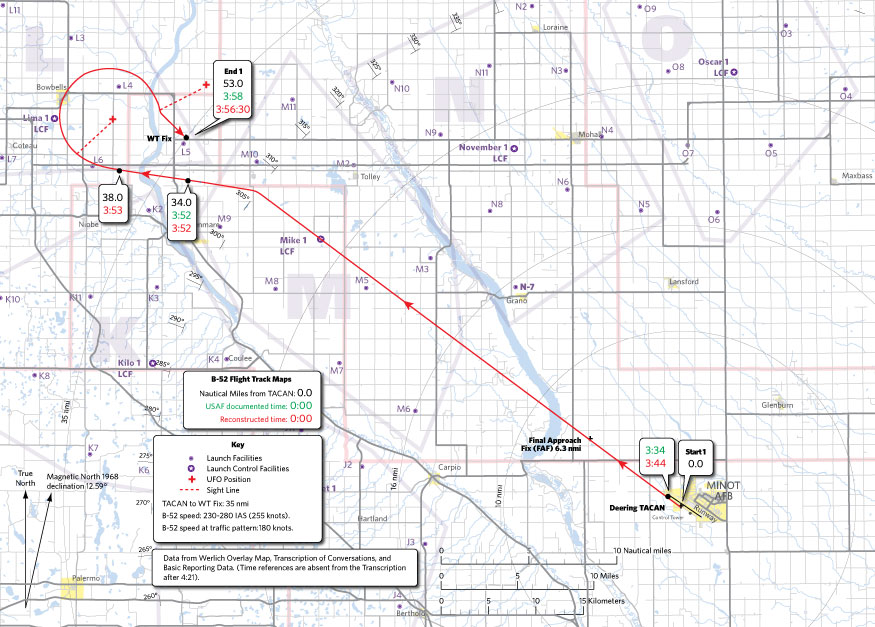
At 3:52, RAPCON informed the pilots, “the UFO is being picked up by weathers [sic] radar also, should be your 1:00 position 3 miles now.” About a minute later, McCaslin observed the UFO on the B-52 radarscope off the right wing at co-altitude. As the B-52 banked around the wide turn, the UFO maintained its distance, while transiting 6 miles to the northeast outside of the B-52 turn radius, to a position 3 miles off the left wing after the turnaround.
Following the turnaround, the UFO began pacing the B-52 until the aircraft reached the WT fix to begin the descent back to the base. At this point, within a 3-second sweep of the radarscope, the UFO appeared to instantaneously close distance to one mile on the aircraft at what would be an extremely high-rate of speed, while altering course to match the heading, speed, and descent of the B-52.[102]
Werlich’s original report to Blue Book included estimates of the closure speed, and acknowledges a right to left (of the aircraft) passage of the UFO, though the sequence is transposed:
Initially the target traveled approximately 2 1/2 mile in 3 sec or at about 3,000 mi/hr. After passing from the right to the left of the plane it assumed a position off the left wing of the 52.[103]
On the other hand, in the official report, he omits the UFO passing from right to left of the B-52, and simply notes after the turnaround, “A BRIGHT ECHO SUDDENLY APPEARED 3 MILES ABEAM AND TO THE LEFT OF THE AIRCRAFT.” Moreover, he does not provide specific data or estimates of the closure rate, other than stating, “THE ECHO RAPIDLY CLOSED ON THE AIRCRAFT.”
[2] AFTER ROLLING OUT OF A RIGHT TURNAROUND TO THE TACAN INITIAL APPROACH FIX, A BRIGHT ECHO SUDDENLY APPEARED 3 MILES ABEAM AND TO THE LEFT OF THE AIRCRAFT. THE ECHO RAPIDLY CLOSED ON THE AIRCRAFT AND REMAINED AT ABOUT 1 MILE.[104]
Although Werlich remains oblivious to the weather radar detection of the UFO, he nevertheless provides the exact location of the B-52 at the time of the initial air-radar observation at “38 NAUTICAL MILES NW 300 DEGREES RADIAL.”[105] He indicates the same location on his Overlay Map, including the initial position of the UFO three miles to the right of the B-52, and the secondary position of the UFO six miles northeast of the original position (three miles to the left of the B-52 after the turnaround).

Partial scan of Werlich’s Overlay Map showing the B-52 flight track and 180-degree turnaround back over the WT fix (black circle). The UFO positions (X’s) and flight track are in red, while the blue section is Werlich’s estimate of where the radarscope photos were exposed. Werlich also indicated six lat./long. coordinates on the Overlay to accurately align it onto a base map. [Click for complete Overlay Map]
On Thursday, 31 October, in responding to Marano’s earlier request for information on other radar systems, Werlich insisted the only radar system that detected a UFO was onboard the B-52.
Anyway, I’m sending the RAPCON TAPES, PHOTOS, and an overlay showing a movement of the aircraft, description of the aircraft movement prior to VFR [Visual Flight Rules].[106] Aircraft was going through maneuvers and it would be almost impossible to track it perfectly cause he was doing steep turns, “S” turns, etc. Now time and duration of the sighting was in my message. Speed of the B-52 was in the TWX. I only stated one radar in the message because there was only one radar set. The [B-52’s] ECM [Electronic Counter Measures] equipment hadn’t been used. RAPCON was painting, IFF [Identification Friend or Foe] equipment was operating in the airplane. It’s a fairly good size blip. Every time it sweeps it shows the blip. The object would have been covered by the blip. There is a Sage site to the south [Minot AFS]. They do not remember having any unidentified paints. The only one I have is the one on the plane.[107]
Even after Werlich sent Blue Book “the RAPCON TAPES” confirming the weather radar detection of a UFO correlated with the B-52, in the weeks following he did not respond to requests from Marano for additional information regarding the weather radar.[108] Werlich also said he would send Blue Book an “overlay showing a movement of the aircraft.” Later in the conversation, he informed Marano that the overlay was based on a classified 200-series bomb-targeting map chart, and due to security restrictions he was sending an overlay to save time, while directing Blue Book to acquire the classified master chart at Wright-Patterson AFB. He then told Marano:
Gen Hollingsworth has been given all the information that Col Werlich obtained. Col Werlich said that Gen Hollingsworth was briefing Gen Compton and this briefing was probably going on at the time that Col Werlich was speaking with Lt Marano (time was approx 2 pm, EST, [Thursday] 31 Oct).[109]
The impression is that Werlich prepared the original map at the behest of Hollingsworth for briefing SAC Commanders. Following receipt of the Basic Reporting Data, if Blue Book had not specifically requested the supplemental information it seems unlikely that Werlich would have forwarded any of the supporting documentation.
B-52 Loss of Radio Transmission
At 3:58, as the B-52 cleared the WT fix, within one sweep of the radarscope the UFO appeared to instantly close distance on the aircraft. At the same time, the B-52 radio transmitters failed. When the UFO departed and communications resumed after 4:02, RAPCON queried Capt. Runyon wondering “if that could have been your radio troubles,” to which he responded, “I don’t know, but that’s exactly when they started.”[110]
According to Werlich, when the echo rapidly closed to one mile:
[2] AT THIS MOMENT THE UHF TRANSMISSION FROM THE B-52 TO RAPCON WAS INTERRUPTED IN MID-SENTENCE. THE RADAR ECHO CONTINUED WITH THE AIRCRAFT DURING ITS TACAN PENETRATION FOR ABOUT 20 MILES. RAPCON HAD REQUESTED THE AIRCRAFT TO CHANGE UHF FREQUENCIES TWICE BUT THE AIRCRAFT WAS UNABLE TO TRANSMIT ON EITHER FREQUENCY. THE B-52 UHF RECEIVER WAS NOT AFFECTED NOR WAS THE IFF/SIF IDENTIFICATION FEATURE AFFECTED. DURING THIS TIME, RADAR SCOPE PHOTOS WERE OBTAINED AND CLEARLY SHOW THE RADAR ECHO. AS SOON AS THE ECHO DISAPPEARED THE B-52 UHF TRANSMITTER BECAME OPERATIONAL.[111]
Werlich stated that “RAPCON REQUESTED THE AIRCRAFT CHANGE UHF FREQUENCIES TWICE BUT WAS UNABLE TO TRANSMIT ON EITHER FREQUENCY.” According to the communications transcript, at 4:00, RAPCON requested the B-52 “attempt contact on frequency 271.3” without response, until 4:02 — after the UFO had disappeared from the radarscope — when they were asked to change to 326.2 and heard loud and clear.[112] On Thursday, referring to the fact that the B-52 had two separate UHF radios onboard; Werlich explained to Marano that the crew changed both radios with no difference in functioning, which discounts the possibility of equipment malfunction.[113]
The unusual part is the B-52 was in the middle of a sentence and the voice just quit transmitting right in the middle of the word. Because we had an accident a couple of weeks ago we were quite interested. Ground control asked them if they had any trouble to give Mayday Squawk. The airplane changed both UHF and neither would transmit but they could receive, and each time to show that they could receive they hit the ident squawk which would last for thirty seconds each time. There was quite a bit of this. The navigator [saw] the paint disappear as fast as it appeared. My personal opinion is that it couldn’t be a malfunction because they transmitted before and afterwards. The aircraft was not checked out afterwards because the transmission was working. I didn’t know if the heavy haze would have been enough to blank out the transmission.[114]
Later in his comment section, Werlich listed the radar echo and loss of transmission as two of the
(6) FOUR OCCURRENCES THAT CANNOT BE CORRELATED OR EXPLAINED AT THIS LEVEL ARE: (A) WHAT CAUSED THE AIRCRAFT RADAR ECHO. (B) AIRCRAFT LOSS OF UHF TRANSMISSION.[115]
Certainly there is a correlation between the close approach of the UFO and the UHF transmission failure. Later, during the B-52’s overflight of the UFO on or near the ground, Runyon recalled that the radio transmitters failed again.[116] In both instances, none of the B-52’s other electronic equipment was affected, nor the radio reception and ability of the SIF/IFF transponders to transmit.[117]
The B-52 continued on its descent to Minot AFB. At 4:02, after the UFO had disappeared from the radarscope and radio communications fully resumed, the aircraft was about 19 nautical miles from the runway emerging below the overcast at 9,000 feet MSL. These estimates are based on our reconstruction of the B-52’s flight track, supported by Dr. Claude Poher’s photogrammetric study of terrain features evident in B-52 radarscope photograph #783, which reveal a section of Lake Darling on the periphery of the scope.[118]

Radarscope Photo #783 superimposed on Werlich’s Overlay Map, a USGS map, and corresponding satellite image of a section of Lake Darling. Terrain features evident in 783 (on the periphery at 70 and 80 degrees) appear to correspond to Lake Darling, establishing the location of the B-52 at the time of the photo (4:06:51) at 18.8 nmi from the TACAN, at an altitude of 8865 feet MSL. No UFO echo is evident in #783. A satellite image of Lake Darling at the Grano Crossing is available from Wikimapia.
Werlich estimates the B-52 was closer to base at the time of the last radarscope photo:
RADAR ECHO ACCOMPANIED AIRCRAFT TO APPROXIMATELY 14 NAUTICAL MILES, 296 RADIAL, APPROXIMATELY 9,000 FEET MSL.[119]
[2] WHATEVER CAUSED THE ECHO WAS NOT VISUALLY SIGHTED BY THE AIRCRAFT CREW MEMBERS NOR WAS IT SEEN BY THE TOWER OPERATOR WHO WAS FOLLOWING THE AIRCRAFT PROGRESS THROUGH BINOCULARS. DUE TO HEAVY HAZE AND SEVERAL CLOUD LAYERS, THE AIRCRAFT WAS NOT VISIBLE THROUGHOUT THE APPROACH.[120]
Again, Werlich ignores information in the AF-117s. In fact, the Base Operations dispatcher directed the ground observers at N-7 to the precise time and location of the incoming B-52 in the west. At 4:02, the UFO had disappeared from the radarscope as the B-52 emerged below the overcast at 9,000 feet. The ground observers were completely unaware of the B-52’s air-radar UFO encounter and loss of radio transmission, while under the impression that the aircraft had been diverted to check out their UFO observation in the southeast. For example, O’Connor noted, “a B-52 was sent to the area to check out the sighting and was seen west of the object at first.”[121] Security Alert Team member A1C Jablonski compared the bright illumination of the UFO to the landing lights of the incoming B-52:
When the B-52 had flown in its search, it had been using its landing lights which were quite similar in nature. As to avoid confusion between the plane and the object, Base Ops had pointed out where and when we saw the B-52. Must add that the B-52’s engines could be easily heard, while the UFO made no sounds to be heard at about the same distance.[122]
For over an hour, the observers at N-7 had been reporting a UFO in the southeast, but by the time the B-52 appeared high in the west, the UFO had gradually descended to the horizon and was no longer seen in the area.[123]

Clearing the WT fix, the UFO closed to one mile and the B-52 radio transmission failed. According to the transcription, communications fully resumed at 4:02, after the UFO had disappeared from the radarscope. The observers at N-7 were directed to the time and location of the incoming B-52 and would have first observed the aircraft as it emerged below the overcast at 9,000 feet. According to Poher, at the time of the last radarscope photo (4:00:18 by our reconstructed time), the B-52 would have appeared in the west-southwest at about 6.5 miles from N-7, at an altitude of 8865 feet. At the same time, the UFO they had been observing in the southeast disappeared from view. It is notable that the UFO pacing the B-52 disappeared from the radarscope shortly before emerging below the overcast into view. In addition, our reconstructed time during this segment is about 1 minute and 30 seconds behind the documented time; perhaps because the B-52 speed during the turnaround back over the WT fix was less than our average of 255 knots.
After the B-52 passed by on its way to the base, the observers at N-7 returned to their respective duties. O’Connor and Isley completed their maintenance work at N-7, secured the site and returned to base. Jablonski and Adams went on patrol, while remaining in radio contact with the Base Operations dispatcher.[124] Along with SSgt. Bond, they continued reporting a UFO in the west until at least 5:18. According to Jablonski:
Prior to our return to N-1 it caught our attention again, this time WSW in location. It had appeared as before starting bright orange-red, to white and finally green. The object was stationary at the time and appeared aprox. 1,000 FT above ground. The green light started to diminish slowly [until] no longer seen.[125]
B-52 Air-Visual Observation
The B-52 continued on descent to Minot AFB. According to the communications transcript, after 4:04, RAPCON cleared the B-52 for “low approach report missed approach” to the runway. Following this, procedures required RAPCON to direct the B-52 onto the radar traffic pattern, which would ultimately bring them back around to final approach. By 4:06, they had passed the runway and were turning left on the 335-degree crosswind leg of the traffic pattern, at a standard altitude of 3200 feet MSL (more or less 1,500 feet above the ground). After 4:09, RAPCON advised the pilots that if radio transmissions fail while in the traffic pattern they were cleared to take over visually; then vectored the B-52 to turn left to a heading of 290 degrees onto the downwind leg. After a few minutes, this would bring them out in the vicinity of N-7. At 4:13, RAPCON queried Runyon whether they were “observing any more UFOs,” to which he responded, “Negative on radar, we can’t see anything visually.” The controller affirmed, “The personnel from the missile site advise they don’t see anything anymore either.”[126] RAPCON then provided the remaining vectors directing the B-52 to final approach at 4:17.

First go-around of the traffic pattern after a low approach and missed approach to the runway. After 4:06, the B-52 is turning onto the 335-degree crosswind leg. [Note: 4:06:14-4:06:51 is also the time recorded on the radarscope photos, suggesting that the B-52 onboard time was ahead by 6-7 minutes.] At 4:13, RAPCON asks the pilots whether they are “observing any more UFOs,” before providing the vector for the turn onto the 200-degree base leg. Total flight time is 13:51 minutes.
According to B-52 crewmembers, some time after radio communications resumed the pilots received an unexpected request from a General officer to continue back around the traffic pattern and overfly a UFO on or near the ground.[127] Runyon reluctantly agreed, and rather than landing, at 4:21, requested another “vector around for an IFR, surveillance approach” with a terminal landing or “full stop” at 4:40.[128] RAPCON confirmed, then directed the B-52 to once again “turn left heading 335 maintain 3200” onto the crosswind leg; reminding them that if the radios fail they are cleared to take over visually and land. After this, the remainder of the time code references, including RAPCON’s next vector for the 290-degree downwind leg (when the pilots observe the UFO ahead of the aircraft for several minutes before turning over it), are conspicuously absent from the communications transcript.[129] At some point, RAPCON informed the pilots, “JAG 31 (garbled) requests that somebody from your aircraft stop in at baseops [Base Operations] after you land,” then provided the 200-degree vector to the base leg, 140-degree dogleg, and finally, a 115-degree vector to an “extended final” approach.[130]

Second circuit of the traffic pattern. Since time references are omitted from the transcription following 4:21, we have plotted several possible patterns that would bring the B-52 to a full stop with engines off at 4:40. Total flight time is between 15:02 and 17:05 minutes, which is an additional 1-3 minutes compared to the first go-around, indicating that the B-52 flew further out (to the north and/or west) during the second go-around.
The communications transcript reads as if both circuits around the traffic pattern were merely routine and uneventful.[131] In fact, during the second go-around, as the B-52 was turning onto the 290-degree downwind leg, pilot Major James Partin observed a
bright orange ball of light at my one o’clock position. It appeared to be about 15 miles away and either on the ground or just slightly above the ground. The light remained stationary as we flew toward it. I turned onto the base leg about one mile to the South of the light and was above it. The light did not move during this time.
He noted the location of the initial observation as 10 miles northeast of Minot AFB, and the time of the air-visual observation as 4:30-4:35.[132]
According to co-pilot Capt. Bradford Runyon:
RUNYON: Just as soon as we rolled out at wings level [on the downwind leg] there was an orange glow sitting out there, almost off our nose about 11:30 position, a little bit to the left side of the airplane, so we were heading straight to it.
Runyon got busy completing the routine checklists in preparation for landing, but when he eventually looked up and out the pilot’s window they were flying alongside a very large UFO.
RUNYON: We are level and don’t bank until we get right to the end of it. Major Partin started his turn as we got abreast of the end and turned almost over the top of the thing. I am sure we were told to turn by the ground controllers so they knew exactly where we were in relation to it.[133]
During the second go-around, Runyon recalls that RAPCON provided the vectors to fly directly to the location, and turn onto the base leg around and over the top of the UFO. On the other hand, Partin simply notes in his AF-117, “I turned onto the base leg about one mile to the South of the light and was above it.” Werlich locates the B-52 at the 200-degree turn onto the base leg of the traffic pattern for the first go-around: “POSITION OF AIRCRAFT DURING VISUAL SIGHTING: 14 NAUTICAL MILES 320 RADIAL OF THE DEERING TACAN AT 3200 FEET MSL.”[134] He also indicates the location of the UFO within a rectangle representing the “probable area of aircrew ground sighting” two miles further out on his Overlay Map.
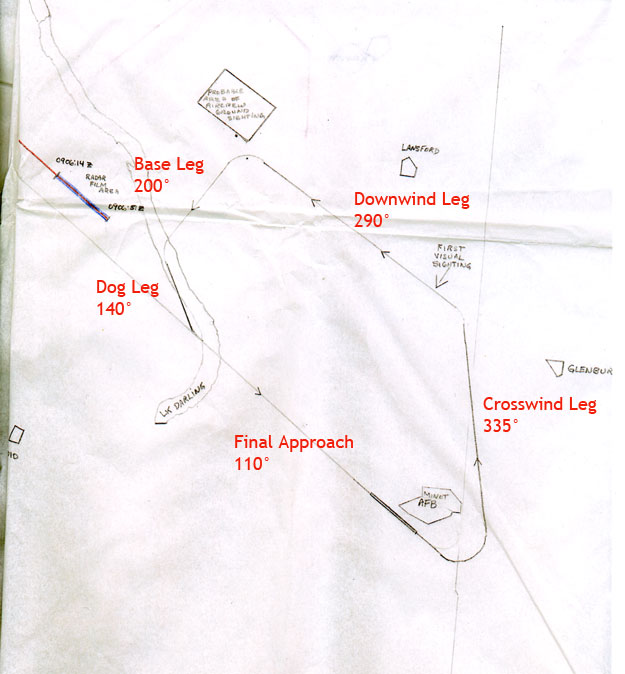
Partial scan of Werlich’s Overlay Map showing the first circuit around the traffic pattern. Werlich did not plot the second circuit, when the pilots observed and overflew the UFO on or near the ground.
Werlich did not interview the B-52 crewmembers, and it seems he did not personally interview Partin before completing the Basic Reporting Data. His brief account is at variance with several details compared to Partin’s AF-117 questionnaire, which was completed two days after submitting the Basic Reporting Data. For example:
[2] REMAINING AT RADAR TRAFFIC PATTERN (3200 FEET MSL) THE AIRCRAFT COMPLETED ONE GCA [Ground Controlled Approach] AND MISSED APPROACH AND WAS ON A HEADING OF 335 DEGREES [“As I turned on to the (290-degree) downwind leg … I saw a bright orange ball of light.”] FOR A RADAR VECTOR TO THE GCA DOWNWIN[D] LEG WHEN THE INSTRUCTOR PILOT, SITTING IN THE RIGHT SEAT [Partin was piloting from the left seat] VISUALLY SIGHTED AN OBJECT AHEAD AND BELOW. AS THE AIRCRAFT APPROACHED TO WITHIN APPROXIMATELY 2 MILES [“I turned about one mile to the South of the light and was above it.”], THE OBJECT SEEMED TO REMAIN STATIONARY AND CLOSE TO THE GROUND. VISIBILITY WAS REPORTED AS 25 MILES AT THAT ALTITUDE. THE AIRCRAFT TURNED ONTO THE BASE LEG, LOST SIGHT OF THE OBJECT AND CONTINUED WITH A GCA AND TERMINAL LANDING.[135]

Maj. Partin’s drawing of the UFO in his AF-117 Questionnaire (p. 6). In a 2001 interview, he recounted that at 1500-1700 feet altitude a house on the ground appeared to be about the size of a die, or a Monopoly house, and the UFO appeared to be much larger than that. The second drawing (bottom) represents the head of a match at arm’s length overlaid on the orange ball of light. The match head is about 1/4 the diameter of the ball of light, and the object is about 100 arc minutes. Partin states that he turned "one mile to the south of the light and was above it" (4), whereas, Werlich states approximately 2 miles to the south (BRD, 7). At 1-2 miles, the object would be about 150-300 feet in diameter.
Werlich’s description of the UFO also varies from Partin’s account:
WHEN VIEWED FROM ABOVE BY A B-52 CREW, THE OBJECT [HAD A] FAINTLY WHITE OBLONG HALO ON ONE SIDE WITH AN ORANGE SPOT ON THE OTHER SIDE AND THE BODY APPEARED TO BE A BRIGHT WHITE LIGHT.[136]
Partin did not describe “AN ORANGE SPOT,” or the body appearing “TO BE A BRIGHT WHITE LIGHT” in his AF-117. Rather, he described it twice as a “bright orange ball of light,” which compared to a common object looked “like a miniature sun placed on the ground below the aircraft.” These differences suggest that Werlich received a second hand account of Partin’s observation, most likely from Base Commander Col. Kirchoff, subsequent to Partin’s debriefing in Base Operations after landing.
Our 2001 interview with Partin provided some additional details, including his recall of the air-radar encounter that was not mentioned in his AF-117.
PARTIN: I recall we were on a crew mission and we were back in the local area at Minot, and we were about ready to make our penetration and low approach, and I guess we were in the neighborhood of 20,000 feet probably. The radar called and said he had a return off the left wing and did I see anything? I looked up there and did not see anything. All of a sudden, he said “God Almighty!” and I said, “What’s wrong?” He was alarmed, you know, he said that whatever that was took off to our left at a tremendous rate of speed, he couldn’t even measure it.
INTERVIEWER: Is he seeing this on the radarscope?
PARTIN: Yeah, he watched it go. So we forgot it and went on down and were shooting low approaches in the traffic pattern. Somewhere in the process, I changed seats, got into the co-pilot’s seat. I don’t remember doing that — but I remember looking off to my right probably about the 2 o’clock position, as they used to say, and low and I saw a — it was sort of oblong, there were, looked like windows around it that were lit and it was just hovering there… . We must have been around 1500-1700 feet above the ground — you could see houses on the ground from that altitude, and they looked like, you know, the size of dice — a die.
INTERVIEWER: Maybe like a Monopoly house?
PARTIN: Yeah, right, and this was much larger than that… . When I described to the crew over the interphone what I was seeing the navigator, the radar navigator, and everybody tried to get up in our lap in the cockpit and — [laughs]. [137]
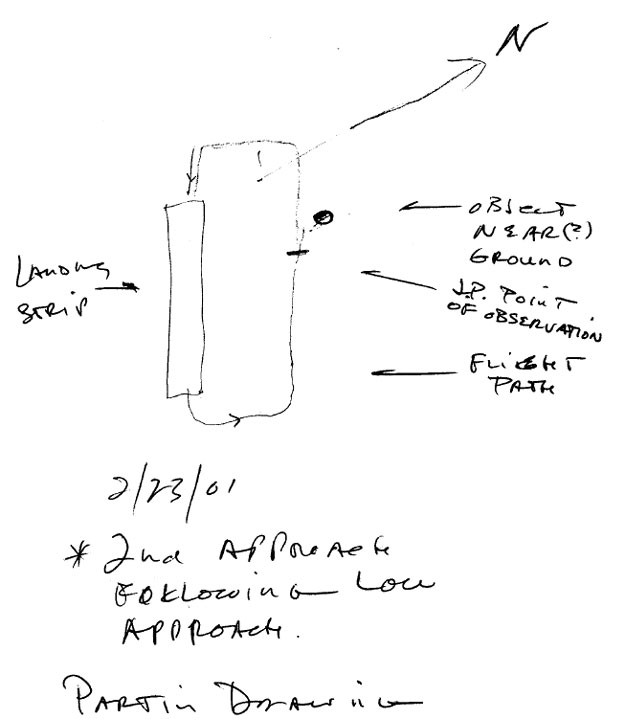
Maj. Partin’s drawing made during our meeting in February 2001. The notations are mine based on information provided by Partin. In his AF-117, he noted it was an “unusually bright light I had never seen at night in this area,” which “appeared to be about 15 miles away” and either on or slightly above the ground. It disappeared from view when he “turned onto the base leg about one mile to the South of the light and was above it” (4, 5). Whereas, Capt. Runyon recalls that the UFO was a little to the left of the B-52, inside the turn radius, and they flew alongside before turning over and around the UFO onto the base leg of the traffic pattern.
While Partin’s preoccupation was piloting the B-52 at low altitude, Runyon would have been in a better situation to view the UFO. In a 2000 interview, you get the impression from Runyon’s descriptions that he is struggling to make sense of what he is seeing, over too brief a time.
RUNYON: We were vectored back around over the thing and on our downwind leg, or base leg, then perpendicular to the runway, we were just to the outside of it, so Major Partin could look right down into — over the object. I was in the right seat so I had to look sort of across the airplane. Well, anyway our radios went out again, of course every time the radios went out, you know, they thought we had a problem… . Anyway we’re looking and surrounded by the airplane too, close to the ground things go by real fast so I didn’t have a long time to look at the object, but I could see the part that was — everyone said it was glowing, but anyway, there was pretty much an egg-shaped object on the ground, okay? It was lined up with the runway, but the orange glowing part, which looked like either molten metal, or lava, something like that — it wasn’t shiny or glowing. I mean it was just, well, it was dull… . But the one part that sort of made me wonder whether the thing had turned around, or why it was pointed in the direction it was, then there was a shiny tubular section that came from the end, away from the runway, it was a smooth metallic-looking round tunnel. It attached to a sort of crescent moon-shaped object, which sort of wrapped around the one end of the larger mass, and it was smooth, shiny, metallic-looking, and —
INTERVIEWER: Like a bumper?
RUNYON: Yeah, only bigger, it was a pretty good size too.
INTERVIEWER: The bumper was separated from the object?
RUNYON: Yes, by this tunnel-like thing. But, where the object was curved on the back end — or the front end, whichever it was — the metallic part also had the same curvature, and it was the same width as the rest of it, but just wasn’t very long. I tried looking in there. I could see some lights, and it seems to me I can remember green and yellow. There were lights, and I thought I should be able to see objects in there. We went over real fast and I really couldn’t distinguish anything inside.[138]
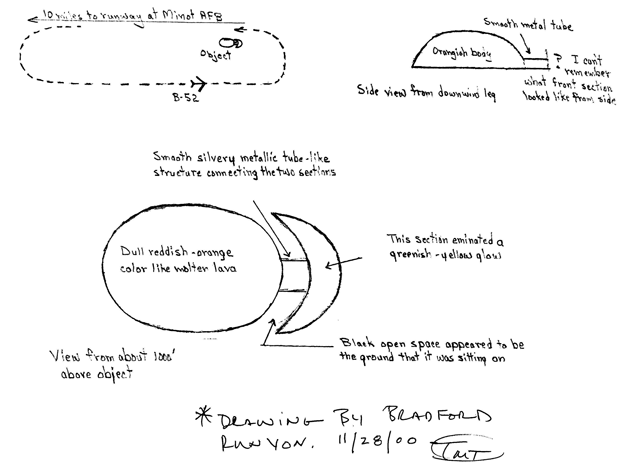
apt. Bradford Runyon’s drawing of the UFO following our initial interview. He cautiously estimated the size as 200 ft in length; 100 ft in width; and 50 ft. in height. At 3200 MSL, their altitude would have been around 1500 feet above the local terrain.
Based on discussions overheard from the flight deck, the impression of B-52 navigator Capt. Patrick McCaslin was that they flew directly over the UFO.[139]
McCASLIN: The first time I was aware that the pilots saw anything was after that low approach, when we came back and were basically bombing the position, and when they — there was an expletive from the top, they started describing this thing and asking if I wanted to come up and see it. After the fact, when we were talking in the debriefing, and as we were taxiing in and all that, everybody agreed it was pretty spectacular.
INTERVIEWER: Did he describe it to you?
McCASLIN: I don't remember if it was Brad or one of the other pilots. The description to me was this: that it was an elliptical shape, kind of a cough drop-shaped thing, glowing orange with a boomerang exhaust, or boomerang-shaped exhaust, or whatever — a fluorescence off one end the same color. And that’s all I remember of the description.[140]
Werlich listed the air-visual as the third of
(6) FOUR OCCURRENCES THAT CANNOT BE CORRELATED OR EXPLAINED AT THIS LEVEL ARE: … (C) THE CAUSE OR SOURCE OF VISUAL AIRCRAFT SIGHTING OF A BRIGHTLY LIGHTED OBJECT AS PREVIOUSLY DESCRIBED IN PARAGRAPH A(6) AND A SIMULTANEOUS GROUND SIGHTING IN APPROXIMATELY THE SAME LOCATION.[141]
Werlich is under the impression that ground personnel observed the B-52 overflight of the UFO.[142] In his original report to Blue Book on 24 October, he noted the location of the UFO “about 10 miles northwest of the base,” which is the location of the bright UFO “moving in a large circular area to the south” of N-7 reported by O’Connor and Isley at 3:00, until disappearing around 4:02. Werlich assumes the UFO observed by personnel at N-7 was the same UFO later observed during the air-visual observation and overflight by the B-52 pilots. For example,
In response to the maintenance man’s call the B-52, which had continued its penetration run, was vectored toward the visual which was about 10 miles northwest of the base. The B-52 confirmed having sighted a bright light of some type that appeared to be hovering just over or on the ground.[143]
Early on Monday, 28 October, O’Connor and Isley met with Werlich to complete the AF-117 questionnaires. At this time, Werlich queried the maintenance team whether they did in fact observe the B-52 in close proximity to the UFO on the ground. Later, during his conversation with Marano on Thursday, he explained,
I (Col W) asked if they saw the B-52 come towards the object. We know the B-52 got real close to it. Did they see the object on the ground? (Lt M asked). They were able to see a light source while the 52 got in real close then it disappeared.
It seems that Werlich continues to confuse two distinct incidents separated in time. In fact, the ground observers at N-7 were completely unaware of the B-52’s close overflight of the UFO on or near the ground, which occurred about 26 minutes after their final observation. Nobody reported a UFO in this location, and even the Base Operations Dispatcher was not privy to RAPCON communications during the second go-around, and unaware of the air-visual observation by the pilots.[144]
Col Werlich said Lt Marano should get a section map of the area… . Look on map, half way down the runway, TACAN, 320 radius, 16 nautical miles. This is where aircraft saw the object. There’s farm fields there. There is nothing there that would produce this type of light. The same for O’Connor and [Isley] from November 7 which is near Grano. I have gone over that [area] with a chopper… . I (Col Werlich) think you will find that the most information comes from Airman O’Connor and Isley, and an aircraft instructor [Partin]. Much of their description and discussion incorporates the activity of the B-52. It was only at the end that I was unable [able?] to pin point the fact that they did observe a light source and the B-52. You can see the lights of the base for at least 50 miles away. I (Col W) asked if they saw the B-52 come towards the object. We know the 52 got real close to it. Did they see the object on the ground? (Lt M asked). They were able to see a light source while the 52 got in real close then it disappeared.[145]
Werlich is referring to the B-52 pilot’s air-visual observation of the UFO (at about 4:28), whereas, during questioning O’Connor and Isley were undoubtedly referring to their final observation of the UFO (at about 4:02), when the B-52 first appeared high in the west. At the time, all of the observers at N-7 were under the impression that the B-52 had been diverted to the area to check out their UFO sighting. In either case, they would have seen the B-52 “come towards the object.” They did “see the object on the ground,” low on the horizon in the southeast when it disappeared, and “they were able to see a light source while the B-52 got in real close,” as the aircraft also disappeared low in the southeast on its way to base.
In any case, these discrepancies underscore the lack of resources available for Blue Book investigators to collect and collate all of the available data, and methodically evaluate the information.
OSCAR-7 Break-in Investigation
Shortly after the B-52 landed, security alarms at the O-7 missile Launch Facility sounded in the Oscar-Launch Control Center.[146] It was highly unusual for both the Inner-zone and Outer-zone alarms to activate simultaneously, and in this instance, Oscar-Flight Security Controller SSgt. William Smith personally accompanied his Security Alert Team of A1C Donald Bajgiar and A1C Vennedall to secure the site.[147]

Oscar-7 Launch Facility located 24 miles north of Minot AFB to the south of ND Highway 5. By coincidence, at around 5:00 a.m., the maintenance team of O’Connor and Isley were driving by on their return to base, at the same time the Oscar-Security Alert Team was arriving to investigate the break-in.
Col. Werlich’s third comment in the Basic Reporting Data pertains to the missile silo break-in.
(3) AT 0949 ZULU (0449CDT) OSCAR 7 SITE’S INNER AND OUTER ALARMS SOUNDED AT WING SECURITY CONTROL. OSCAR 7 IS 10 MILES NORTH AND ELEVEN AND ONE HALF MILES EAST OF NOVEMBER 7. A SECURITY ALERT TEAM WAS DISPATCHED AND FOUND THE PADLOCK TO THE CHAINLINK FENCE OPEN AND THE FENCE GATE STANDING OPEN. THIS SET OFF THE OUTER ALARM. INSIDE THE COMPLEX, A HORIZONTAL DOOR HAD BEEN UNSECURED AND LEFT OPEN AND THE COMBINATION LOCK DIAL HAD BEEN TURNED OFF ITS SETTING THUS TRIGGERING THE INNER ALARM. NO TRACKS, PRINTS, OR IMPRESSIONS WERE FOUND.[148]
He listed this as the fourth of
(6) FOUR OCCURRENCES THAT CANNOT BE CORRELATED OR EXPLAINED AT THIS LEVEL ARE: … (D) THE OSCAR 7 ALARMS COULD BE ATTRIBUTED TO CIRCUMSTANTIAL EFFORT OF PRANKSTERS, HOWEVER NO EVIDENCE OF TRESPASSERS WAS FOUND.[149]
An attempt to break into an ICBM missile silo is obviously a serious security concern, though to achieve this required passing through formidable barriers. The 150 Launch Facilities at Minot are dispersed over a wide area to limit an attack from destroying more than a handful. Each of the 15 Launch Control Centers are responsible for 10 Minuteman missiles, while aboveground Launch Control Facilities constantly monitor missile security status.

The weather cover has been opened and the vault door removed (lower right), providing access to controls for raising the large primary door, or A-plug. (Photo: USAF, Western Launch and Test Range, Vandenberg AFB, CA).
Surrounding each Launch Facility is a chain-link fence, with a chain and padlocked entry gate, and onsite motion detectors that trigger the outer-zone perimeter alarms. Additional systems prevent unauthorized access to the missile and nuclear warhead. The underground missile silos and support facilities are hardened in concrete and steel, while access is protected by inner-zone alarm systems linked to the respective Launch Control Center, while also networked to the 91st Strategic Missile Wing, Security Control, and SAC headquarters.[150]
In order to access the missile silo and auxiliary equipment rooms required personnel to unsecure a weather cover (navy-style hatch) and enter a combination, which allows for the extraction of the vault door.
This provides the ability to retract the locking bolts, and operate the hydraulic controls that slowly raise the massive steel and concrete primary door (A-plug, or personnel access hatch), allowing access into the shaft. They would then descend a few feet down the shaft and enter another combination into the secondary door, or B-plug, allowing the retraction of several locking pins. The solid steel B-plug, weighing several tons, is suspended in the passageway on a large threaded rod from the lower level of the equipment room. Activating a switch, the plug requires at least 10 minutes to lower far enough for any human to enter the equipment rooms adjacent to the missile silo, while also allowing sufficient time for a Security Alert Team to arrive on site.

The B-plug in the fully retracted position, allowing access to the upper and lower launch equipment rooms surrounding the missile. (Photo: Library of Congress). In addition, see Bruce Ecker’s spherical panoramic photographs of Minuteman Launch Facilities at Ellsworth AFB, SD, from: The Minuteman Missile National Historic Site.
In the case of O-7, the gate had been unpadlocked and left standing open. Physical entry onto the site triggered the OZ alarm. In addition, the weather cover was unsecured and left propped open. Inside, someone had turned the combination dial on the vault door off of its setting, thus triggering the IZ alarm.
The unit history of the 91st Strategic Missile Wing for the fourth quarter of 1968 records security alarm violations for the 150 Launch Facilities at Minot AFB. For example, in October there were 17 IZ alarms and 387 OZ alarms. The OZ alarms decreased in October due to a decline in animal activity, but increased overall during the quarter due to accumulations of snow. The unit history also notes an ongoing problem with defective OZ transmitters, particularly their tungsten filaments, which frequently failed due to extreme weather conditions and age. There are no indications of any physical violations of the sites, or the 24 October O-7 break-in.[151]
Though Werlich suggested that this might have been the result of “pranksters,” he seemed less convinced during his final conversation with Marano. The timing of the break-in is quite curious with everything else that was going on, and it is hard to imagine that this violation would not be considered a serious offense.

Security Alert Team on patrol checking the vault door (B-plug), and (inset) the Flight Security Controller monitoring missile security status at the Launch Control Facility (Photo: USAF).
This is a sensitive subject. Anybody that could unlock the padlock wouldn’t be a prankster from the farm areas. There are keys for these padlocks and it’s hard to judge how many keys have been made. It looks like a navy hatch and underneath is the combination lock. Pranksters just couldn’t go and open it. The person, if it was a person, would have to know how to open it. We have had about three occurrences of this in the last two or three years doing this. All three of these cases were traced back to AP’s. Guys who had been in the service on these areas. It is not a serious offence. 99 chances out of 100, that if a person, a human being, accomplished this thing then it had to be somebody who had a key to the padlock. Lt Marano told Col Werlich that we have no evidence though that the UFO events did this. Col Werlich agreed but said that a Lieutenant examined the area the next day and could find no evidence of cars, tire tracks, footprints, etc. Col Werlich said he didn’t know if an examination [sic] investigation was going on or not but felt they probably were looking into it. Lt Marano asked him to get the results of their investigation.[152]
No further information was provided to Blue Book investigators.
Reports of Two UFOs
Werlich’s fourth comment refers to two similar objects observed concurrently by at least 14 ground observers from various locations, including the security personnel at Mike Flight, Juliet Flight, and Oscar Flight. Werlich simply notes:
(4) AT ONE POINT DURING THE GROUND SIGHTINGS, THE FIRST OBJECT WAS OBSERVED JOINED FOR A SHORT TIME BY A SECOND LIKE OBJECT.[153]
The Wing Security controller noted between 3:20 and 3:25 that
SSgt Smith at Oscar 1 saw the object separate in two parts and go in opposite directions and return and pass under each other. At this time Juliet Flt and Mike Flt Team observed the same things and described it the same way.[154]
During the same period, O’Connor, Isley, Jablonski, Adams, and Bond also reported two similar or “exactly the same” objects moving toward each other and one object disappearing.[155]
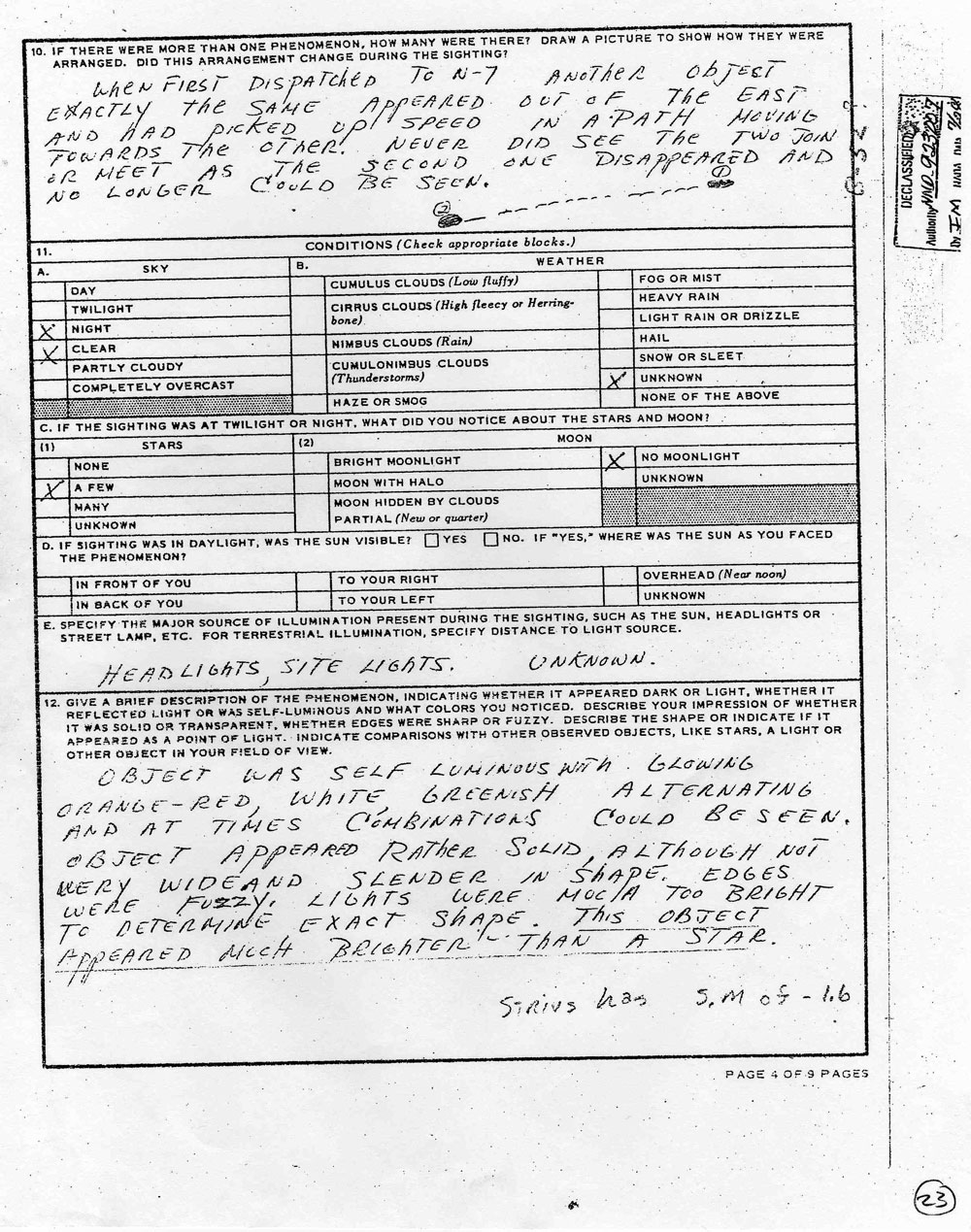

A1C Jablonski’s (above) and A1C Adams’ (below) AF-117 Questionnaires (p. 4). They were dispatched to N-7 shortly after their initial observation at 3:08. [Click each for full page]
Jablonski recalls when they first started out heading east to Mohall, before turning south towards N-7, they observed smaller lights that appeared to be coming off the larger object in the south and streaking to the north before fading out.
JABLONSKI: Well (gestures upward — circles hand), bright lights. Now these lights that I saw coming off it while we were going down there were small you know, almost like shooting stars but they weren’t because they were actually maneuvering (gestures curving paths), and they were going towards the direction of Oscar Flight.
INTERVIEWER: So this object you were seeing in the southeast — and those objects would have been to the east of you going up north?
JABLONSKI: Yeah, and [Adams] saw them too, but he did not want to see them (laughs). I said, “Look at what’s going on!”
INTERVIEWER: Did they just disappear; or come back?
JABLONSKI: They faded out, but there were so many of them.
INTERVIEWER: How many — more than ten?
JABLONSKI: Oh yeah. This is when we first started out, Then we focused mainly on the site [N-7] because we were getting more in a straight line [heading south], and then we were not seeing them anymore.[156]
Again, since Mike Flight extends to the west of N-7, Juliet to the south, and Oscar to the northeast, it is unfortunate that investigators did not acquire complete sighting data in order to triangulate the observer positions and establish the precise time and location of the UFOs.
Two UFOs were reported on at least three other occasions. For example, according to the communications transcript, at 3:30 [3:40] “Controllers received information on a UFO 24 miles NW” of the base (about 7 miles northwest of N-7), at the same time that observers at N-7 were reporting a UFO in the southeast at an estimated distance of 2-5 miles.[157] In addition, during the time of the B-52 air-radar encounter with a UFO at altitude high in the northwest (3:52-4:02), the observers at N-7 continued reporting another UFO in the southeast. Furthermore, the dispatcher noted an observation ostensibly by Bond at 4:26: “Object direct SW of N-1 moving north then lights went out,” which is during the time of the B-52 air-visual observation of the stationary UFO on or near the ground (4:24-4:28).

Locations of the ground observations at 3:20-3:25 of two objects separating in opposite directions and returning to pass under each other. Additionally, Jablonski and Adams on the road to N-7 observed a second identical object in the east on a path to the first, which got close and disappeared. O’Connor and Isley at N-7 noted, “at one time there were two in the area,” indicating a second object in the southwest. Bond at N-1 noted two objects moving toward each other, and the second object disappearing at the point of contact, which “was in view for only about three minutes” (AF-117s, 4).
The problem that Blue Book investigators faced was that ongoing observations occurred over a period of 3 hours, involving various, distinct groups of military witnesses. Quintanilla admitted as much when he informed Pullen, “This business of two hours is too long to make an accurate report.”[158] Given the mandate to reduce unidentified reports to the minimum, and inability to conduct a full-scale investigation, the only possible solution was to broadly generalize a natural phenomenon or object as a cause or stimulus for the reports. Quintanilla explains that rather than investigating, their process was to identify certain characteristics in the sighting reports and simply categorize them. In this case, he ultimately identified the cause of the observations as being a natural phenomenon — of which little is known of its physical nature, and no accepted theory exists for its cause.[159]
6. Project Blue Book Evaluation
On Friday, 1 November, Quintanilla consulted with a Mr. Goff at FTD. The previous day, Werlich had informed Marano he was sending additional information, including the RAPCON tapes, radarscope photos, and overlay map, however, at this time the only information available to Quintanilla was the Basic Reporting Data.
Talked to Mr. Goff, TDPA, who is quite familiar with air-borne radars. Mr. Goff said that from the evidence at this time it would appear to him that the sightings may have been precipitated by some type of ionized air plasma similar to ball lightning. He felt that a plasma could account for the radar blip, loss of transmission and some of the visual sightings. The entry of the missile site is being investigated by local authorities and with the information at our disposal at this time no explanation is offered.[160]
Later that day, Col. Quintanilla responded to Col. Pullen’s earlier request to submit a preliminary report for Deputy Chief of Staff/Intelligence Gen. Stewart “to get this thing simmered down.” He had previously told Pullen, “I’m (Col Quintanilla) pretty sure it was either caused by an internal radar malfunction that also caused the blip or because of the inversion he might have also picked up an anomalous blip,” however, he apparently reconsidered due to his conversation with Mr. Goff.
TO COL PULLEN SSO SAC. FROM LT COL QUINTANILLA. REFERENCE OUR TELECON WITH REGARDS TO MINOT AFB UFO’S. IT IS MY FEELINGS, AFTER REVIEWING PRELIMINARY INFORMATION SUBMITTED BY M[I]NOT THAT UFO PAINTED BY B-52 ON RADAR AND ALSO OBSERVED VISUALLY BY IP AND PERSONNEL ON GROUND IS MOST PROBABLY A PLASMA OF THE BALL-LIGHTNING CLASS. PLASMAS OF THIS TYPE WILL PAINT ON RADAR AND ALSO AFFECT SOME ELECTRONIC EQUIPMENT AT CERTAIN FREQUENCIES. PLASMAS ARE NOT UNCOMMON, HOWEVER, THEY ARE UNIQUE AND EXTREMELY DIFFICULT TO DUPLICATE IN THE LABORATORY. ALSO BECAUSE OF THE TIME DURATIONS, FEEL STRONGLY THAT SOME SECURITY GUARDS AND MAINTENANCE CREW WERE OBSERVING SOME FIRST MAGNITUDE CELESTIAL BODIES WHICH WERE GREATLY MAGNIFIED BY THE INVERSION LAYER AND HAZE WHICH WAS PRESENT AT MINOT DURING THE TIME OF THE UFO OBSERVATIONS. DO NOT CONSIDER THE PHYSICAL VIOLATION OF THE LOCK AS BEING RELATED IN ANY WAY WITH UFO’S. I CONSIDER THE UFO REPORTS AS FAIRLY ROUTINE, EXCEPT FOR THE PLASMA OBSERVATION WHICH IS INTERESTING FROM A SCIENTIFIC POINT OF VIEW. WE WILL STUDY THIS REPORT IN MORE DETAIL WHEN WE RECEIVE THE RAW DATA FROM MINOT.[161]
This is the first indication in the documents of a mechanism to explain both the air-radar and air-visual observations by the B-52 crew, which could also account for the loss of UHF transmission. Since “plasma of the ball lightning class” will be Blue Book’s final identification of the cause for the UFO reports, this would be an appropriate place to consider the basis for their conclusion.
“Plasma, Similar to Ball Lightning”
Plasma is the most abundant state of matter in the universe, which is visible as the electrically charged gaseous state of our sun and the stars. It is a distinct phase of matter separate from solids, liquids, and normal gases, which occurs at high temperatures when atoms are stripped of negatively charged electrons to form positively charged ions.
Most importantly, ionized gas can conduct an electrical current. The field of plasma physics is the science of ionized gases interacting with electric and magnetic fields that profoundly influence the state, either generated by current flows within the plasma (such as lightning), or applied externally. For example, the aurora borealis and australis is an affect of plasma accelerated from the sun's atmosphere into interplanetary space in the form of solar wind, compressing the earth’s magnetic field.

Massive explosions in the sun emit streams of electrically charged particles 3 million miles to Earth causing the northern and southern polar auroras. When the solar wind smashes into Earth's magnetic field, some plasma is swept towards the poles at the polar cusps. Collisions between these ions and atmospheric atoms and molecules result in energy (photon) releases in the form of auroras appearing in large circles around the poles. [Click image for alternate depiction]
Furthermore, lightning is a result of electrical discharges in the atmosphere breaking down into plasma, creating a conductive channel to earth for current in the form of a superheated lightning bolt to flash back up to the thundercloud. In all cases, a tremendously powerful source of energy is required to produce and sustain the state; otherwise, the plasma quickly dissipates and recombines as a neutral gas.
Ball lightning is an ephemeral phenomenon most often associated with thunderstorms. Witnesses typically describe a luminous ball one to 25 centimeters in diameter with the brightness of a domestic light bulb. It nearly always moves at speeds of about three meters per second, while floating about one meter above the ground; and may last up to 10 seconds or more, whereupon the ball extinguishes noiselessly or sometimes with a bang.[162]
It is a well-documented phenomenon in the sense that it has been observed for centuries, and in many cases by well-qualified observers. However, anecdotal descriptions vary widely making it difficult to distinguish its specific and defining characteristics.[163] Whatever it is, its appearance and behavior are unlike anything else we routinely come across in nature, however, without fully established properties, it cannot be argued to be an explanation for any strange report of a variety of glowing atmospheric phenomena.
Modern Mechanics and Invention, November 1931.
Still, scientists endeavor to formulate an explanation for the existence of ball lightning. For example, a popular explanation proposed by Nicola Tesla (1904), is that ball lightning is highly ionized plasma (plasmoid) contained by self-generated magnetic fields. However, on closer examination this hypothesis appears untenable, since the ionized gas would be extremely hot and rise like a hot-air balloon. Adding magnetic fields might solve the problem of the coherence of the plasma but would make it even lighter. Most importantly, what source of energy could sustain a stable plasma ball preventing it from rapidly dissipating?
Plasmas are notoriously unstable and by nature evanescent, except when suitably contained and provided a sustaining energy source. Any valid theory for ball lightning must incorporate the energy source. For example, John Lowke (1996) proposed an interesting mechanism to explain the occurrence of ball lightning occasionally reported to enter houses through screens or chimneys, and even through glass windowpanes. To account for this, he proposes that after a lightning strike to ground, a moving electrical field pulse following filamentary paths in the ground continually breaks down atmospheric gases above the ground, thereby producing a moving corona ball. The reforming of the ball as the field moves through the windowpane gives the observer the impression that the ball has passed through the windowpane.[164] While many theories have been advanced, none account for all reported characteristics; furthermore, it has not been created under laboratory conditions.
Though ball lightning has long been a scientific curiosity, renewed interest in the 1960s followed the publication of statistical investigations by J. R. McNally (1960) in the Proceedings of the Second Annual Meeting of the Division of Plasma Physics of the American Physical Society. Interest increased as scientific journals published on the subject and research opportunities became available. For example, in 1968, the Air Force Office of Scientific Research provided a grant to physicists at Westinghouse Research Laboratories to study ball lightning; and a popular book written by an editor for Aviation Week & Space Review theorized ball lightning might be the cause of many unusual UFO reports (Klass 1968).

Ball Lightning (bolbliksem) photographed by Mirjam Ruyter on 10 September 2005 in Rijswijk, Netherlands. The round, bright-white ball appeared near the power line of a tram where it remained for 3 minutes before vanishing. Photo source: Association for Meteorology and Climatology in the Netherlands. See: http://www.youtube.com/watch?v=sOYcGiNCBQ0.
In October 1967, under the auspices of an Air Force UFO study contract with the University of Colorado, a group of physicists expert in plasma and atmospheric electricity convened to consider the theory. They examined a report of a large glowing object that paced an RB-47 aircraft over a distance of more than 700 miles, which was observed as an intensely luminous light by the pilots, confirmed by ground-radar, and detected on sophisticated ELINT (Electronic Intelligence) monitoring gear onboard the RB-47. After review, the unanimous conclusion was that the object was not plasma or an electrical luminosity produced by the atmosphere.[165]
While the plasma-UFO theory found no support in the scientific community, it was occasionally useful to Blue Book in identifying some unique UFO reports, despite the fact it postulated one unknown phenomenon to explain another. Even so, the reported characteristics of the Minot UFO scarcely suggest a correlation to “plasma of the ball lightning class.”
For example:
- Most commonly, ball lightning observations occur during thunderstorms and are associated with lightning. Aside from the fact that late October is not when seasonal thunderstorms occur in northern climates, the weather was moderate and cool, with a high overcast, and visibility reported as 25 miles.
- Whereas a typical ball lightning is about the size of an orange or a grapefruit; in nearly all instances, the size of the UFO was described as very large — compared to the size of an aircraft.
- Whereas, ball lightning has a lifetime of 10 seconds to one minute, the UFO echo painted on the B-52 radar paced the aircraft for about 10 minutes. Later, the pilots visually observed the UFO in a stationary position on or near the ground for at least 4 minutes.
- Whereas, ball lightning typically moves horizontally about a meter above the ground at a velocity of a few meters per second, the UFO paced the B-52 from 20,000-9,000 feet altitude at speeds up to 280 knots (322 mph).
The only characteristics that correlate to some degree are color — typically red to yellow (though ball lightning is not particularly bright, or reported to change color); and the correlation to electromagnetism, which provided Blue Book with a justification for explaining the B-52’s radar echo and concurrent loss of UHF transmission.
Project Blue Book Final Report
On Thursday, 7 November, the Special Security Office at SAC Headquarters responded to Col. Quintanilla’s message of 1 November, prompting him to complete his analysis and forward a final case report.
REFERENCE YOUR TDPT MESSAGE REGARDING MINOT AFB UFO. SAC COMMANDER AND STAFF ARE EXTREMELY INTERESTED IN THIS ITEM. REQUEST A COPY OF YOUR REPORT OF THIS INCIDENT BE FORWARDED THIS HEADQUARTERS AS SOON AS POSSIBLE. IF ANY DIFFICULTY IS ENCOUNTERED SECURING RAW DATA OR ASSISTANCE FROM MINOT PLEASE ADVISE. YOUR EXPEDITIOUS HANDLING OF THIS INCIDENT IS APPRECIATED.[166]
Nearly one week later, on 13 November, Quintanilla completed his evaluation and forwarded the Minot UFO case report to SAC. The final report consists of a one-page letter providing his conclusions in the form of multiple-choice possibilities, and eleven pages of attachments cobbled together supporting the conclusions.
TDPT (UFO) 13 NOV 1968
UFO Observation, 24 October 1968
Special Security Office (SAC)
1. Reference SSO message 071540Z, with regards to evaluations of UFO reports from Minot AFB. The following conclusions have been reached after a thorough study of the data submitted to the Foreign Technology Division. The ground visual sightings appear to be of the star Sirius and the B-52 which was flying in the area. The B-52 radar contact and the temporary loss of UHF transmission could be attributed to a plasma similar to ball lightning. The air visual from the B-52 could be the star Vega which was on the horizon at the time, or it could be a light on the ground, or possibly a plasma. The physical violation of the lock of OSCAR 7 does not seem to be related to UFOs in any way.
2. No further investigation by the Foreign Technology Division is contemplated. For your information we are attaching a copy of the sequence of events, a resume of the sightings and a discussion of the background information.
FOR THE COMMANDER
HECTOR QUINTANILLA, Jr., Lt Colonel, USAF Chief,
Aerial Phenomena Branch, Aerospace Technologies Division, Production Directorate.[167]

Quintanilla explains the ground-based observations as appearing to be “the star Sirius and the B-52 which was flying in the area.” Misidentification of aircraft and celestial objects were useful default explanations, particularly when there was insufficient information available to rule out the possibility. In fact, an accurate reconstruction of the entire flight track of the B-52 was possible, since RAPCON controlled all movements and conversations were recorded with time references.[168] In any case, the notion that military personnel, whose work required them to remain at remote stations for days in the countryside surrounding Minot AFB, would not be familiar with routine movements, patterns, and sounds of jet-powered aircraft is disingenuous.
Quintanilla suggests that the haze and layered cloud conditions could have diffused the light sources making identification difficult. However, the overcast conditions only existed above 9,000 feet, while the B-52 would have been below these altitudes when it was in vicinity of the base, which is also when the landing lights would be turned on. In addition, such an explanation requires believing that more than 16 ground observers in various locations all misidentified the aircraft — an unlikely occurrence. It also requires that both the B-52 and the star Sirius account for the entire range of ground observations, implying that observers could not differentiate between a scintillating fixed star and a B-52 in flight.

Project Blue Book index card providing a brief description of the case. Note that time, length of observation, and physical evidence — submitted in the form of the radarscope photos — are inaccurate. Final Blue Book Statistical Data for the year 1968 categorizes the Minot AFB UFO case as Identified (Other) by Radar Analysis as plasma.[169]
For an extended period, the personnel at N-7 were observing a UFO in the south-southeast sky, though their descriptions scarcely suggest the misidentification of a fixed star.[170] Sirius is one of the brightest celestial objects in the sky and easily seen during the winter months due to its blue-white brilliance. At the time of the sightings, it was in the south-southeast to south sky at 159-175 degrees azimuth, ascending at elevations above the horizon from 22 to 24 degrees.[171] To account for the confusion of the observers, Quintanilla introduces contributing factors, including a moderate temperature inversion during the period.
Normally, rising air will cool at a uniform rate as it ascends in the atmosphere, creating a gradient in which temperature decreases by an amount known as the adiabatic lapse rate. Due to weather conditions, in certain situations a warmer layer of air above prevents the cooler air from rising, creating irregularities in normal lapse rates, while increasing the scintillation of celestial objects viewed through the atmosphere.[172]
Blue Book typically appealed to any evidence of a temperature inversion, especially when explaining anomalous radar echoes, since atmospheric inversion layers can refract and reflect radar waves, producing spurious returns on the radarscope. But recent evaluations by Martin Shough of Blue Book’s radiosonde data, including a more comprehensive data set provided by the U.S National Climatic Data Center, indicate gradients generally close to the mean, and do not support the conditions inferred by Blue Book.[173]
The view of the southeast horizon from N-7. During the times of the UFO observations on 24 October 1968, the star Sirius was ascending to the right. Bear in mind, if the reported overcast from 9,000 to 25,000 feet also extended to the south; it is unlikely these stars would be visible. For example, Smith at O-1 noted in his AF-117 that it was “completely overcast” and no stars were visible (4).
As previously discussed, the possibility that “plasma similar to ball lightning” could be the cause for the B-52 radarscope return is untenable, and without scientific foundation. On the other hand, Claude Poher has proposed that the loss of radio transmission could conceivably be the result of a zone of highly ionized air encompassing the UFO. For example, when the B-52 co-pilot pressed the button to transmit, the amplitude of the antenna's local electrical field would increase, immediately attracting the ions and electrons. With a thick layer of ions encircling the transmission antenna the transmitting energy would be absorbed in the agitation of ions and the heating of air. In this instance, the critical frequency (484 MHz) is superior to the frequency of communications (270 MHz), and the wave is absorbed rather than transmitted. In addition, the B-52’s IFF/SIF transponder transmitted without a problem since it operated above the critical frequency at 1 GHz.[174]
Quintanilla further suggests that ”possibly a plasma” could account for the large object visually observed by the B-52 pilots on or near the ground. Ball lightning is such a rare and ephemeral phenomenon that the probability of a huge ball of plasma maneuvering at various speeds near a B-52 for 10 minutes, and later appearing to hover near the ground for at least 4 minutes without any evident source of energy to sustain it, in actually fact constitutes a UFO in all but name. Nevertheless, Quintanilla provides two additional possibilities: “The air-visual from the B-52 could be the star Vega which was on the horizon at the time, or it could be a light on the ground.” Based on information supplied by Quintanilla in his report (Attachment #3-1), at the time of the observations the star Vega was about 345 degrees azimuth, and two degrees below the horizon. The B-52 heading was 290 degrees placing Vega to their right. In other words, for the pilots to observe Vega they would have had to view it out of the right side cockpit window — below the horizon line. In fact, they flew directly toward the object that was on or near the ground beneath them.
The view of the northwest horizon from N-7, during the times of the UFO observations on 24 October 1968. The star Vega was descending below the horizon to the right.
Finally, the suggestion that it “could be a light on the ground” fails to identify any source for the “unusually bright light never seen [before] in this area,” which “looked like a miniature sun placed on the ground.”[175]
The 24 October 1968 Minot AFB case provides a unique opportunity to examine official attitudes and Air Force policy regarding the UFO phenomenon. In this case, Quintanilla’s conclusions were typical of the methods, and faux science the Air Force employed to eliminate unidentified reports, and reassure the public of the lack of evidence behind UFOs. For over two decades the policy was successful, and continues to reinforce a prohibition on taking UFOs seriously. This is particularly true in authoritative public sectors where the publication of erroneous and more often misleading scientific data, sustained by the repetition of false narratives, has effectively established a culturally induced ignorance or doubt. What has always been lacking and remains so after more than 60 years is an objective, systematic scientific study of the UFO phenomenon — in a search for the truth.
Endnotes
[1] From 1946-1992, Strategic Air Command was the operational establishment of the United States Air Force, responsible for the bomber-based, and ballistic missile-based strategic nuclear arsenal. Minot AFB, in northwestern North Dakota, was a principal SAC dual-wing base, consisting of the 5th Bombardment Wing, with 15 B-52H Stratofortress strategic bombers capable of delivering nuclear and conventional ordinance worldwide; and the 91st Strategic Missile Wing, responsible for 150 Minuteman, Intercontinental Ballistic Missiles (ICBMs) housed in underground Launch Facilities scattered across an area of 8,500 square miles. In addition, the 862nd Combat Support Group provided base security and material support to the wings. At the time, the wings were subordinate to the 810th Strategic Aerospace Division at Minot AFB, which was responsible for mission support at Minot AFB, Glasgow AFB, MT, and Malmstrom AFB, MT. The 810th SAD was subordinate to the Fifteenth Air Force, March AFB, CA, and Strategic Air Command, Offutt AFB, NE. Today both wings continue operations under the major command of the Air Force Global Strike Command. For a better understanding of the military environment surrounding the UFO events, see: Background section.
[2] Schulgen, George F., Intelligence Requirements on Flying Saucer Type Aircraft (Draft of Collection Memorandum), 30 Oct. 1947. Available from: http://www.roswellfiles.com/FOIA/Schulgen.htm.
[3] Reflecting on the incredible events, Harry G. Barnes wrote in a widely distributed newspaper account that the UFOs seemed to “become most active around the planes we saw on the scope…. They acted like a bunch of small kids out playing. It was helter-skelter as if directed by some innate curiosity. At times they moved as a group or cluster, at other times as individuals over widely-scattered areas…. There is no other conclusion I can reach but that for six hours on the morning of the 20th of July there were at least 10 unidentifiable objects moving above Washington. They were not ordinary aircraft. I could tell that by their movement on the scope. I can safely deduce that they performed gyrations which no known aircraft could perform. By this I mean that our scope showed that they could make right angle turns and complete reversals of flight. Nor in my opinion could any natural phenomena account for these spots on our radar. Neither shooting stars, electrical disturbances nor clouds could either. Exactly what they are, I don’t know.” Quoted from: Harry G. Barnes, “How Radar Spotted Whatzits That Air Force Couldn’t Find,” Washington Daily News (July 30, 1952). Reprint available online (p. 16 of PDF) from: http://www.nicap.org/articles/newsarticlesJuly1952.pdf.
[4] The Background summary is abridged from: Sign Oral History Project, “History of the United States Air Force UFO Programs” (1947-1969). Source references are in the original work. In addition, the “Durant Report on the Robertson Panel Proceedings” is available from: http://www.cufon.org/cufon/robert.htm.
[5] United States. Department of the Air Force. Air Force Regulation No. 200-2, Unidentified Flying Objects (UFO), Washington D. C.: 20 July 1962.
[6] In July 1968, a research assistant to the University of Colorado UFO study, Herbert Strentz, queried Blue Book chief Lt. Col. Hector Quintanilla regarding the nature of the investigations: “We don’t investigate too much… .We collect data. It’s a misnomer to think we investigate.” Because this was contrary to Air Force chief of staff Gen. Thomas D. White’s statement that “all unidentified flying object sightings are investigated in meticulous detail by Air Force personnel and qualified scientific consultants,” Quintanilla was asked to clarify his statement: “We are more or less a collection agency… . We contact everybody we can with regards to trying to identify the stimulus which caused the observer to report a UFO sighting, however, this is not really investigating, this is checking details. We do use scientific disciplines to evaluate the information, however, this is an after the fact evaluation. We have only subjective statements made by the witnesses to work with … but we are not empowered to check the individuals background…Collection is part of the investigative process and we accept the data as fact, however, we seldom really complete the cycle… . You don’t really do much investigating when you check out satellite observations, astronomical observations, moving lights, weather balloons, etc.” Moreover: “We have certain characteristics for sightings…characteristics for astronomical reports, aircraft, balloons. If any of these (UFO reports) have characteristics that fall into such categories, the plausible answer is that it (the UFO) was that… . Sometimes there is a thin line in classifying a UFO, but if it falls in the category, it’s in the category. You can quibble… . But I cut them off when I think we’ve got the answer.” Herbert J. Strentz, “A Survey of Press Coverage of Unidentified Flying Objects, 1947- 1966” (Ph.D. diss., Northwestern University, 1970), 216-217; 224. In addition, Col. Quintanilla's unpublished manuscript entitled, "UFO’s: An Air Force Dilemma" is available from: http://www.minotb52ufo.com/pdf/Quintanilla-afdilemma.pdf.
[7] Abridged from: Sign Oral History Project, “History of the United States Air Force UFO Programs” (1947-1969), esp.: http://sohp.us/sign_oral_history_project/usaf/the_cia_robertson_panel.php. In addition: Jacobs, David M. The UFO Controversy in America (Bloomington, IN: Indiana University Press, 1975), 134-135.
[8] Werlich refers to a “Gen. Hollingsworth” twice (Memo, 1 Nov. 1968a, 4, 6). We have been unable to locate any information whatsoever on a General by this name in USAF records and SAC rosters for the period.
[9] Transcription of Recorded Conversations, Transcript of tape for 24 Oct 68, 0921+. The precise time of the request is unknown, since the time code references are omitted in the transcription after 4:21. “JAG 31” is the call sign for the B-52. The transcription is time-coded to GMT (minus 5 hours CDT).
[10] Later that day, when Werlich first reported the UFO observations to Blue Book he affirmed, “the Base Commander and Major General Nichols of the 15th Air Force were both interested” (Memo, 24 Oct., 1). It is likely that during the UFO events the Base Operations Dispatcher alerted Base Commander Col. Kirchoff, who subsequently notified his superior, Maj. Gen. Edward M. Nichols Jr., Vice Commander of the Fifteenth Air Force, March AFB, CA. In this scenario, Col. Kirchoff and Gen. Nichols may have been monitoring the situation with RAPCON; relayed the order to the B-52 pilots to overfly the stationary UFO; and requested the debriefing following the landing.
[11] Partin was not a regular member of this crew, but onboard during this mission being evaluated by Aircraft Commander Capt. Don Cagle to maintain ratings. “Since Major Partin was a little bit more senior than I was, he went in to tell what he had seen and so I have no idea what he said. We never discussed it afterwards” (Runyon 2000, 14). In addition: Goduto describes the routine post-flight procedures at: Goduto, Thomas, 2001. Transcript of interview by Thomas Tulien, 20 February (Sign Oral History Project), 23-24.
[12] Holland, Ralph T., 2005. Transcript of interview by Thomas Tulien and James Klotz, 20 February (Sign Oral History Project). B-52 EWO Goduto recalls that General Thompson debriefed them, however, at the time the only General stationed at Minot AFB was Holland (Goduto 2001, 24-25). Also: McCaslin, Patrick, 2001. Transcript of interview by Thomas Tulien, 25 February (Sign Oral History Project), 26-27.
[13] Clark, Richard, 2003. Transcript of interview by Thomas Tulien, 11 July (Sign Oral History Project), 9.
[14] Clark 2003, 19, 24. The original film was 35mm negative stock that analysts displayed on a viewer similar to a Microfilm reader.
[15] After leaving the AF, Clark passed on the first-generation radarscope photos to his brother-in-law, William McNeff, who preserved them and made them available to our research.
[16] Clark 2003, 23. In addition: “Basically, the big question was, ‘how fast is this puppy going?’ Nothing about how big it is, they wanted to know how fast it was going and what we felt it was. Hey, it’s going over 3000 mi. an hour, it’s a UFO guys; there’s nothing else that could do it. I don’t care what anybody says, there is no other explanation for that [indicating scope photos]. I mean, I don’t believe that we have the technology today to do what that — ” (Clark 2003, 24). Clark’s report is not included with the case documents, and it appears that Werlich and Blue Book staff were unaware of this analysis.
[17] Clark 2003, 22. A few days after the events, B-52 Navigator McCaslin recalls being at squadron headquarters when target studies officers invited him in to view the original radarscope film along with “a team from Washington looking at the incident” (2001, 36-37; 46-47). Also: McCaslin, Patrick, 2000. Transcript of interview with James Klotz (Sign Oral History Project), 15. In addition, Brad Runyon recalls that around 1995, while taking a civil services test he ran into a former high school classmate. During the conversation, he mentioned that he had been stationed at Minot AFB. In response, the former classmate said that the CIA had sent him to Minot to investigate an incident between a B-52 and a UFO. Runyon explained that he was piloting the B-52, and the AF concluded that what they observed was not a UFO, to which his classmate responded, “They lied. It was a UFO” (2000, 25). Unfortunately, we have been unable to identify and locate the former classmate.
[18] Holland 2005, 5-7. See U.S. Air Force Biography for Major General Ralph T. Holland available from: http://www.af.mil/information/bios/bio.asp?bioID=5835. USAF Fact Sheet for the 810th SAD available from: http://www.afhra.af.mil/factsheets/factsheet.asp?id=10152.
[19] Don Cagle planned to be in Atlanta for a job interview with Delta Airlines later that morning. When it became apparent they were being asked to search for a UFO he excused himself from the flight deck, leaving Maj. Partin and Runyon in charge. Cagle had missed an appointment with Delta one month earlier, due to an unannounced Operational Readiness Inspection (ORI). His concern was any direct involvement with the UFO events would require him to remain at Minot and miss another opportunity for a new career. Early that morning, he flew to Atlanta for the interview and was hired by Delta, resigning his commission in Jan. 1969. During recent interviews (7 Nov. 2000; 18 March 2001; and 27 Feb 2005), he claims to have no recollection of the UFO events. See: Runyon 2000, 9, 26; and McCaslin 2001, 27-28.
[20] Runyon, Bradford, Jr., 2005. Transcript of interview by Thomas Tulien, 25 February (Sign Oral History Project), 20-22. Also: Runyon, Bradford, Jr., 2000. Transcript of interview by Thomas Tulien and Jan Aldrich, 5 May (Sign Oral History Project), 15-17. In addition, Runyon, Bradford, Jr. 2000. UFO Sighting Questionnaire-General Form, 11 February (Center for UFO Studies, Chicago, IL). Standardization and Evaluation Board (STANBOARD, or STANEVAL) is an instructor certification given to the most proficient crews in order that they may administer the standardization program, including flight and ground evaluations to other squadron members. All of the B-52 crew were certified as instructors in their respective positions.
[21] McCaslin 2001, 29-33. Also: McCaslin, Patrick, 2000. Interview by Jim Klotz, 11 November (Sign Oral History Project), 10-11; 18-19. Holland’s story of the Air Police as recalled by Runyon and McCaslin, may be corroborated by 5th BMW intelligence officer SSgt. Richard Clark: “I don’t know how accurate it is, and I can’t remember who I heard it from, but it had to be somebody in the wing. I heard that they sent a crew out to one of the missile silos after the alarms went off and something happened to the crew, the motor stopped, the lights went off — I can’t remember. I don’t even remember which three silos went off. [Three silos?] Three separate silos went off and they ended up, what I did hear was that they couldn’t find anything” (2003, 14). B-52 EWO Capt. Goduto also recalled hearing about security intrusions at three missile sites. “What I understood, was that the intrusion alarms went off and security reaction teams responded but they found no locks, or no entries there.” Goduto, Thomas, 2000. Transcript of interview by Jim Klotz, 22 November (Sign Oral History Project), 5.
[22] Jablonski recalls: “You could hear them on the radio yelling that this thing was hovering above them or whatever. And we all went outside. Naturally, me and the other guy had to respond. On our way to the pickup, you know, everyone else was outside and you could see it (gestures to sky) — [Do you recall what they told you they were seeing?]. No, they were hysterical (laughs) like I said. Oh yeah, you could see it. And me and the other guy got in the pickup and started going down there…” Jablonski, Joseph, 2005. Transcript of interview by Thomas Tulien, 22 February (Sign Oral History Project), 10. Also, Bond recalled: “I remember the combat crew said something about the maintenance team was getting a little flaky out there and they might need some help from security, because they were getting a little scared” (2005, 21). O’Connor explained, “[Were you excited at all during — ?] Apprehensive, I wanted to know what it was I was seeing — didn’t understand what was going on and just knew that it wasn’t normal. I just wanted to report to the base that something was happening that I didn’t know what it was” (2005, 23).
[25] Goduto, Thomas, 2000. Transcript of interview by Jim Klotz, 22 November (Sign Oral History Project), 5. In addition: Goduto, Thomas, 2001. Transcript of interview by Thomas Tulien. 20 February (Sign Oral History Project), 27.
[26] Goduto 2001, 24-27. Judd recalled: “It was to me, and what the crew always called stuff like that was cover your ass type stuff, you know, in case somebody happened to ask them.” Judd, Arlie, Jr., 2001. Interview by Thomas Tulien, 27 February (Sign Oral History Project), 20-21.
[27] Basic Reporting Data and Format [Teletype], 290428Z OCT 68, SUBJ: UFO REPORT, 7-8. The actual date and time of the document is Monday, 28 Oct. 10:28 p.m. CST. Daylight Savings ended on 27 Oct and CST offset from GMT is minus 6 hours.
[28] Smith, William E., Jr., 2001a. Interview by Jim Klotz, 11 July (Sign Oral History Project), 8-10. Also: Smith 2001b, 13; 22-23.
[29] Smith recalls that at the time of the events his capsule crew contacted ADC at Minot AFS: “From what he was saying they were able to use some radar manipulations, and see something operating 50 miles above where we were in the general vicinity — they couldn’t pinpoint it, but they said 50 miles above” (2001b, 13).
[30] “The UFO is being picked up by the weathers [sic] radar also, should be your 1:00 [o’clock] position three miles” (Transcription, 0852).
[31] Memo for the Record, 1 November 1968a, Subj: Telephone conversation of 31 Oct 68, Col Werlich - Lt Marano, 4. In addition, Col. Weyant in Operations at SAC/HQ told Lt. Marano “he was trying to determine whether ADC had any known phenomena on radar” (Memo, 28 Oct. 1968b).
[32] Memo for the Record, 8 November 1968. Subj: Minot AFB Sightings; and Memo, 14 Nov. 1968, Telephone call of 13 Nov 68 to Minot AFB.
[33] Regarding ADC’s non-confirmatory posture: In the late 1960s, Grover Austad worked as an FAA controller in the SAGE building at Malmstrom AFB, MT. [Semi-automatic Ground Environment was a computer-based network of defense radars]. In a telephone interview conducted by Robert Hastings in December 2003, he recalled his involvement in the radar tracking of a UFO: “One night this object came on the radar and it was moving at tremendous speed. We estimated that it was flying about 2,400 mph. Now, the controllers who worked at SAGE knew about the SR-71 — even though it was still secret. But this thing, whatever it was, was even faster than that.” Austad continued, “So I called ADC — that’s Air Defense Command — to see if they had it too. The controller I talked to [affirmed], ‘Yeah, I see it, but UFOs don’t exist, do they?’ Then he laughed. The object played around for a few minutes. It zigzagged back-and-forth, covering hundreds of miles. Then it disappeared off the scope.” Austad said that this tracking — and similar ones that he heard about involving other FAA controllers at Malmstrom — were formally logged, and reported to the ADC radar unit at SAGE. “We always told them about what we saw [on radar], but they never gave us any feedback.” (This account was personally provided to this author by Robert Hastings).
[34] Blue Book was a low-priority project with minimal staff headed by a relatively low-ranking officer. Generally, sighting reports were not classified higher than Restricted. Information on security classification levels from: http://www.fas.org/sgp/library/quist2/chap_7.html.
[35] On 26 October 1962, at Malmstrom AFB, MT, the first operational-ready Minuteman I missile went on "strategic alert" after it was discovered the Soviet Union had placed nuclear missiles in Cuba. Over the next four days, the 10th Strategic Missile Squadron placed four more missiles on alert, with the last missile from Alpha-flight achieving alert status 10 November. The Soviets eventually removed their missiles from Cuba. Later, President Kennedy said the Soviets backed down because they knew he had an “Ace in the Hole,” referring directly to the Minuteman missiles of the l0th SMS. In November 1960, the USS George Washington (SSBN-598) became the first ballistic missile submarine to enter service with 16 Polaris A-1 missiles. Between 1960-1966, forty more submarines entered service.
[36] When President Dwight D. Eisenhower received his first report on the SIOP 62 (for fiscal year 1962), he commented that it “frighten[ed] the devil out of me.” An excellent history of the creation and evolution of the SIOP, including many declassified documents, is available from the National Security Archive website: http://www.gwu.edu/~nsarchiv/NSAEBB/NSAEBB130/index.htm#1. In the documents section, see Document 28: Headquarters, Strategic Air Command, History & Research Division, History of the Joint Strategic Target Planning Staff: Background and Preparation of SIOP-62, n.d., available from: http://www.gwu.edu/~nsarchiv/NSAEBB/NSAEBB130/SIOP-28.pdf.
[37] Gen. Stewart was assigned to Headquarters Strategic Air Command, Offutt AFB, NE, as Deputy Chief of Staff for Intelligence in June 1966. See USAF Biographies from: http://www.af.mil/information/bios/bio.asp?bioID=7265.
[38] Memo for the Record, 30 October 1968a, Subj: Telephone conversation [on 29 October] with Col. Pullen, Hq SAC. SSO-SAC is the acronym for the Special Security Office at Strategic Air Command headquarters. Originally, the SSO was under the authority of the United States Air Force Security Service (a subsidiary to the National Security Agency), responsible for devising encrypted communications capabilities and providing security support to military commands and other organizations receiving intelligence and communications. In 1965, the SSO functions transferred to the major user commands (MAJCOM). Within the commands, the primary function of the SSO officer is the management of Special Access Programs (SAP), and Sensitive Compartmented Information (SCI), in which even the extra protection measures applied to Top Secret information are not sufficient. The term refers to a method of handling certain types of classified information that relate to specific national security topics or programs whose existence is not publicly acknowledged, or of a sensitive nature requiring special handling. These “need-to-know” classifications necessitate a special “SCI access,” or SAP approval, before anyone can gain access to this information. For additional information see: http://en.citizendium.org/wiki/Compartmented_control_system.
[40] “Col Wyatt [Weyant] said he gave Col Werlich the guidance and he guessed that Col Werlich got our telephone number out of the regulation” (Memo, 28 Oct. 1968b).
[41] Memo, 1 Nov. 68a, 4, 6. We have been unable to locate any information whatsoever on a General by the name “Hollingsworth” in USAF records and SAC rosters for the period. It is possible that Werlich is referring to SAC Commander in Chief, Gen. Bruce K. Holloway, however it seems unlikely that the Commander in Chief would brief the Vice Commander. See USAF Biographies for Lt. Gen. Keith Compton from: http://www.af.mil/information/bios/bio.asp?bioID=5051. Gen. Bruce K. Holloway became Commander in Chief of SAC (CINCSAC) on 1 Aug. 1968. See: http://www.af.mil/information/bios/bio.asp?bioID=5837.
[42] Teletype, AFSSO FTD to SSO SAC, 012014Z (1 Nov. 1968c), TO COL PULLEN SSO SAC, FROM LT COL QUINTANILLA REFERENCE OUR TELECON. Perhaps Quintanilla was motivated to respond to Pullen’s request after learning of the SAC commander’s debriefing the previous day.
[43] Teletype, SSO SAC to AFSSO FTD, 071540Z (7 Nov. 1968), REFERENCE YOUR TDPT MESSAGE REGARDING MINOT AFB UFO. Quintanilla completed the report on 13 November, and forwarded a copy to the Special Security Office at SAC headquarters.
[44] Runyon 2005, 14; Runyon 2000, 23; McCaslin 2001, 22; and Goduto 2001, 19.
[45] Transcription, 0904-0921. Runyon recalled: “We proceeded on to the base and then we had a General officer came on the radio and told us to go back and — but, I mean, he could have been patched in from anyplace — he told us to go back and fly over the object. I really don’t remember whether we had film in our Bombay cameras, but we were supposed to take over and fly — over fly the thing and observe it and take pictures if we could” (2000, 11). In addition Runyon recalls: “Before we could tell the ground people we wanted to land someone came over the radios, and said, he didn’t say ‘This is General such-and-such,’ he just said, they said, ‘General such-and-such wants you to go back around and over fly the object’” (2005, 14). Furthermore: Runyon 2000, 23-24; McCaslin 2000, 7-8; and Goduto 2001, 18-19.
[47] Transcription, 0921+. Also: Runyon 2000, 23.
[48] Runyon 2000, 14, 23. Also, Runyon, UFO Sighting Questionnaire - General Form; and Runyon 2005, 16, 18.
[49] Partin, James 2001. Transcript of interview by Jim Klotz, 20 January (Sign Oral History Project), 4.
[50] McCaslin, Patrick D., 2000. Transcript of interview with Jim Klotz, 11 November (Sign Oral History Project), 8.
[51] Transcription, 0921+. Runyon also questioned the transcription: “They have changed some things, added and deleted and I’m pretty sure some headings were wrong there” (2005, 17).The final time entry of “0928 [4:28]: JAG 31 on final for landing” is erroneous. In our reconstruction of the flight track, the B-52 has turned onto the base leg at about 4:28, and on final approach at about 4:30:40-4:33:40 for a “full stop” (engines off) at 4:40.
[52] For comparison see the communications transcripts contained in the “B-52H Aircraft Mishap Report, 4 October 1968” (Headquarters, Air Force Safety Center, Judge Advocate Mishap Records Division [AFSC/JAR], Kirtland AFB, NM). The Transcription of Recorded Conversations begins when the B-52 (FOG 31) is approximately 600 miles east of Minot, under control of Minneapolis, and subsequently Great Falls Air Route Traffic Control Centers (ARTCC). It covers a period of time from 0256-0852Z before passing to Minot approach control. The Aircraft Accident Transcription-Minot Approach Control covers the period from 0842-0907Z. The communications span a period of 6 hours, the jargon is accurate, and time references are precise to increments of seconds.
[53] Background summary abridged from: Sign Oral History Project, “History of the United States Air Force UFO Programs (1947-1969),” In particular: http://sohp.us/sign_oral_history_project/usaf/a_turning_point_in_the_controversy.php. Condon’s conclusion was “That nothing has come from the study of UFOs in the past 21 years that has added to scientific knowledge. Careful consideration of the record as it is available to us leads us to conclude that further extensive study of UFOs probably cannot be justified in the expectation that science will be advanced thereby.” On 17 December 1969, Secretary of the Air Force, Robert C. Seamans, Jr. announced the closure of Project Blue Book, echoing Condon that its continuation “cannot be justified either on the ground of national security or in the interest of science.” See: Blue Book Termination notice.
[54] United States. Department of the Air Force. Research and Development. Air Force Regulation No. 80-17, “Unidentified Flying Objects (UFO)”. Washington D. C.: 19 September 1966. (Courtesy of Jim Klotz). Also, AFR 80-17 with changes and attachment at: http://www.project1947.com/shg/condon/appndx-b.html. AFR 80-17 superseded AFR 200-2, 20 July 1962, which had been revised since 26 August 1953.
[55] In this instance, Werlich’s “comments and conclusions” comprise the last four pages of the Basic Reporting Data (8-page Teletype).
[56] Memo for the Record, 24 October 1968, Subject: UFO Observation, 1. Major General Edward M. Nichols Jr. was vice commander of the Fifteenth Air Force, one of the Strategic Air Command’s three numbered Air Force command units with jurisdiction over SAC bases in the Midwest region. See U.S. Air Force Biographies at: http://www.af.mil/information/bios/bio.asp?bioID=6604. Regarding the Fifteenth Air Force, see Archives section: www.minotb52ufo.com/archives.php#15thaf.
[57] Memo, 24 Oct. 68, 1-2.
[58] Jablonski, Joseph P., Air Force Form 117 (AF-117), Sighting of Unidentified Phenomena Questionnaire, 25 October 1968, 8. In addition: Jablonski 2005, 16.
[59] Bond, AF-117, 8; and Bond 2005, 21-22. Smith, AF-117, 8.
[60] According to Smith: “I was debriefed by somebody within our command structure on base, and talked to somebody from Operation [Project] Blue Book that came out. I’m not sure when we got back, but we were told that we were not to talk to anybody, not to talk to any of the press especially about this incident — that people would be coming and checking with us. The only people we could talk to were people within our chain of command. So, when the person, I think he was a Lieutenant Colonel [Werlich], that’s what I remembered. For some reason I thought he had come from some other — because I didn’t know him. He interviewed me and from what I understood some people — I was briefed on this — were going to be coming out and setting up campers. Some of our camper crews had told us, and some of our officers had told us, that they had seen lights up at Oscar-2. A lot. So, when I briefed him on that he literally took a camper and went out there for a while. I think he spent some time on some of our sites. We were told that he would be out near our sites, to be aware that he’s there and don’t bother him. We could identify him if we wanted to, but as long as he was not on the property, he was OK. And I think he spent some time up near Oscar-2, because we’d had some sightings up there.” Smith, William E., Jr., 2001b. Interview by Thomas Tulien and Jim Klotz, 25 August (Sign Oral History Project), 22.
[61] O’Connor recalls being awoken early on 24 October by the desk clerk in his barracks, and instructed to go to Base Operations for a debriefing. However, both AF-117’s specify they were completed on Monday, 28 October. O’Connor, Robert M. 2005. Transcript of interview by Thomas Tulien (Sign Oral History Project), 15-17. Isley, Lloyd M. 2001. Transcript of interview by Thomas Tulien and Jim Klotz (Sign Oral History Project), 15-16.
[62] Partin, James A., Air Force Form 117 (AF-117), Sighting of Unidentified Phenomena Questionnaire, 30 October 1968, 8. It is unknown how Werlich received the information concerning Partin’s air-visual observation in the Basic Reporting Data (7). His account contains several discrepancies compared to the information submitted by Partin in his AF-117.
[64] Wing Security Controller summary, On 24 Oct 68 the following personnel, n.d. In addition, the O-6 Camper Team of R. McDowell and W. Johnson are listed as personnel who observed the UFO. No time is given. Werlich appears to be unaware that reporting began with the Camper Team (and Target Alignment Team) at 2:15 a.m. (Smith, AF-117, 5). Note: under “Additional Ground Observers” in the Basic Reporting Data he includes a location “7 miles south of Renville,” which is the location of O-6 (2-3). Also, both Smith and the maintenance team first reported the UFO at 2:30; however, Werlich notes the time of the initial observation (only by the maintenance team) incorrectly as 0800Z (3:00 CDT) (2).
[65] During their initial phone conversation on 24 October, Quintanilla requested that Werlich compute the “azimuth and elevation from the fourteen witnesses to determine if they were looking at the same object.” This request was never specifically followed through.
[66] Memo for the Record, 28 October 1968a, SUBJECT: 24 Oct 68 UFO Sighting from Minot AFB, N.D.
[68] Basic Reporting Data, 1. The TWX date is 29 October 1968 at 0428Z. Daylight Saving Time ended on Sunday 27 October, and CST offset from GMT for Minot is now minus 6 hours. He transmits the Basic Reporting Data to Air Defense Command, Ent AFB, Colorado; Air Division (Defense) at Malmstrom, AFB, Montana; Foreign Technology Division (FTD) at Wright-Patterson AFB, Ohio; and Chief of Staff, USAF (CSAF) for Air Force Research and Development Command (AFRDC), and Secretary of the Air Force, Office of Information (SAF-OI).
[69] Memo for the Record, 29 October 1968, Subject: UFO Sighting, 24 Oct 68, Minot AFB.
[70] These are two of Blue Book’s standard default explanations, (also referred to by Blue Book scientific consultant Dr. J. Allen Hynek, as a “poverty of hypotheses”). Firstly, if only one radar system paints a UFO, it is always possible that it was a result of a malfunction. The second requires some basic understanding of atmospheric physics. In the lower atmosphere, air (gas) temperature cools as it rises and the pressure decreases. This is referred to as an adiabatic lapse rate. Under certain conditions, a warmer (less dense) air mass moves over a cooler (denser) air mass, inverting the normal adiabatic lapse rate. In some instances, electromagnetic waves propagating from radar can be refracted off the temperature inversion boundary layer to the ground, (then back to the original source) resulting in anomalous radar returns. Thus, if radar paints a UFO, and an inversion was present at the time, it is always possible that it was a result of anomalous propagation.
[71] Memo, 30 Oct. 1968a. Quintanilla responded to Pullen through the Special Security Office on Friday 1 November, but did not provide examples of comparable UFO incidents involving other aircraft. Presumably, the attachment #3-2 (Eielson AFB, Alaska, 11 July 1968) to his final report on 13 November was intended to be a comparable radar-visual UFO sighting, even though no aircraft were involved. Blue Book concluded that the Eielson AFB RAPCON radar detection was probably caused by anomalous propagation, and visual sightings by the tower personnel located 35 miles west of Eielson at Murphy’s Dome were probably astronomical (the full moon).
[72] Memo for the Record, 30 October 1968b, Subj: Need for Additional Info on Minot Sighting, 1-2.
[73] Memo, 1 Nov. 68a, 6-7.
[76] “The object was first seen in the southern part of my area by a posted sentry. I directed my gaze south of my position and saw the object about 15 minutes after my sentry sighted it” (Smith, AF-117, 5). The (security) camper team would report to Smith, while the targeting team would report to the capsule crew in the Oscar-LCC.
[77] O’Connor, AF-117, 8; and Isley, AF-117, 8.
[78] Smith, AF-117, 8.
[79] Wing Security Controller summary; and Bond, AF-117, 8. The 91st Strategic Missile Wing maintains a distinct, control communications network linking all 15 underground Launch Control Centers (each manned by two Missile Combat Crew Commanders, or capsule crew) with Wing Security Control, and by extension, SAC/HQ, Offutt AFB, NE. The network provided a secure communications channel and means to monitor the real-time status and security of all 150 missiles. The MCCCs would communicate directly with the Flight Security Controller, aboveground in the Launch Control Facility, who provided the security requirements for the 10 Launch Facilities (missile silos) encircling the LCF. The Launch Support Building was separate from the silo and housed electrical distribution equipment, a back-up generator, and brine chiller to maintain temperature and humidity-controlled air for the launch equipment in the silo. Bruce Ecker’s spherical panoramic image of a 1963 Launch Support Building at Ellsworth, AFB is available from: http://nonplused.org/panos/minuteman/html/delta09_support.html.
[80] In his AF-117, Bond notes his initial observation at 3:08 (1), and that he is certain the length of time was 2 hours 26 minutes (3), for a total period (2:15-5:34) of 3 hours 19 minutes.
[82] See: “Discrepancies and Omissions in the Transcription of Recorded Conversations” (3:30-3:35 (0830-0835Z)).
[83] “My memory is about 3:00 in the morning we showed up at Minot, and the reason I think we were coming from Grand Forks, my memory is that we were coming from the east to the west and flew an approach of some kind to the runway, did a low approach as I remember it” (McCaslin 2001, 11).
[84] Runyon 2005, 8. In order to avoid flying over the base and missile complex, within a 50-mile radius surrounding Minot AFB the only open country is to the east and northeast.
[85] Basic Reporting Data, 3-4. In addition, “THE B-52 AIRCRAFT, OPERATING IN THE LOCAL AREA, REPORTED A HEAVY HAZE CONDITION AT FL200 DOWN TO 10,000 FEET” (4). Later, during the time of the B-52 air-radar encounter, Werlich notes, “WHATEVER CAUSED THE ECHO WAS NOT VISUALLY SIGHTED BY THE AIRCRAFT CREW MEMBERS NOR WAS IT SEEN BY THE TOWER OPERATOR WHO WAS FOLLOWING THE AIRCRAFT PROGRESS THROUGH BINOCULARS. DUE TO HEAVY HAZE AND SEVERAL CLOUD LAYERS, THE AIRCRAFT WAS NOT VISIBLE THROUGHOUT THE APPROACH” (7).
[86] Memo, 1 Nov. 68a, 1.
[87] Memo, 1 Nov. 68a, 3.
[90] Basic Reporting Data, 4. “(B) 0355 CDT — RADAR 9,000 FEET OVERCAST, VISIBILITY 25 STATUE MILES, TEMPERATURE 32, DEW POINT 29, WIND 160 DEGREES 4 KNOTS ALTIMETER SETTING 20.12 INCHES, RADAR CLOUD TOPS, OVERCAST 24,700 FEET.” Roughly, half of the B-52 approach would be below 9,000 feet.
[91] Base Operations Dispatcher log, 24 October 1968, 0800. Object S/E of N-7, 0830-0844.
[92] Maj. Partin’s description in his AF-117 varies somewhat compared to Werlich’s. He noted, “It looked like a miniature sun placed on the ground below the aircraft” (7); and “As I turned on to the downwind leg in the traffic pattern I saw a bright orange ball of light at my one o’clock position” (4). In his drawing, he noted an “orange ball of light” and “a very dim ring of soft white light” projecting from the object to the right side (6). He did not describe the object having “AN ORANGE SPOT” or the body appearing “TO BE A BRIGHT WHITE LIGHT.”
[93] Basic Reporting Data, 1-2.
[94] See: Discrepancies and Omissions in the Transcription of Recorded Conversations 3:30-3:35 (0830-0835Z).
[95] Transcription, 0830.
[96] Basic Reporting Data, 5-6. Werlich refers to the procedure as a “VOR penetration.” VOR is the acronym for VHF Omni-directional Radio Range, which in combination with Distance Measuring Equipment (DME) provides range and bearing information for civil aviation, comparable to, though less accurate than, the military’s Tactical Air Navigation system (TACAN). “Penetration” is a colloquial term that refers to departing FL200 and “penetrating” the airspace under the control of Minot AFB radar approach control (RAPCON).
[97] Transcription, 0834-0835.
[98] Transcription, 0852.
[99] McCaslin 2001, 15. Also, McCaslin 2000, 6-7.
[100] Basic Reporting Data, 3. Also, Werlich Overlay Map. When RAPCON notified the B-52 of the weather radar detection at 3:52, they would have been about 34 nmi northwest (at an average speed of 255 knots).
[101] McCaslin 2001, 16-17. Also, Werlich Overlay Map.
[102] McCaslin 2001, 18-19. In addition: McCaslin 2000, 7; Runyon 2005, 9-10; and Werlich Overlay Map.
[103] Memo, 24 Oct. 1968, 1. Note: Werlich’s 3000 mph estimate is an average minimal speed. For example, prior to the closure, the UFO was pacing the B-52 at three miles while matching the forward speed at about 300 mph. It then altered course (about 45 degrees per Werlich’s map) and would have accelerated to 6000 mph, before decelerating back to 300 mph while altering its course to resume pacing the B-52 at one mile. The change of position occurred within one 3-second sweep of the radar.
[104] Basic Reporting Data, 6. In response to Werlich’s account, McCaslin stated, “Okay, that’s at variance with what I say because I saw it on the way out” (2001, 48).
[105] Basic Reporting Data, 3.
[106] Whether Werlich actually sent the RAPCON TAPES, or the transcription included in the Blue Book file is unknown. VFR rules govern flight during periods of good visibility and limited cloud cover (i.e., a pilot’s ability to fly and navigate by looking out the windows of the airplane). Aircraft flying under the VFR system are not required to be in contact with air traffic controllers. In this instance, Werlich’s statement is unclear. Perhaps he is referring to the point where the pilot takes over visually during landing.
[107] Memo, 1 Nov. 68a, 4. SIF/IFF [Selective Identification Feature/Identification Friend or Foe] is an electronic radio-based identification system using transponders, which can also determine bearing and range from the interrogator. SAGE (Semi-Automatic Ground Environment) was a nation-wide network of advanced computer-based, automated control centers for air defense. Developed and implemented in the 1950s and 1960s, by the time SAGE was operational the Soviet bomber threat was replaced by the Soviet missile threat, for which SAGE was entirely inadequate. In 1958, Air Defense Command established a SAGE Sector Direction Center at Minot AFB, including a site at Minot AFS, which were only active from June 1961-May 1963. Regarding the B-52 ECM capabilities see: Goduto 2001, 9-10. Actually, ECM was powered up during the UFO encounter, see: Goduto 2001, 12-14.
[108] Memo, 8 Nov. 1968; and Memo, 14 Nov. 1968.
[110] Transcription, 0904.
[111] Basic Reporting Data, 6.
[112] Transcription, 0900-0902.
[113] Regarding the B-52’s radio systems: “I want to explain the UHF antennas — there was radio 1 and radio 2 UHF. The antennas for those were located on different parts of the airplane. One was low and forward, and the other was up in the back. The reason for that was a lot of times the UHF radio reception and transmission quality was [better] using one, depending on where you were relative to one site or the other” (Goduto 2001, 11-12).
[114] Memo, 1 Nov. 68a, 4-5. “Mayday Squawk” refers to the activation of the SIF/IFF transponder’s "ident" button, which results in the aircraft's blip "blossoming" on the controller’s radarscope. In this instance, the ident feature was used to determine if the radio failure was only one way, and whether the pilot could still receive. The accident Werlich refers to occurred on 4 Oct. involving a B-52H that had lost radio contact during approach. Due to engine failure, the aircraft spun out of control and crashed killing four crewmembers. The “USAF Accident Report” is included in the Archive section.
[115] Basic Reporting Data, 8.
[116] According to Runyon: “Okay, well it went off again, because the controllers were asking me if we had it and so forth. I’m talking to them. Then, after we went by it and turned towards the runway again then the radios came back in. Of course, they had me change and trying different frequencies, but there wasn’t anything wrong with the radios (2000, 14).”
[117] Centre National d’Etudes Spatiales (CNES) French space agency scientist and astronomer, Dr. Claude Poher recently considered this problem in terms of plasma physics. See: Claude Poher, “5-9. The Loss of VHF Transmissions,” in Analysis of Radar and Air-Visual UFO Observations on 24 October 1968 at Minot Air Force Base, ND (2005).
[118] See: Claude Poher, “3.4. Refining the B-52 Position With Terrain Features,” in Analysis of Radar and Air-Visual UFO Observations on 24 October 1968 at Minot Air Force Base, ND (2005). Resolving the B-52 altitude in radarscope photo #783, see: Poher, “4.7. Discussion 1: The B-52 Altitude and the Tilt-up Angle of the Radar Antenna.”
[119] Basic Reporting Data, 3.
[120] Basic Reporting Data, 7.
[121] O’Connor, AF-117, 3. Isley: “A B-52 was in the same area as the object, just before the object left our view” (AF-117, 3). Adams: “B-52 bomber heard approximately 45 minutes after seeing UFO. B-52 west and much higher than UFO” (AF-117, 3). Also: O’Connor 2005, 11-13.
[122] Jablonski, AF-117, 7. At N-7, Jablonski’s impression of the distance to the UFO was 3-5 miles to the south-southeast ( 2, 7). The shortest distance to the B-52’s flight track was about 5 miles to the southwest. In addition, Claude Poher’s analysis of the radarscope photos locates the B-52 west-southwest of N-7 about 6.5 miles, at an altitude of 8865 feet.
[123] Jablonski: Just prior to our sighting the diverted B-52 in the WSW the object had descended gradually and for 1 minute or 2 had appeared to be obstructed by trees… . When the B-52 flew in the vicinity (SSE) it was no longer seen in that location. (AF-117, 5, 9). Adams: “Right before the B-52 was seen. The UFO descended gradually behind what could have been trees. Hard to say about trees it was so dark” (AF-117, 5); and “B-52 west and much higher than UFO” (3). Isley: “It [UFO] went low and out of sight in the southeast” (AF-117, 5).
[124] Base Operations Dispatcher log, 0926-1010.
[125] Jablonski, AF-117, 5; and Adams, AF-117, 5. Bond: “Appeared to land and slowly changed to a dim green, after about 15 minutes it disappeared (gradually)” (AF-117, 5).
[126] Transcription, 0913. There are no entries in the Base Operations dispatcher’s log after 3:58 until 4:26.
[127] Runyon 2000, 11; Runyon 2005, 14; McCaslin 2001, 22; and Goduto 2001, 19-20. See: 2. “Discrepancies and Omissions in the Transcription of Recorded Conversations 4:04-4:21 (0904-0921Z).”
[128] Transcription, 0921. “Terminal landing” and “full stop” refer to the B-52 being parked with the engines turned off. In a personal communication with this author, Runyon explained his request to RAPCON: “ I'm asking for headings and altitudes under instrument flight rules [IFR] for a surveillance approach, in which the radar controller will tell me if I am left or right of the proper course for landing, but does not give glide slope info. I am asking him to adjust my pattern based upon my speed so I can land at 40 minutes past the hour.”
[129] See: 3. “Discrepancies and Omissions in the Transcription of Recorded Conversations 4:21-4:40 (0921-0940Z).”
[130] Transcription, 0921-end [0928].
[131] Runyon also questioned the credibility of the Transcription: “I know, it confuses me too. They have changed some things, added, and deleted, and I’m pretty sure some headings were wrong there” (2005, 17).
[132] Partin, AF-117, 1, 4. Our reconstruction of the flight path indicates the air-visual observations occurred at roughly 4:24-4:28. Again, suggesting the B-52 onboard time was ahead by 6-7 minutes. Also, the location of the “first visual sighting” is actually north of Minot AFB.
[133] Runyon 2005, 14-16; Runyon 2000, 11-12. Also, McCaslin 2001, 23-24.
[134] Basic Reporting Data, 3. Werlich did not plot the second go-around, possibly because the time references and vector for the downwind leg are absent from the communications transcript. Our reconstruction of the second traffic pattern reveals an additional 1-3 minutes of flight time compared to the first, allowing for the extension of the second pattern further out to the north and/or west.
[135] Basic Reporting Data, 7. Werlich also noted the location of the B-52: “VISUAL SIGHTING DATA: 3200 FEET MSL, 335 DEGREES MH [Magnetic Heading], APPROXIMATELY 180 IAS” (2). In a personal communication with this author, Runyon explained: GCA is a ground-controlled approach including precision and surveillance approaches. The precision approach provides corrections right and left and above and below a predetermined glide path to the runway. During surveillance approach, the ground controller only gives heading corrections and it is up to the aircrew to determine their own rate of descent.
[136] Basic Reporting Data, 2.
[137] Partin 2001, 2-4. Werlich also states in the Basic Reporting Data that Partin was “SITTING IN THE RIGHT SEAT” (7). In fact, Partin was piloting the B-52 from the left seat, and it would be highly unusual if not prohibitive for him to unstrap and change seats with the co-pilot — particularly while piloting the B-52 at low altitude. He reiterates this memory later in the interview: “Thinking back, I could have unstrapped and raised up and looked over the right side, but it seems like I was sitting on the right in the co-pilot’s seat” (4).
[138] Runyon 2000, 12-14. Also: Runyon 2005, 15-16.
[139] “The pilots talked about seeing something down there, and my impression was that we overflew it” (McCaslin 2001, 24). Also, “I heard the pilots say something like ‘holy shit look at this,’ or something like that. They indicated there was something on the ground, they were talking back and forth about it, apparently we flew right over the thing” (McCaslin 2000, 8).
[140] McCaslin 2000, 12-13. In addition: “At that briefing it was described as an orangish, elliptically-shaped object — not perfectly circular, but elliptically-shaped, with kind of a halo — a boomerang-shaped exhaust, if you will, of the same color, slightly separated from the elliptical shape. I didn’t see it, so I just go with what the pilot said, but that’s what I was told. And that’s my memory of what General Holland was told” (McCaslin 2001, 30). Goduto recalls, “Brad’s description that came over intercom was it was kind of a reddish, orangish football shape” (2001, 19-22).
[141] Basic Reporting Data, 8. PARA. A(6) reads: “WHEN VIEWED FROM ABOVE BY A B-52 CREW, THE OBJECT [HAD A] FAINTLY WHITE OBLONG HALO ON ONE SIDE WITH AN ORANGE SPOT ON THE OTHER SIDE AND THE BODY APPEARED TO BE A BRIGHT WHITE LIGHT. ONE SOURCE DESCRIBED THE OBJECT, AS SEEN FROM THE GROUND ALMOST OVERHEAD, TO BE SIMILAR IN GENERAL OUTLINE TO A STING RAY FISH” (2).
[142] Partin also provides the curious recollection that at about the same time as the B-52 overflight of the UFO, “the Air Police [missile security personnel] saw something in the same vicinity and then they heard this I believe they phrased it as a 60-cycle per second hum I guess, like electric motors or something. Of course, we could hear nothing where we were. And then all of a sudden it was gone” (2001, 3).
[144] At the time the B-52 pilots were on the downwind leg observing the stationary UFO ahead of the aircraft, the dispatcher notes an observation ostensibly by Bond: “4:26. Object direct S/W of N 1 moving north then lights went out.” Following this, he notes the B-52 radar encounter and first go-around of the traffic pattern, but appears to be completely unaware of the second go-around and air-visual observation. “A B-52 went out to location of sighting and saw object and had on radar 20,000 feet. Object followed B-52 to fifteen miles from base. During this time B-52 lost radio contact on all frequencies. At this time N-7 lost sight of object. B-52 went around again and negative contact. 4:40. B-52 landed. 4:40. N-7 picked up object again 3 miles west of site … ” (0926-0940).
[145] Memo, 1 Nov. 68a, 1-2.
[146] Missile security was monitored by the Missile Combat Crew Commanders (capsule crew) in the underground Launch Control Center, and by extension to the 91st SMW, Security Control, and SAC/HQ. The MCCCs would communicate directly with the Flight Security Controller, who was in charge of the aboveground Launch Control Facility, while providing physical security requirements for the 10 remote missile Launch Facilities encircling the LCF.
[147] Smith 2001b, 6, 14; and Jablonski 2005, 8-9. In our initial interview with Smith he explains that he accompanied his crew to O-6: “We went through that whole process, and I was with my crew when they did that — as supervisor I decided that I needed to go out there and find out what's going on. I stayed with the crew, which I didn't have to being in charge of security. Anyway, that is how I knew what went on (2001a, 8-10).
[148] Basic Reporting Data, 7-8.
[149] Basic Reporting Data, 8.
[150] The 91st Strategic Missile Wing, Command Post, or Missile Support Base (MSB), provides logistics support and control communications for the 740th, 741st and 742nd Strategic Missile Squadrons, consisting of 15 Launch Control Centers (LCCs) at Minot AFB. Three Squadron Command Post (SCP) LCCs, serve as command units for their respective squadron within the wing, and report directly to the Wing Command Post. One SCP serves as the Alternate Command Post (ACP) for the Wing Command Post. The other 12 LCCs are designated as primary LCCs. The four primary LCCs within each squadron report to their respective command post (SCP).
[151] Available in the Archives section: Department of the Air Force. History of 91st Strategic Missile Wing, 1 October - 31 December 1968, Minot AFB, ND, 32-33.
[152] Memo, 1 Nov. 68a, 1-2. Earlier in the conversation Werlich made the off-hand remark: “This weekend I would like to go down with a Geiger counter and go down to the OSCAR-7 break in” (1). Apparently, he was aware that investigators detected abnormal radiation readings on the site, but apparently he did not inform Blue Book of this detail. His daughters recall that he did go to O-7 and detected abnormal readings. See: Oral History Conversation with Kim Werlich-Flippo and Melody Werlich-Gibson.
[153] Basic Reporting Data, 8.
[154] Wing Security Controller summary.
[155] O’Connor, Isley, Jablonski, Adams, and Bond, AF-117, 4.
[157] Jablonski, Adams, O’Connor, and Isley, AF-117, 7.
[159] In July 1968, a research assistant to the University of Colorado UFO study, Herbert Strentz, queried Quintanilla regarding the nature of the Blue Book investigations: “We collect data. It’s a misnomer to think we investigate.” Because this was contrary to Air Force chief of staff, Gen. Thomas D. White’s statement that “all unidentified flying object sightings are investigated in meticulous detail by Air Force personnel and qualified scientific consultants,” Quintanilla was asked to clarify his statement: “We are more or less a collection agency… . We contact everybody we can with regards to trying to identify the stimulus which caused the observer to report a UFO sighting, however, this is not really investigating, this is checking details. We do use scientific disciplines to evaluate the information, however, this is an after the fact evaluation. We have only subjective statements made by the witnesses to work with … but we are not empowered to check the individuals background…Collection is part of the investigative process and we accept the data as fact, however, we seldom really complete the cycle… . You don’t really do much investigating when you check out satellite observations, astronomical observations, moving lights, weather balloons, etc.” In addition: “We have certain characteristics for sightings…characteristics for astronomical reports, aircraft, balloons. If any of these (UFO reports) have characteristics that fall into such categories, the plausible answer is that it (the UFO) was that. … Sometimes there is a thin line in classifying a UFO, but if it falls in the category, it’s in the category. You can quibble… . But I cut them off when I think we’ve got the answer.” Herbert J. Strentz, “A Survey of Press Coverage of Unidentified Flying Objects, 1947- 1966” (Ph.D. diss., Northwestern University, 1970), 216-217; 224. In addition, see: Quintanilla's unpublished manuscript entitled, “UFO's: An Air Force Dilemma.”
[160] Memo for the Record, 1 November 1968b, Talked to Mr. Goff, TDPA.
[161] Teletype, 012014Z (1 November 1968), TO COLONEL PULLEN SSO SAC. FROM LT COL QUINTANILLA (AFSSO FTD).
[162] See: Martin D. Altschuler, “Atmospheric Electricity and Plasma Interpretations of UFOs,” in Daniel S. Gilmore, ed., Scientific Study of Unidentified Flying Objects (New York; Bantam Books, 1969), 1164-1172. Available from: http://www.ncas.org/condon/text/s6chap07.htm#s7. Additional information regarding ball lightning and its various properties from: http://www.daviddarling.info/encyclopedia/B/ball_lightning.html.
[163] For a compilation of anecdotal reports of ball lightning see: http://amasci.com/weird/unusual/bl.html.
[164] J. J. Lowke, “A Theory of Ball Lightning as an Electrical Discharge,” Journal of Physics D: Applied Physics, 29 (1996), 1237-1244. Available from: http://www.australiasevereweather.com/storm_news/2000/docs/0006-02.htm. More BL theories from: http://www.scientificamerican.com/article.cfm?id=periodically-i-hear-stori
[165] “Plasma UFO Conference” in Scientific Study of Unidentified Flying Objects, from: http://www.ncas.org/condon/text/s6chap07.htm#s18. This case is referred to as the RB-47 Radar/Visual case, which occurred over the southern U.S. in July 1957. See: http://www.project1947.com/shg/condon/case05.html; and http://www.ufoevidence.org/cases/case665.htm. Brad Sparks’ seminal work on the case is included in: Jerome Clark, The UFO Encyclopedia: The Phenomenon From The Beginning (Vol. 2) (Detroit: Omnigraphics Books, 1998), 761-790. In addition, atmospheric physicist, Dr. James McDonald, refutes Klass’ plasma-UFO theory in a presentation to the Canadian Aeronautics and Space Institute, Astronautics Symposium, Montreal, Canada, March 12, 1968. Available from: http://web.archive.org/web/20080907132128/http://ufologie.net/htm/mcdonaldca.htm.
[166] Teletype, SSO SAC to AFSSO FTD, 071540Z (7 Nov. 1968), REFERENCE YOUR TDPT MESSAGE REGARDING MINOT AFB UFO.
[167] Hector Quintanilla, Jr., 13 November 1968, UFO Observation, 24 October 1968 (final case report with attachments).
[168] For an example of the precision that was possible see: “B-52H Aircraft Mishap Report, 4 October 1968” (Headquarters, Air Force Safety Center, Judge Advocate Mishap Records Division [AFSC/JAR], Kirtland AFB, NM). The Transcription of Recorded Conversations begins when the B-52 (FOG 31) is approximately 600 miles east of Minot, under control of Minneapolis, and subsequently Great Falls Air Route Traffic Control Centers (ARTCC). It covers a period of time from 0256-0852Z before passing to Minot approach control. The B-52 Aircraft Mishap Report covers the period from 0842-0907Z. The communications span a period of 6 hours, the jargon is accurate, and time references are precise to increments of seconds.
[169] Project Blue Book chief Lt. Col. Hector Quintanilla wrote an unpublished manuscript concerning his Blue Book experiences, entitled, UFOs: An Air Force Dilemma (1974). The final chapter provides Blue Book statistical data based on UFO reports received for the years 1953-69 (1968 at p. 117 of online PDF version).
[170] See for examples the AF-117 Questionnaires for: Isley, O’Connor, Jablonski, Adams, and Bond (located north of N-7 at N-1). Smith (located northeast of N-7 at O-1) viewed the object in the south-southwest (2) and indicated that he did not observe any stars (4). In Attachment #3 to the final case report, “Discussion of Background Information,” Quintanilla incorrectly states, “Stars could be seen and this was indicated in all the AF Forms 117.”
[171] Attachment #3-1 in the final case report indicates from 3:00-4:00: Sirius is 138-152 azimuth at 24-28 degrees elevation.
[172] Quintanilla informs Pullen that “BECAUSE OF THE TIME DURATIONS, FEEL STRONGLY THAT SOME SECURITY AND MAINTENANCE CREW WERE OBSERVING FIRST MAGNITUDE CELESTIAL BODIES WHICH WERE GREATLY MAGNIFIED BY THE INVERSION LAYER AND HAZE WHICH WAS PRESENT AT MINOT DURING THE TIME OF THE UFO OBSERVATIONS.” (Teletype, 1 Nov. 1968).
[173] See: Martin Shough, “6-11. Anomalous propagation,” in Anomalous Echoes Captured by a B-52 Airborne Radarscope Camera: A Preliminary Report. A complete NCDC raw insonde dataset for 0000 hrs. and 1200 hrs., 24 Oct 1968, Bismarck, ND is included as endnotes #10.
[174] Claude Poher, “5.9. The Loss of VHF Transmissions,” in Analysis of Radar and Air-Visual UFO Observations on 24 October 1968 at Minot AFB, ND, USA.
[175] Partin, AF-117, 5, 7.